We all know someone who seems to have been born good at something, the cousin who sings every film song in tune or the classmate who solves the maths problem before the teacher has finished writing it. As the Cambridge Dictionary puts it, an innate ability is one you were born with, not one you have learned, like a baby’s readiness for language or an unusually good ear for pitch. However, most of what we call talent turns out to be a mix, where genes hand some of us a head start and practice decides how far any of us goes.
Quick pick
Where Should You Start?
Tap the line that sounds most like you to jump to your part.
- Need the meaning for class? Read the plain definition
- Want real examples? See mind and body examples
- Not sure what you’re good at? Try the five steps
- Feel you have no talent at all? Read this part first
- Know your ability and want to grow it? Make the most of it
Keep reading below Innate vs learned Genes or practice? Strengths surveys Questions
Knowing the meaning is the easy half. The harder half, and the one our self-help pages keep coming back to, is what we do with whatever we were given.
What Is an Innate Ability?

Merriam-Webster describes something innate as existing in, or determined by factors present in, an individual from birth, and gives ‘inborn’ and ‘native’ as its closest cousins. So an innate ability is something we could already do, or were naturally set up to do, when we arrived, before a single lesson or coach got to us.
Not everything that feels natural is innate, though. Riding a bicycle feels automatic to most adults, yet every one of us wobbled before we balanced, so that is a learned skill which has become something we do without thinking.
An innate ability is also different from a reflex or an instinct. A reflex is a fixed, automatic reaction, like snatching your hand off a hot pan, whilst an ability is something we can stretch, train and use in different ways.
○ Innate Ability vs Learned Skill
A learned skill is something we built through teaching, practice or experience, like typing, driving, a second language or a decent pot of dal. An innate ability is the raw material underneath it, such as quick hands, a good memory for sounds or a natural understanding of people.
In real life the two are tangled together. A child with a natural ear who also gets piano lessons ends up with a skill nobody can neatly split into ‘born’ and ‘built’, and that’s fine, because nobody needs to split it to use it!
Students often meet this as a quiz question, and the answer is that innate ability is to learned skill as nature is to nurture.
Nature is what we inherit, nurture is everything the world does to us afterwards, and psychologists have argued about the balance between the two for generations.
○ Talent, Aptitude and Innate Qualities
People search for this idea under many names, and the names are close cousins rather than twins. ‘Innate skills’ is a slightly odd phrase, since a skill is learned by definition, but it usually means a skill that came unusually easily.
Innate qualities are traits of character, like patience, curiosity or calm under pressure, rather than things we do.
Aptitude is a natural readiness to learn something quickly, which is what aptitude tests try to measure. Talent is the everyday word for the same idea, and inborn ability, innate capacity and innate strength all mean much the same as innate ability.
Examples of Innate Abilities in Mind and Body

Examples help more than definitions here, and they fall into two groups, the abilities nearly every human baby arrives with and the abilities that are different from one person to the next.
○ What Almost Every Baby Is Born With
Newborns arrive with a toolkit nobody taught them. They suck and swallow, grip a finger that touches their palm, turn towards voices and cry for help, all before a single lesson.
The biggest example is language. The linguist Noam Chomsky argued that humans are born with a built-in capacity for grammar, which he called universal grammar, as Simply Psychology explains in its guide to the nature and nurture debate.
Scientists still argue over how much of it is built in, yet toddlers everywhere pick up whatever language is spoken around them, and that readiness is hard to miss.
○ Innate Abilities That Differ From Person to Person
This is where the interesting differences between people show up. Some of them live in the body and some in the mind, and most of us carry a few of each.
- In the body: coordination, balance, speed or stamina. Height and build count too, since they matter in some sports, and they are not something we can train or wish away.
- In the senses: an ear for pitch and rhythm, or an eye that catches the small details everyone else misses.
- In the mind: a memory for faces or numbers, a feel for space and shapes, a way with words or a knack for spotting patterns quickly.
- With people: reading a room, putting strangers at ease, or a natural pull towards leading the group.
And underneath all of these sits temperament, the way some of us are naturally calm, cautious, lively or curious.
If this sounds like Howard Gardner’s theory of multiple intelligences, that is because the two overlap. Gardner proposed in his 1983 book Frames of Mind that each of us develops a mix of separate intelligences, eight of them once naturalistic intelligence was added in 1999, as Britannica records.
It is a handy map for thinking about your own mix, though Britannica also notes that the eighth is not as widely accepted as the other seven.
How Much of Your Ability Is Really Innate?
So how much of what we can do was settled at birth? Well, a fair amount, but less than the ‘born with it’ crowd believes and more than the ‘just practise’ crowd admits.
The biggest single look at the question came from Polderman and colleagues, who pooled the twin studies published over fifty years on 17,804 human traits. Across all of those traits, genes accounted for 49% of the differences between people, on average.
That average covers traits of every kind, not only abilities. It is also not a measure of how fixed you are, because it describes differences between people in large groups and cannot tell you how far your own ability will go with practice.
Practice has had its own big studies. Princeton University’s news office traced the popular ‘10,000-hour rule’ to Malcolm Gladwell’s 2008 book Outliers, which made practice sound like the key to success in any field.
Then Brooke Macnamara and her colleagues pooled 88 studies, and Princeton reported that deliberate practice explained about 26% of the differences in games like chess, 21% in music and 18% in sports, but about 4% in education and less than 1% in professions. Overall it came to about 12%.
Macnamara’s own verdict, in the same Princeton story, was that practice is “unquestionably important, but not nearly as important as proponents of the view have claimed”.
A Swedish study led by Miriam Mosing went further and tested 10,500 twins. Within identical twin pairs, the twin who had practised music more did not score better on rhythm, melody and pitch than the twin who had practised less. Those were listening tests rather than playing tests, which matters, because nobody is born knowing where the fingers go on a guitar.
Even the famous violin study behind the ‘practice is everything’ idea did not fully hold up when Macnamara and Maitra repeated the study with a stricter method, and practice still mattered, but much less than the first study reported.
So here is where we land. Talent sets the starting line and makes the first steps feel easy, whilst practice decides how far we go, and practice is the only one of the two that we can control.
Rice University, where Frederick Oswald, one of the review’s authors, teaches, put the team’s conclusion plainly in its release. Practice will not make perfect for everyone, but it “will make almost everyone better”.
How to Find Your Innate Abilities
Most of us are poor judges of our own abilities, because whatever comes naturally feels too ordinary to count. These five steps work around that blind spot, and none of them needs a personality quiz.
1. Notice What You Learn Faster Than Others
Enjoyment is a weak clue on its own, since we can love things we are only average at. Speed is a better one, so remember the class, game, app or task at work where you were ahead of the group early on, without trying especially hard.
Write down a few of those experiences and look for what they share. The ability usually hides in the common thread rather than the particular subject, so a fast start in both chess and coding might point to spotting patterns rather than to either hobby.
2. Go Back to What You Did Unasked as a Child
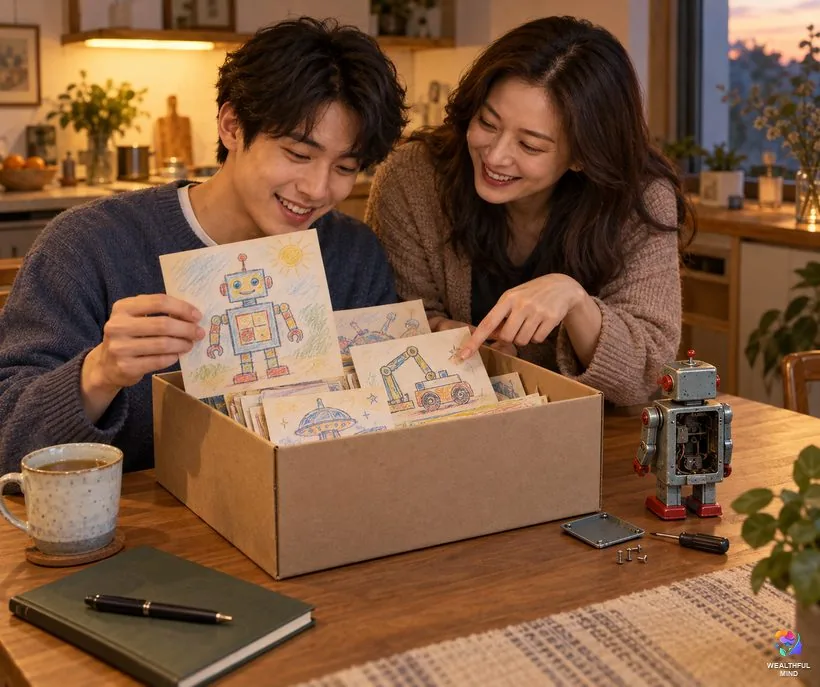
Ask a parent, grandparent or old teacher what you did for hours when nobody was making you. Taking toys apart, drawing on every scrap of paper, telling stories to anyone who would listen, these childhood habits are some of the clearest clues we have.
Nobody was grading them yet, and that is exactly why they are so honest.
3. Listen to What People Keep Asking You For
Friends rarely ask for help with the things we are bad at. If people keep asking you to check their essays or fix their phones, they have noticed something about you before you did.
Look one layer down, though. The friend who always plans the group trip may not have a gift for travel at all, but for seeing what could go wrong before it does!
4. Run a ‘Sampler Month’
Some abilities stay hidden because we have never tried something that needs them. So give yourself a ‘sampler month’, with one small, cheap experiment at a time, such as a free drawing class, a beginner coding class or a football game in the park.
You are not looking for what you are good at straight away. You are looking for the thing where you get noticeably better between your first try and your next few tries.
5. Use a Strengths Survey as a Starting Point, Not a Verdict
A survey can put words to something you already half understand. Gallup’s CliftonStrengths assessment sorts “what you naturally do best” into 34 themes, and the VIA character strengths survey is the one used in the study below.
However, knowing your strengths is not the useful part. In a well-known study by Martin Seligman and his colleagues, people who only learned their top strengths saw no change, while people who used one top strength in a new way every day for a week were happier than a comparison group for six months afterwards.
What If You Feel You Have No Natural Talent?
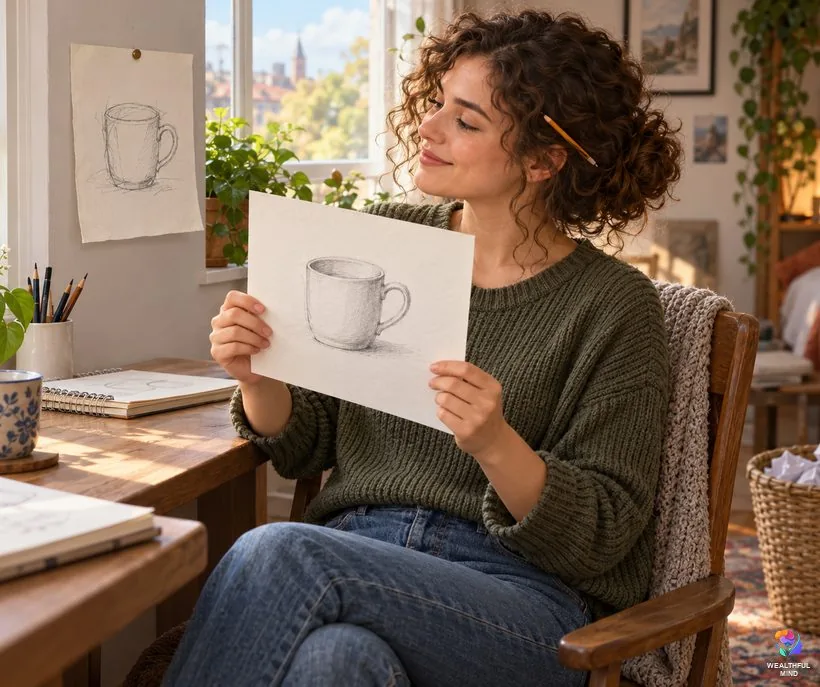
Scroll through Reddit’s advice forums and the same fear keeps coming up. One person asks why some people are born with so many talents and others with none, another quit drawing the moment they saw someone better, and a film student loves storytelling but freezes when it is time to create.
We understand the feeling, and we also think it rests on a misunderstanding. Most of us compare our first attempts with someone else’s years of practice, and judge our talent at the exact moment it is least visible.
Firstly, compare yourself with yourself a while back, not with the best person in the room.
Next, make small, deliberately rough versions of the thing (a bad short story, a bad sketch, a bad little video), so the fear of being bad has nothing left to bite on.
Lastly, notice that the twin research cuts both ways. Mosing and her colleagues suggested that our genes shape how inclined we are to practise as well as how able we are, so finding the thing we’ll happily repeat is half the work, not a consolation prize.
A growth mindset helps with all of this, and our guide to mastering a growth mindset goes further. Still, a belief on its own is not the engine, and Michigan State University’s review of the research found the link between growth mindset and grades is weak, with mindset programmes in schools having only a small effect.
The belief gets us started, and the practice does the rest.
If years of comparison have dented your confidence, these confidence building exercises are a kind place to begin.
One more thing, said kindly. If ‘I am not good at anything’ has turned into feeling low most days, that is more than a talent question. The NHS separates ordinary down patches from depression, where the sadness hangs on for weeks or months instead of lifting after a few days, and it advises seeing a GP if you think you may be depressed.
Talking to a doctor, a school counsellor or a trusted adult is a strong move, never a weak one.
How to Make the Most of Your Innate Ability
Finding an ability is only the start, and the habits below are what turn an innate ability into something we can actually use.
○ Give Your Practice a Target
Hours alone are not the point, as the research above showed. What helps is practice with a target, so pick one small weakness, work on just that, get feedback quickly and stop before you are too tired to concentrate.
For a singer, that might mean one tricky line recorded and played back again and again, rather than a whole playlist sung on autopilot.
Doing it on the days you don’t feel like it is the real trick, which is why we keep saying discipline beats motivation.
○ Use Your Strength in a New Way Every Day
Borrow the exercise from the strengths study above and keep it simple. Each day, take the strength you suspect is yours and use it somewhere new.
If your strength is a way with words, write the birthday message for the family group. If your strength is curiosity, ask a classmate how their hobby really works.
The new part is the important part. The same strength used in the same way every day turns into a routine, and a routine is where we stop noticing what we’re good at.
○ Pair It With a Skill You Learn
An innate ability on its own is rarely rare enough to stand out. Paired with a learned skill, it gets much harder to copy, so an ear for rhythm plus video editing makes for unusually well-cut videos, and a way with people plus a second language opens doors that neither opens alone.
This is also the most practical way to think about work and everything after school. If you are changing direction, as many of us do at some point, our guide on how to start over in life walks through it step by step.
○ Put It to Work for Someone Else

Our abilities are for us, but they grow fastest when they are useful to somebody else. The friend who explains maths well becomes a brilliant explainer by tutoring a younger cousin, because every confused face is instant feedback.
There is a quieter reward too, which we wrote about in our piece on serving others, and it is the feeling of being needed for something we are naturally good at.
○ Find People a Little Better Than You

Go looking for people who share your ability and are a step or two ahead. A school club, an online group or one good mentor will show you what the next level looks like, and tell you, kindly, what you can’t see in your own work.
A little better is the sweet spot. Someone far ahead can feel discouraging, while someone just ahead shows us a road we can actually walk.
We do not choose what we are born with. We do choose what we practise.
Questions About Innate Ability
What is an example of an innate ability?
A baby’s readiness for language is an innate ability nearly everyone shares, alongside built-in reflexes like gripping a finger. Between people, examples include an ear for pitch, natural coordination, a memory for faces or an easy way with strangers, and all of them still grow with practice.
Innate ability is to learned skill as what is to what?
Nature is to nurture. Innate ability is what you inherit (nature), while a learned skill comes from teaching, practice and experience (nurture).
What are the 11 abilities?
It usually means a popular YouTube list that sorts people into ability types such as musical, logical, linguistic, visual-spatial, interpersonal, intrapersonal, movement, natural and digital. Most of those names come from Howard Gardner’s theory of multiple intelligences. Treat the list as prompts for thinking about yourself, not as a scientific test.
Can you develop an innate ability, or lose one?
You can develop one: an innate ability is a starting point, and focused practice is what turns it into a skill. Whether an unused ability fades depends on the ability, but one you never try stays rough and unnoticed, which is why trying new things matters.
Is having an innate ability helpful?
Yes. It gives you a head start and can make the early stages of learning feel easier and more fun. It is not enough on its own, though, because practice, feedback and opportunity decide how far that head start carries you.
What are innate qualities?
Innate qualities are traits of character you seem to have been born with, such as a calm temperament, curiosity or a strong sense of fairness. Like abilities, they are a starting point that experience keeps shaping.