

We all hit moments when life feels either strangely planned or painfully random, and that is usually when the question shows up. So, is fate real? Nobody has proven it either way, and our honest answer is a split one, because part of our life is handed to us and part of it is ours.
The family we are born into, our bodies, the place and year we arrive in and the accident nobody saw coming are all given, and that part we may fairly call fate.
Although we might not get to choose the cards that life deals us, the way we play them is still about our own freewill. Most philosophers agree with some version of this, since 59% of the 1,758 philosophers who answered the PhilPapers Survey of 2020 accepted or leaned towards ‘compatibilism’, the view that a world full of causes still leaves room for genuine choice.
People have asked it for thousands of years, and here in our self-help corner we think it deserves something better than an inspirational quote and a shrug.
What Is Fate, Really?
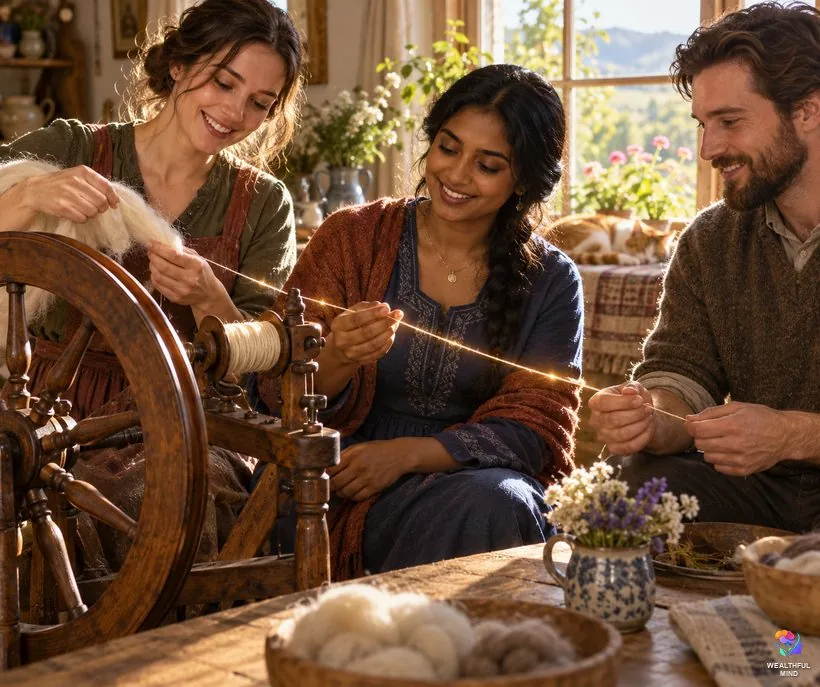
Well, the word itself gives the game away. English borrowed “fate” from the Latin fatum in the late 14th century, and the Online Etymology Dictionary says it literally means “thing spoken (by the gods)”. So fate began as a sentence passed on us by someone more powerful than ourselves.
The ancient Greeks pictured three Fates, Clotho, Lachesis and Atropos, who spun each person’s thread of life and decided when to cut it, and the Norse imagined three similar beings standing for past, present and future. Philosopher Michael Allen Fox, writing in The Conversation, notices that the same picture still hides in everyday phrases like “as fate would have it” and “it must have been written in the stars”.
Old English had its own word for it, wyrd, and the Online Etymology Dictionary traces our modern word “weird” back to it, through “weird sisters”, an old name for the three Fates (the same strange sisters who later haunt Macbeth). A delightful reminder that fate has always felt slightly uncanny!
Fox also offers a down-to-earth definition that we find far more useful, describing fate as the fixed conditions of life, such as birth, growing older, death, the time and place we live in, our genes and our first language. As he explains in The Conversation, these are fateful “because we do not choose them but have to make of them what we can and will.”
○ Is Destiny Real? Fate vs Destiny
In everyday conversation, fate and destiny mean the same thing, and Wikipedia’s page on destiny describes it simply as a course of events set in advance. However, the same page offers a helpful distinction, whereby fate is the future that our decisions cannot change, whilst destiny is about the present, where every decision we have made has brought us to where we stand.
By that distinction, destiny is absolutely real, because every one of us is standing exactly where a long line of decisions has led. Whether a fixed fate waits further down the road is the part nobody can prove, so we would rather spend our energy on the part we can actually see.
Fate vs Freewill
For some, the Universe is governed by fate, for some by freewill, and for some, it is a combination of the two. Philosophers have names for these positions, and the three that matter most here are ‘fatalism’, ‘determinism’ and ‘compatibilism’.
Fatalism says that whatever will happen will happen, regardless of what we do. Determinism says every event, our thoughts included, is caused by everything that came before, while compatibilism insists our choices remain real and remain ours inside that chain of causes.
The classic argument for fate is a puzzle from Aristotle about a sea battle, and the Stanford Encyclopedia of Philosophy walks through it carefully. If the sentence “there will be a sea battle tomorrow” is already true or false today, then tomorrow seems settled before anyone picks up an oar.
Aristotle himself did not accept that everything happens of necessity, the Stanford Encyclopedia of Philosophy explains, and philosophers have argued about where the puzzle goes wrong ever since.
○ Eyes of the Beholder
Even if we believe that our lives are indeed predestined, the question arises, predestined by whom or what? Some people believe in God, some in astrology, karma or intuition, and others in absolute freewill.
Religious traditions answer this differently, and often debate it among themselves. Wikipedia’s page on destiny notes that some Christians believe all humans have free will while others believe in predestination, and that in Islam, fate or qadar is the decree of God.
Many Hindus and Buddhists speak of karma, the belief that our own past actions shape whatever comes back to us, which places a good deal of the pen back in our own hands.
Scientifically minded people point to physics rather than a god, and in that worldview the “author” of fate is simply the past.
No matter what our idea of the divine plan is, it only comes into fruition when somebody acts on it. The plan, whoever holds it, still needs our hands.
○ What Science Can and Cannot Say
Science has not discovered a force called fate, and it has not proven that our choices are an illusion either. The experiment everyone loves to quote is Benjamin Libet’s from the 1980s, which, as Wikipedia’s summary of the research explains, found brain activity building up about half a second before volunteers felt they had decided to flick a wrist.
However, later work by Jeff Miller and Judy Trevena suggested that the signal may only show the brain “paying attention”, the same Wikipedia summary adds. These experiments also measure a tiny, instant movement, not whom we marry or what we decide to study. So, no laboratory has demonstrated that your life is pre-written.
Stephen Hawking, who understood the laws of physics better than almost anybody, took a wonderfully practical view, and Wikiquote records his words, “I have noticed that even people who claim everything is predetermined and that we can do nothing to change it, look before they cross the road.”
His argument, as Wikiquote preserves it, was that nobody knows what has been determined, so we have to live as though our choices count, and take responsibility for them.
Is Fate a Thing in the Bible?
Yes and no, because the Bible speaks of God directing human lives, and in the same breath it asks people to choose for themselves.
The best-known verse on chance is in Ecclesiastes, which says in the King James Version that “the race is not to the swift, nor the battle to the strong”, because “time and chance happeneth to them all.”
Earlier in that chapter of Ecclesiastes, the NIV says “All share a common destiny” and “The same destiny overtakes all”, and read in context, that destiny is death, which eventually comes to everyone.
Proverbs 16:9 holds both sides in a single line, “A man’s heart deviseth his way: but the Lord directeth his steps.” Deuteronomy 30:19 then hands the decision straight to the reader, “I have set before you life and death, blessing and cursing: therefore choose life.”
So a Christian asking whether fate is real is in good company, because the tradition itself holds God’s plan and human choice side by side. Believers still differ on how much is planned, and that is a conversation worth having with your own church community.
Does Fate Exist in Love?

Ask anyone who met their partner through a missed bus or a wrong number, and many of them will tell you fate exists in love! The feeling that someone was meant for us is one of the sweetest feelings we ever get to have.
However, psychologist C. Raymond Knee studied exactly this belief, and his 1998 paper in the Journal of Personality and Social Psychology is worth knowing. Knee describes ‘romantic destiny’ as the belief that two people “are either meant for each other or they are not”, and contrasts it with growth beliefs, where good relationships are “cultivated and developed”.
In Knee’s long-term study, how satisfied a couple felt at the beginning mattered more for how long it lasted among destiny believers, and destiny belief went along with avoiding problems instead of facing them. Growth believers, meanwhile, leaned towards the kind of coping that keeps a relationship going, according to the same Knee paper.
So here is our take on it. The spark may feel fated, but staying together is something two people build, one honest conversation at a time.
Please never let the idea of fate keep you somewhere you are being hurt or controlled, and if a relationship feels like that, talk to someone you trust.
Can We Escape Our Destiny?

The old Greek stories love a hero who runs from a prophecy straight into it, and those stories still make us shiver. However, ancient philosophers also faced a sharper puzzle, which the Stanford Encyclopedia of Philosophy calls “the Idle Argument”.
It goes like this. If it is fated that you will recover from an illness, there is no point calling a doctor, and if it is fated that you will not, there is no point either.
The Stoic thinker Chrysippus had a lovely reply, and the Stanford Encyclopedia of Philosophy says it “seems exactly right”, namely that it may have been fated that you recover as a result of seeing the doctor. In other words, even if fate exists, our actions are part of how it happens, so “why try?” never follows from it.
One person on Reddit put the same thing in simpler words, writing that if they were destined to get a maths degree, they “could not bother studying and still pass anyway”, which nobody seriously believes.
Then there is the line many of us remember from the movies, “no fate but what we make”. Wikipedia’s page on Terminator 2: Judgment Day, the 1991 James Cameron film, notes that the film emphasizes free will, and that Arnold Schwarzenegger quoted this very line to say people control their own destinies.
We like it as a motto, as long as we remember that some things, like our birth, our genes or a storm, were never ours to make.
Why Do We Believe in Fate?

Life is unpredictable, and the idea of a plan takes the edge off that uncertainty. Psychologists Konika Banerjee and Paul Bloom studied this in the journal Cognition, starting from the plain observation that people often believe big life events happen for a reason.
Banerjee and Bloom found that people who were better at understanding other people’s minds were more likely to believe in fate. Believers in God saw more purpose in their life events, yet non-believers did it too, so the urge to see a plan seems to come from how our social brains work, not only from religion.
Psychology also has a name for how much control we feel over our lives. The American Psychological Association describes ‘locus of control’, a term introduced by Julian Rotter, where people with an external locus see what happens to them as coming from forces outside their control. People with an internal locus, the American Psychological Association adds, see their outcomes as the result of their own effort and abilities. Most of us slide between the two depending on the week we are having!
Fate ideas have a darker side as well. Michael Allen Fox points out in The Conversation that racism, sexism and caste have all been defended with the claim that some people’s fixed, “fated” identities make them lesser.
Whatever we believe about fate, it should never become a reason to look down on anybody, ourselves included.
○ The Duality of Ego
It is human nature to blame things on a third party when they do not work out in our favor. When everything goes to plan, we say we made it happen, and when it falls apart, we blame fate and take comfort in that thought.
Psychologists call this the self-serving bias, and Wikipedia’s page on it describes our habit of crediting success to our own abilities and effort whilst blaming failure on outside factors. The trouble is that we cannot learn anything from a disappointment we have handed over to fate.
A kinder habit is to ask, after any setback, which part of this was given and which part was ours. The given part we can grieve, and the part that was ours we can work on, which is how we learn to accept the good and the bad without drowning in either.
○ Fate or Coincidence?
Imagine bumping into an old school friend in a city neither of you lives in, on the very day you were thinking about them. Was it fate or coincidence? Well, nobody can check, and the meeting is real either way.
What we can check is what we do next. Many people read moments like this as signs from the universe, and that can be a beautiful way to pay attention, as long as the sign nudges us towards action instead of waiting. Send the message, make the call, and let the meaning grow from there.
What Makes Life Worth Living, Fate or Not

This is the question underneath the question. When we ask whether fate exists, we are often really asking whether our effort counts, and whether a life means anything if everything was decided in advance.
Viktor Frankl, the Austrian psychiatrist and Holocaust survivor, gave one of the clearest answers we know, quoted on Wikiquote from Man’s Search for Meaning. “There is nothing in the world, I venture to say, that would so effectively help one to survive even the worst conditions, as the knowledge that there is a meaning in one’s life.”
Meaning, not a fixed fate, was what Frankl saw carrying people through. Our piece on what’s the point in life when there is suffering everywhere continues exactly there.
○ Sort Your Life Into Two Lists
The Enchiridion, the little handbook of the Stoic teacher Epictetus, opens with a sentence we keep returning to, “Some things are in our control and others not.”
In Epictetus’s list, our opinions, desires, aversions and actions belong to us, whilst our body, property, reputation and position are not ours to control.
Try this tonight. Firstly, draw a line down the middle of a page and write whatever is worrying you on the left side.
Next, for every worry, write on the right the one piece that genuinely belongs to you, such as a phone call, an apology, a habit or a question to ask. Lastly, do the smallest thing on the right tomorrow, and let the left side be whatever it is.
If the worry is an examination result, the result itself goes on the left. The revision timetable, the sleep and the question you finally ask your teacher all go on the right, and that right-hand column is where fate stops and your own life begins.
○ The Power of Choice
The power of our choice is always at play, whether we acknowledge it or not. Life is nothing but a series of such choices, and most of them are tiny, like what we say first in the morning, whom we text back and whether we open the textbook or the app.
There is an old saying that big doors swing on small hinges, and we like to call this the ‘small hinges’ idea, because extraordinary lives swing on them too. Pick one choice you make every day without thinking, and start making it deliberately.
○ The Energy Created is the Energy Received
Many spiritual traditions hold that whatever we give out eventually comes back to us. Believers in the law of attraction say the energy we radiate returns in some form, while karma, as many Hindus and Buddhists understand it, treats our past actions as seeds of what we meet later.
Our pages on the universal laws and the law of compensation go further into these ideas. We hold them as beliefs, not promises, and whether or not the universe keeps score, giving still changes the giver.
Our ability to feel passion for this life, to find our purpose in serving others and to sincerely love what we do is one of the surest ways we know to make a life feel worth living. Open hands, after all, can both give and receive.
○ When Life Feels Decided Against You
Some of us arrive at this question after a loss, a mistake we cannot undo, or a run of misfortune that feels personal. If that is you, please know that a difficult chapter is not a verdict on your whole story, and our page on when life gets hard has kind, practical steps.
If ending your life has started to look like the only way out, please tell someone today, through your local emergency number or a helpline. In the US, a call or text to 988 reaches the 988 Suicide and Crisis Lifeline around the clock, every day of the year, and the conversation costs nothing and stays private.
In the UK and Ireland, Samaritans answers on 116 123, free from landlines and mobiles, and in India, Tele MANAS is toll-free on 14416. You don’t have to carry this by yourself.
Is Life a Predestined Journey?
If we believed in the strength that rests within us, we would not be troubled by the idea of fate at all. Some of the road is laid before we arrive, and some of it we lay with every step we take.
Fate may write the first line, but we’re the ones who write everything that follows.
FAQ
Does fate really exist?
No one has proven that fate exists, and no one has proven that it does not. What we can say is that some things are handed to us, like our family, our body and chance events, and many people call that fate. Our choices still shape what happens next.
What is the difference between fate and destiny?
In everyday speech they mean the same thing. Some writers split them: fate is a future you cannot change, while destiny is where your past choices have brought you, which makes destiny feel like something you take part in.
Does fate control our lives?
Not completely, by the view most philosophers hold today. Circumstances we did not choose shape a great deal, but how we respond to them is still ours, and that response changes where we end up.
Where does “no fate but what we make” come from?
It is a line from the film Terminator 2: Judgment Day. In the story it means the future is not fixed and people can change it by what they do.
Is it fate or coincidence?
There is no test that can tell the two apart. A meaningful coincidence can still be worth acting on, so the useful question is not where it came from but what you will do with it.
Why do people believe in fate?
Believing in a plan makes an unpredictable world feel safer, and research suggests our minds naturally look for purpose in big life events, whether or not we are religious. Faith traditions, karma and astrology also give people a shared language for it.





Suranya,
There is a wonderful simplicity in your ability to offer insightful answers to questions like, “is fate real”. Your essay here has many beneficial and thoughtful points that will help many people find some comfort. This comment though is more of suggestion for revision. I suppose it possible you have a different opinion. The self for example, the duality of it, the notion the we are somehow separate from our thoughts is illusory. So in toe is the concept of an ego. The big one, at least for me is free will. While it true that decisions and choices are crucial to a beneficial outcome, all the options within choices are never available to us. Not only that but when you get right down to it, every decision or choice ‘you’ make, ‘you’ don’t really make at all. Your brain runs the show. We know and have seen through laboratory experiments that your brain has already determined what you will do a measurable amount of time prior to delivering an answer to ‘you’ in consciousness. Of course this is complete and verifiable, and it would seem you undoubtably are aware of this. But even more pressing for me than the fact that free will and the concept of the self are illusions is something you did not even mention once, that has immense impact on all actions we take and don’t take. It is at the very peak of what guides humanity and ought to thought of as the ultimate sacred truth. Morality. It is the quintessential starting point for all actions. Peace 2 U