Seeing a deer is usually read as a quiet message to slow down, move gently and trust your senses. That is the heart of the deer spiritual meaning, and many people add renewal, because a deer’s antlers are grown and shed every year, as McGill University’s Gault Nature Reserve explains. We think the most useful part of the message is also the most literal one: if your deer was near a road, slow down first and think about the meaning later.
The deer is one of many animals in our guide to animal spiritual meanings. Our page on signs from the universe covers how you can notice and read any sign, deer included.
What Seeing a Deer Means
Nobody can tell you for certain what your deer meant. These are the readings you will meet most often, and you are free to keep the one that fits you.
- Gentleness. A deer steps softly and startles easily, so many people take it as a reminder to be kind, to others and to yourself.
- Awareness. A deer is always listening, and you might hear it as “trust your gut on this one.”
- Renewal. The antlers come back every year, so a deer can feel like a promise that something you lost will grow again.
- Peace. Plenty of people say a deer simply calms them down, like a reset button in the middle of a hard week.
- Heart. The wellness site mindbodygreen, quoted by Green Matters, says deer stand for gentleness and what it calls heart intelligence.
To find yours, go back to the minute before the deer appeared. What was on your mind?
A hard decision points to the awareness reading. A tired, bruised week points to gentleness or peace.
○ If You Keep Seeing Deer
If deer keep showing up on your walks or at the edge of your yard, many people would say a message is waiting for you. It is usually read as a call to slow your pace, or to trust yourself more.
There is a down-to-earth reason too. Deer are creatures of habit, and Virginia’s Department of Wildlife Resources notes that they use particular places to cross roads, usually between areas of cover. So the deer you keep meeting may well be the same few animals on the same path.
On your next walk, when you see one, stand still for ten seconds. Notice the first thought that comes to you. If the same thought keeps arriving with the deer, you have found what it means for you.
○ A Deer Staring at You
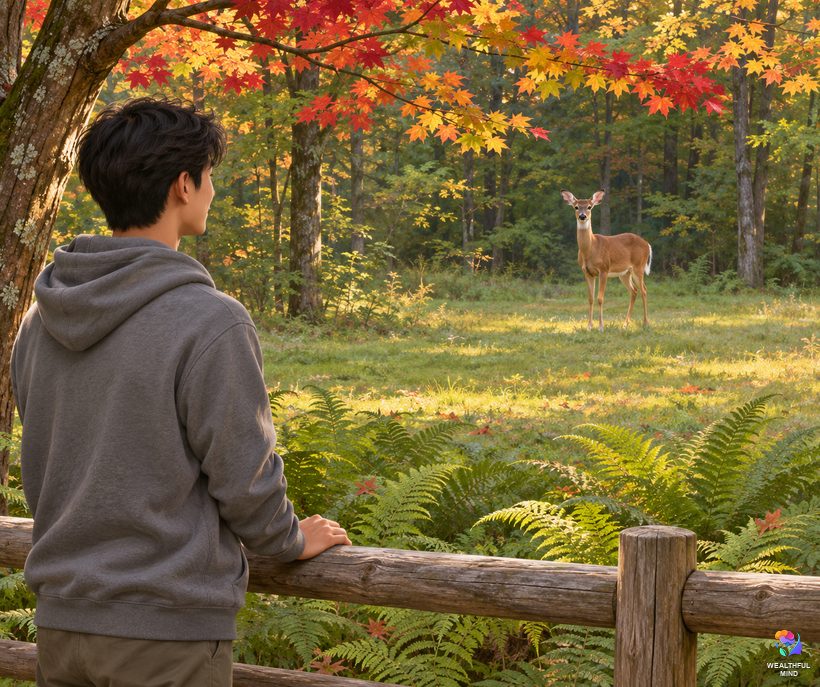
A deer that stops and stares at you can feel like a message meant only for you. Many people take the stare as a sign that you are being seen. Others hear it as a nudge to look at something you have been avoiding.
The deer, meanwhile, is most likely working out whether you are a danger. If it walks on calmly, you passed.
A fawn may not move at all. Virginia’s Department of Wildlife Resources explains that a fawn’s white-spotted coat hides it while it lies still. Young fawns generally will not try to run away when you come near, the Virginia page adds.
So stay where you are, enjoy the moment and let the deer be the one to leave.
Did a deer stare at you in a very dark moment, when you were asking the universe for any sign at all? Please read a deer after a loss or in a dark moment below, because there is a note there for you.
○ A Deer Crossing Your Path
A deer crossing your path is often read as a sign to slow down before a choice and stay alert to what is coming. Some people also see it as an opening, a gentle way through something that looked blocked.
If it crossed in front of your car, though, the first message is a practical one. Read what to do on the road before anything else.
○ Two Deer, a Doe or a Fawn
You might read two deer together as partnership or friendship, or as two people you love. If you saw a doe on her own, many people would call it a caring, motherly presence. A fawn can mean a fresh start in your life that needs gentle handling.
If you often see deer in pairs or small groups, that is ordinary. Female deer frequently travel in groups, says Virginia’s Department of Wildlife Resources, which is also why more may follow the first one across a road.
What to Do When You See a Deer
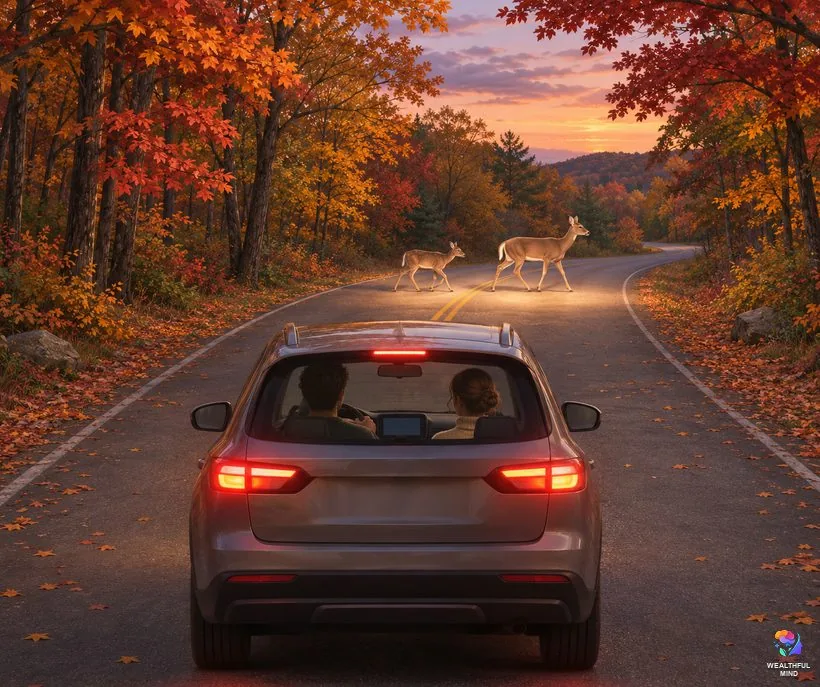
A deer sign is gentle, but a deer on the road is a large animal in front of your car. And a fawn in the grass is easy to harm by being kind.
○ On the Road
Autumn is when you need to be most careful. Fall is the mating season for deer, called the rut, and the time of year when deer are most active, according to Virginia’s Department of Wildlife Resources.
The same Virginia page says about half or more of all deer-vehicle collisions happen in the three months of October, November and December. Wisconsin’s Department of Natural Resources says most happen in October and November. Spring brings a smaller rise too, in May and June, when young deer are out looking for new home ranges, according to Wisconsin’s DNR.
Here is what Virginia’s wildlife agency advises, whether you are driving or watching the road from the passenger seat.
- Be extra careful at dawn and dusk. Virginia’s agency says this is when deer are most active. After the fall time change, it is also when most people drive to and from work.
- Slow down the moment you see one. Virginia’s advice is to slow down immediately, since more deer may be about to cross behind the first.
- Do not swerve to miss a deer, Virginia’s wildlife agency says. Brake and stay in your lane. Leaving your lane or the road almost always ends in a worse crash than hitting the deer, the Virginia agency explains.
- Skip the deer whistle. Virginia’s agency says there is no data or research to show that deer whistles reduce collisions.
If you are the passenger, you can help a lot. Watch the edges of the road and the tree line, and say “deer” out loud the second you see one.
○ A Fawn Alone
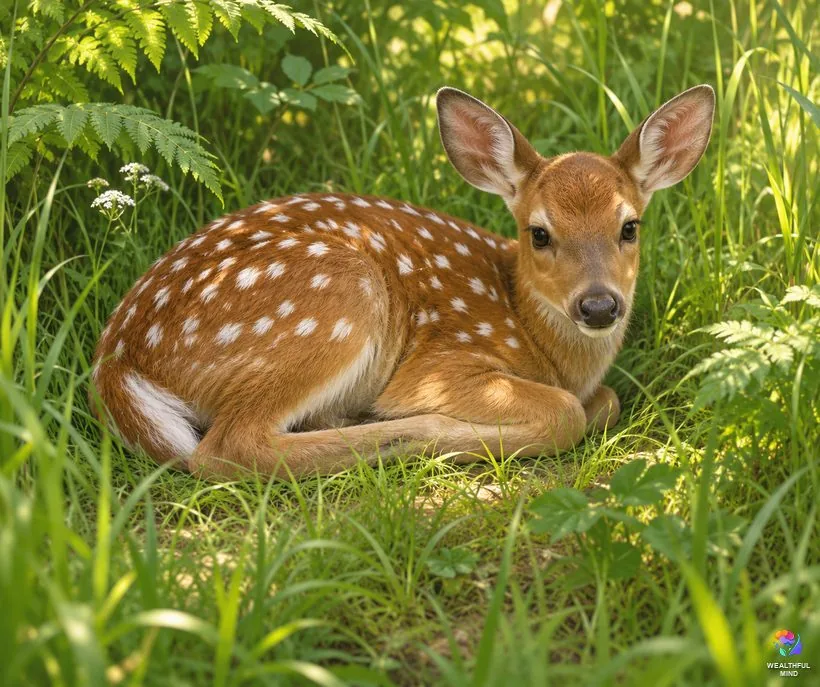
If you find a fawn curled up alone in the grass, leave it where it is. Most fawns found alone are not orphans and should be left alone in the wild, says the Maine Department of Inland Fisheries and Wildlife.
Its mother has not abandoned it, even if it looks that way to you. Virginia’s Department of Wildlife Resources explains that fawns, born from May through July, are left alone by their mothers on purpose. The does stay away so they do not lead predators to their young, and they come back several times each day to move or feed them, the Virginia page adds.
Do not keep going back to check, either. Maine’s wildlife department warns that repeated visits can draw predators and could discourage the mother from returning. Leave the area, and keep your pets away.
Two signs mean a fawn may truly need help, according to Maine’s wildlife department. One is near constant calling all day. The other is a fawn lying weak with its legs splayed, unable to stand or lift its head.
If you see either, call your state wildlife agency and ask for a licensed wildlife rehabilitator. Please do not try to raise it yourself. In Virginia, for example, raising a wild animal in captivity is illegal without a wildlife rehabilitation permit.
Already picked one up? Virginia’s agency says that if less than 24 hours have passed, you should take the fawn back to the exact spot where you found it. Then leave right away, without waiting for the doe.
○ A Deer in Your Yard
A deer grazing at the edge of your yard is lovely to watch from a window. Please do not feed it, though. Virginia’s Department of Wildlife Resources warns that feeding deer can make them lose their fear of humans, which can be dangerous to both people and animals.
That is not a small risk. The same Virginia page says more people in the US are attacked and injured by tame deer each year than by bears.
If a deer in your yard looks hurt, sick or stuck, keep your distance and call your state wildlife agency.
Deer Spirit Animal Meaning

If the deer is your spirit animal, people who work with animal guides would say you are sensitive and gentle. You notice how others feel. You read a room before you speak, and you would rather calm an argument than win it.
The Aktá Lakota Museum & Cultural Center says on its deer page, in modern spirit-animal style, that the deer spirit animal meaning reflects intuition and self-control. It adds that the deer shows awareness is a form of strength.
Every spirit animal has a harder side too. The site spiritanimal.info lists the deer’s shadow side as timidity, feeling vulnerable or defenseless, being innocent to the point of naivety and being easily led astray. If some of that sounds like you, the deer may be asking you to keep your soft heart and add a little backbone.
You will not find a quiz here, and that is on purpose.
You usually find a spirit animal by noticing which animal keeps coming to you over weeks, on walks, in pictures and in dreams. (If “spirit animal” feels like a borrowed phrase, “animal guide” works just as well.)
Why Antlers Make the Deer a Sign of Renewal
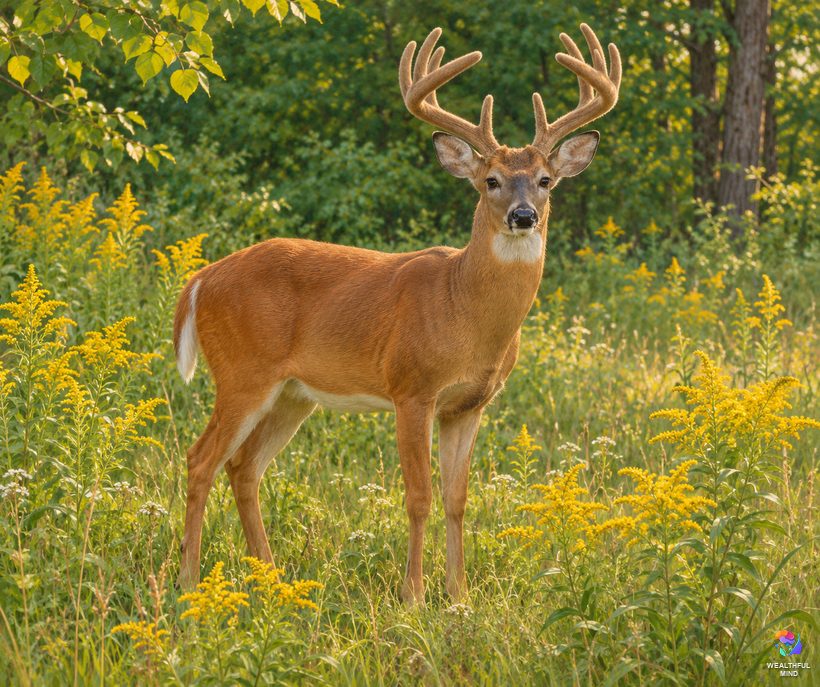
Of all the deer meanings, renewal has the firmest ground under it. You can see it in the animal’s own body.
McGill University’s Gault Nature Reserve explains that antlers are not horns, and they are only found in the deer family. They usually grow only on males (the caribou is the exception). They are also the only mammalian organ capable of complete regeneration, the McGill page says.
Every spring, antler buds start growing on the male’s head under soft, velvety skin, McGill explains. The antlers can gain up to 2.5 cm a day until late summer.
That is why so many people read antlers as a promise that what falls away can grow back.
White Deer Spiritual Meaning

A white deer is the kind of sighting you talk about for years. Many people take it as a sign of purity, a rare blessing or a message from the spirit world.
White deer are real, and Virginia’s Department of Wildlife Resources describes two kinds. A piebald deer can have anything from a little white hair to an almost totally white coat, with brown eyes and black hooves. A true albino has pink eyes and white hooves.
Both are uncommon. Piebald deer typically occur at less than one percent of the population, the Virginia agency says, and it calls albinos rare.
We would not promise you luck from it, because nobody honestly can. But a white deer makes you stop and look, and that pause is a good thing to take home with you.
A Dead Deer, or Hitting One With Your Car
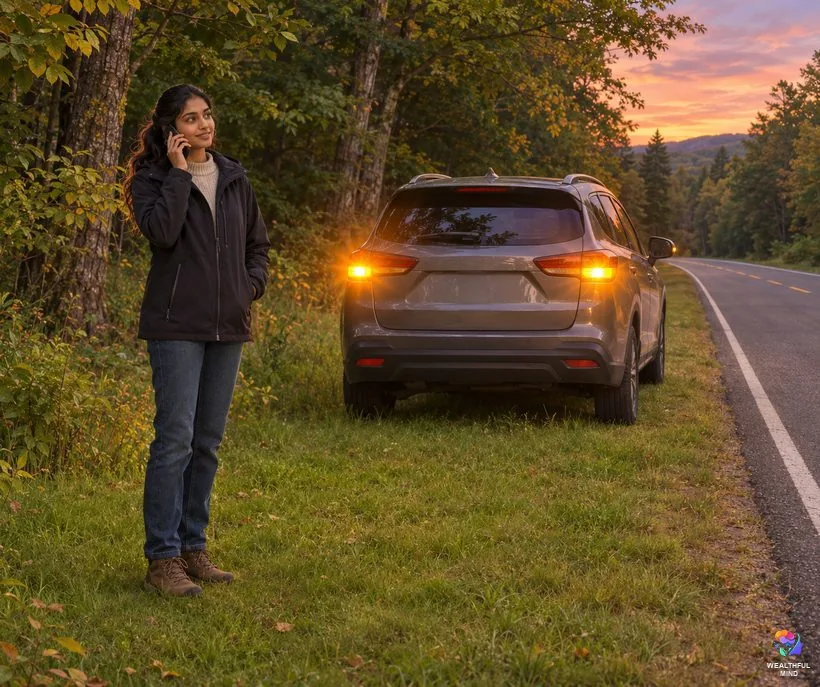
Finding a dead deer by the road, or hitting one, can stay with you for days. Take care of the practical side first, and then the meaning.
- Get yourself safe. Pull over where you can, turn on your hazard lights and call emergency services if anyone is hurt.
- Stay back from the deer. A hurt deer is a large, frightened animal. In Texas, Texas Parks and Wildlife says to call your local game warden dispatcher if the deer is just injured.
- Report it, because the rules differ from state to state. In Virginia, anyone in a collision that kills a deer must report it right away to a game warden or other law enforcement officer. Wisconsin’s DNR asks you to call the local Sheriff’s Department about a dead deer that needs removing from the road.
- Call your insurance company if your car was damaged.
Many people read a dead deer as the close of something gentle, such as a soft season of your life ending. Others take it as a sign to protect your kindness in a harsh place.
It is not a curse, and it does not predict a death.
If you hit one, you may feel awful, and some people are even afraid of bad karma. Here is our honest view. You did not choose to hurt that deer, and we do not believe the universe punishes you for an accident you tried to avoid.
What helps is what you do next. Report it, look after yourself and drive a little more gently through the next autumn.
You can also say a few quiet words for the animal, at the roadside if it is safe or later at home. A small goodbye like that may help you set the guilt down.
A Deer After a Loss or in a Dark Moment
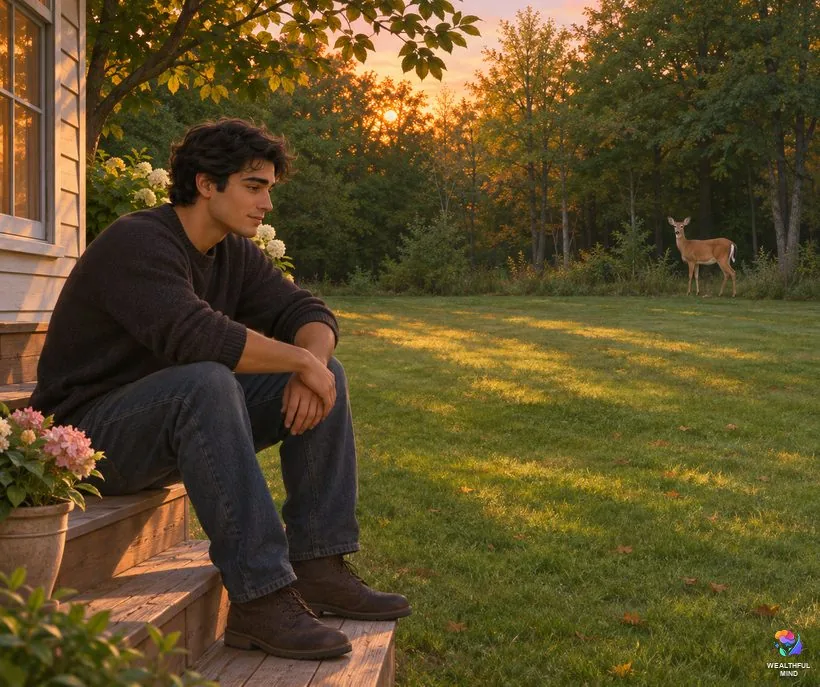
You are on the back steps in the early evening, three weeks after the funeral. A doe walks out of the tree line, looks straight at you for a long moment and then turns away.
To many grieving people, a moment like that feels like a visit. If it felt that way to you, you are free to keep it. We could not find an old tradition that names the deer as a messenger of the dead, so this is a modern, personal comfort.
That does not make it any less real to you.
Some people fear the opposite: that two deer in the yard before or after a death mean another loss is coming. No tradition we found says so, and we hope you can let that fear go.
And if you have been waiting for a sign that never came, that says nothing about how much you loved them. Many people grieve deeply and never see one.
Some nights the weight can feel like too much, and you may find yourself asking the universe for any sign that you should keep going. If that is you right now, please reach a real person tonight. If you are in danger, call your local emergency number.
In the US, you can call, text or chat with a counselor at the 988 Suicide & Crisis Lifeline anytime, day or night, free and in confidence. In the UK, Samaritans answer on 116 123, free from any phone. In India, Tele MANAS runs a toll-free, 24/7 helpline on 14416, according to India’s Ministry of Health and Family Welfare.
Deer in Dreams

No old rulebook lies behind deer dreams. Most of what you read online is one site’s reading, so treat it as a starting point and not a verdict.
One common reading comes from spiritanimal.info. If you are chasing a deer in your dream, it may mean you are conquering your fears. If you are the deer being chased, you may be running from them.
Other deer dreams are usually read like this.
- A calm deer grazing near you is taken as peace coming back, or a gentle person coming into your life.
- A fawn often stands for something new and fragile that you are looking after.
- An injured deer is read as a tender part of you that got hurt and needs care.
The feeling you woke up with matters more than any list, this one included. Write the dream down before breakfast, and look at it again in a week, once the feeling has settled.
What Does the Bible Say About Deer?
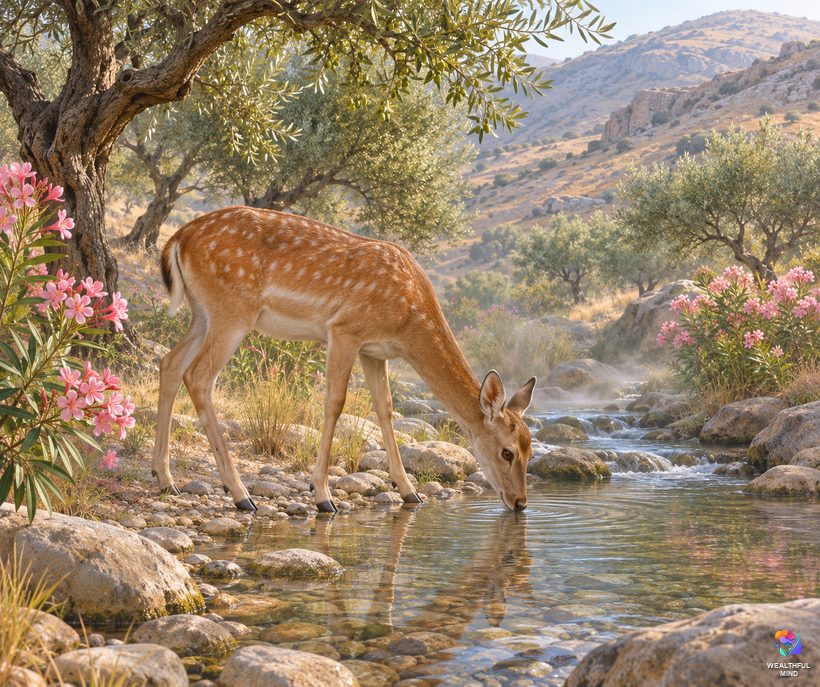
The Bible never tells you what it means to see a deer. It uses the deer as a picture instead, of longing for God and of grace.
The best known is Psalm 42, verse 1, in the NIV Bible: “As the deer pants for streams of water, so my soul pants for you, my God.”
Proverbs chapter 5, verse 19, in the same Bible, calls a beloved wife “a loving doe, a graceful deer.” That verse is about love in a marriage, so it says nothing about a deer you see.
So if you feel God sent you a deer on a hard day, you can treat it as your own faith at work. The psalm writer did something similar when he saw his thirst for God in a thirsty deer.
○ The Stag of Saint Hubert
Christian legend has a famous deer of its own, outside the Bible. The Catholic Encyclopedia tells how Hubert, later a bishop, was pursuing a magnificent stag. In what it calls a pious legend, he saw a crucifix between its antlers and heard a voice telling him to turn to the Lord.
He was honored in the Middle Ages as the patron of huntsmen, the Catholic Encyclopedia adds. So in this Christian telling, a deer can also be your call to stop chasing and turn around.
The Deer in Lakota, Celtic, Greek and Buddhist Tradition
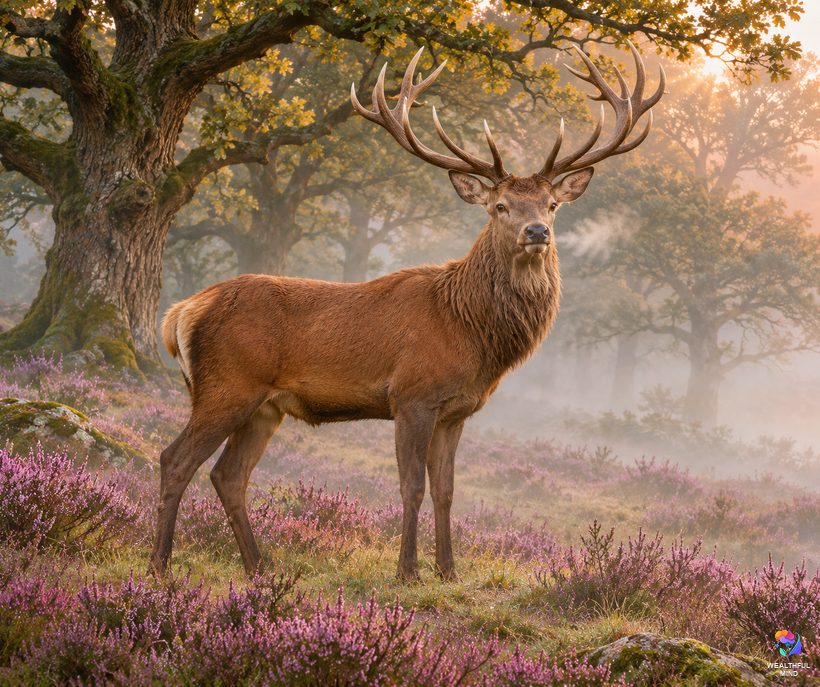
You will read that deer are sacred “in many cultures” on page after page, usually without a single people or text named. These four we could trace.
(If a fox has been crossing your path too, our page on fox spiritual meaning traces its stories the same way.)
○ Lakota: The Deer That Tests You
The Aktá Lakota Museum & Cultural Center shares a Lakota teaching about the deer, tȟáčȟa, that is far less soft than the usual picture. Deer were thought to help men through life, the museum’s page says, but they could be cunning and wary.
In the story the Aktá Lakota Museum tells, it was believed a deer could change form. It could appear as a young woman, lead men astray with an intoxicating perfume and then suddenly turn back into a deer.
A man fooled this way often wanted to kill the deer, and if he did, he was seen as weak. If he walked away unharmed, he was seen as having great power and self-control, the Aktá Lakota page says.
In Lakota understanding, the Aktá Lakota Museum says, the deer stands for both guidance and challenge, a being that tests perception and discipline. We think this is the most useful deer lesson on the page. It is gentle on the outside, and it asks you not to follow every tempting impulse.
This is one nation’s teaching, shared by one museum, so we do not call it a “Native American” belief.
○ Gaul: Cernunnos, the Antlered God
In Paris, four carved blocks discovered in 1710 beneath Notre Dame make up what is now called the Boatmen’s Pillar, the French Ministry of Culture explains. One face shows the Gallic god Cernunnos, bald and bearded, with animal ears and antlers from which hang Celtic necklaces.
The pillar mixes Greek and Roman gods with Celtic ones. The French ministry counts it among the rare pieces of Gallic mythology that have come down to us.
So very little about Cernunnos is known for certain, and you can be wary of pages that give him a long list of powers.
○ Greece: Artemis and Her Golden-Horned Deer
In ancient Greece, deer were sacred to Artemis, who both protected and hunted them. Figurines of deer are numerous at her sanctuaries, according to the Harvard Art Museums.
The Theoi Project, which gathers the old Greek stories and texts, tells of five golden-horned deer sacred to the goddess. Four pulled her chariot, and the fifth, the Kerynitian Hind, roamed free.
○ Buddhism: The Deer Park at Sarnath
Sarnath, near Varanasi in India, is the place where the Buddha delivered his first sermon. The Concise Oxford Dictionary of World Religions says the exact spot is known as the Deer Park, and the event is called the turning of the Wheel of Dharma.
Modern sites often link the deer with awakening because of this, but the dictionary describes a place, not a teaching about deer.
Take the Deer’s Pace With You
The next time a deer lifts its head and looks at you across a field, try matching it for a moment. Stand still, breathe slowly and listen to everything around you.
That small pause is most of what the deer has to teach you. And if you are driving home at dusk some evening in October, use it in the most practical way of all. Ease off the pedal, and watch the trees.
More Questions About Deer Signs
What does it mean if I keep seeing deer?
Many people take repeated deer sightings as a message to slow down and trust their own instincts. There is often a simple reason as well: Virginia’s Department of Wildlife Resources notes that deer use the same places to cross roads, so you may be meeting the same few animals again and again. Notice what is on your mind each time one appears, because that is usually where the meaning sits for you.
What does the Bible say about seeing a deer?
The Bible does not treat seeing a deer as a sign. It uses the deer as an image: Psalm 42, verse 1 compares a soul longing for God to a deer panting for water, and Proverbs chapter 5, verse 19 calls a beloved wife a graceful deer. Feeling that God sent you a deer is personal faith, which is fine to keep, but it is not a teaching from scripture.
Is seeing a deer good luck?
Many people feel lucky when they see a deer, a white one most of all. No tradition we could trace promises luck from a sighting, though. We think the better gift is the pause it gives you and, on the road, the reminder to slow down.
What does it mean when a deer stares at you?
Spiritually, a deer’s stare is often read as being seen, or as a nudge to face something you have been putting off. The deer itself is working out whether you are a threat. Stay still, give it space and let it walk away first.
Is it okay to touch or move a fawn I find alone?
No. The wildlife agencies of Maine and Virginia say most fawns found alone are not orphans, because the mother stays away on purpose and comes back to feed it. Leave it, keep pets away and do not keep checking on it. If you already moved it, Virginia’s agency says to put it back in the exact spot within 24 hours, and to call your state wildlife agency only if it calls nonstop all day or lies weak and cannot stand.
What should I do if I hit a deer?
Get yourself safe first: pull over, turn on your hazard lights and call emergency services if anyone is hurt. Stay away from an injured deer and report the crash, since the rules differ by state; Virginia, for example, requires you by law to report a collision that kills a deer. An accident you tried to avoid is not something you need to carry as guilt.