Across faiths and folk traditions, the insect spiritual meaning you will meet comes in a few clear shapes: butterflies and moths stand for the soul and for change, bees and ants for honest work, and ladybugs and crickets for luck. Which one speaks to you depends on the insect you saw and the moment it found you.
Most visits also have an ordinary cause, like the time of year, a sweaty arm on a hot day or a porch light you left on. We think you lose nothing by knowing the cause (a butterfly can be thirsty and still find you on the one afternoon it mattered).
Quick pick
What Did the Insect Do?
Pick the moment that sounds like yours and go straight to its answer.
- Keeps landing on you? Often salt and warmth, and many read it as being noticed
- The same insect for weeks? The season plus a noticing brain, so keep a small note
- Came after someone died? An old soul belief, and it is fine if no sign comes
- Bugs all over your house? Sort out the pests first, then look for a meaning
- Scared of it, or killed one? No tradition we traced calls it a curse
- Not sure what it means? One short answer and a link for every insect
Keep reading below Where the beliefs come from The Bible and Quran on insects Lucky and unlucky insects Questions

Insects are one family of signs among many. For a method that works on any sign, from a feather to a number on a clock, try our guide to signs from the universe. Here you will find the big insect questions first, then a short stop at every insect that has its own page.
What Do Insects Symbolize Spiritually?
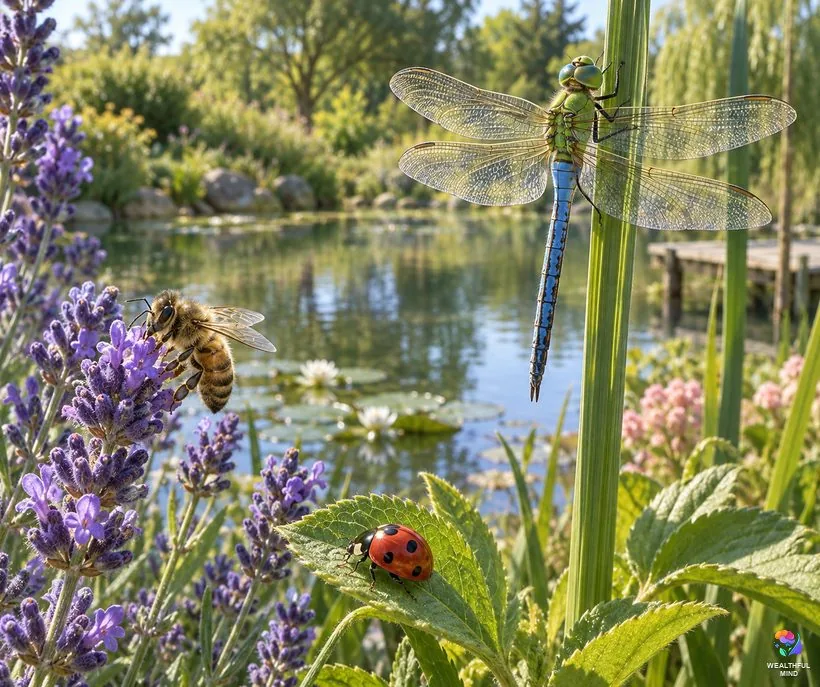
Most insect meanings grow out of things people have watched insects do for thousands of years. You will probably recognize your own moment in one of these.
- Change. A caterpillar turns into a butterfly, and a dragonfly crawls out of a pond as a new creature. So you might read an insect as a sign that your own life is changing shape.
- The soul. A flying insect is small, light and gone in a moment, which is how many people have pictured a soul. In ancient Greek, one word, psyche, meant both the soul and a “butterfly or moth”, as the classic Greek lexicon by Liddell and Scott records.
- Work and community. Ants and bees build together and store food for later, so they can remind you that patience and teamwork pay off.
- Luck. This one belongs to particular insects, like the ladybug or a cricket in your house (more on those below).
You will also find spiders here and across our insect pages. Strictly, they are not insects at all, since they have eight legs to an insect’s six. But you ask about them in the same breath as ladybugs and bees, so we keep them here with the rest.
○ Where These Beliefs Come From
Each tradition below comes with a source we opened and read. Read each one as a belief its people held, not as a rule that every insect follows.
- Ireland. In a tale collected by Lady Wilde, a white-winged creature rises from a dying priest, and “this was the first butterfly that was ever seen in Ireland.” The tale goes on to call butterflies “the souls of the dead” waiting to enter Purgatory.
- Mexico. According to the National Wildlife Federation, the Mazahua people believe monarch butterflies are the souls of their ancestors.
- Japan. At Obon, the summer festival for ancestors, the spirits are said to come home “on the backs of dragonflies,” in the words of a minister at the Idaho-Oregon Buddhist Temple. The Metropolitan Museum of Art says the dragonfly, a favorite emblem of the samurai, was known as kachi-mushi, the “victorious insect”.
- England. Beekeepers in Cambridgeshire told their bees about family births, marriages and deaths, and put black cloth on the hive after a death. The Museum of Cambridge says people feared that untold bees would leave, stop making honey or even die.
- West Africa. Ananse, the trickster of the Akan peoples of Ghana, “commonly takes the form of a spider,” according to Bowling Green State University’s folktale guide. (You will often read that Ananse is Yoruba. He is not.)
- The American Southwest. The Illinois State Museum records that Spider Woman taught the Hopi to spin and weave cotton, and that the Navajo believe she taught them to weave on a loom.
- Southern Africa. Among the San, the mantis was a trickster figure, /Kaggen, “the one who deludes.” The Centre for Astronomical Heritage in South Africa says the popular idea that the San worshipped the mantis as a god “is erroneous”.
Look at what these stories share. The insect carries a soul, a story or a skill between worlds, and almost every modern reading you will meet grows from that.
○ What the Bible and Quran Say About Insects
If you have wondered what God says about insects, here is the plain answer. Scripture uses them as teachers and pictures, not as personal messages to you.
In the Bible, Proverbs chapter 6, verses 6 to 8 sends the sluggard to “go to the ant”, which has no ruler and still gathers its food at harvest. Proverbs chapter 30, verses 24 to 28 counts ants and locusts among four small creatures that are “extremely wise”.
The Bible also uses insects for loss and for plenty. Jesus warns you not to store up treasures on earth “where moths and vermin destroy” (Matthew chapter 6, verses 19 to 20), and Exodus chapter 10 tells of a plague of locusts over Egypt. John the Baptist lived on “locusts and wild honey” (Mark chapter 1, verse 6), and Samson found bees and honey inside a lion (Judges chapter 14, verses 8 and 9).
The Quran names insects too. God “inspired the bees” to build in mountains and trees, and from their bellies comes a drink “in which there is healing for people” (chapter 16, verses 68 and 69). In chapter 27, verse 18, an ant warns its colony to hurry home so Solomon’s army does not crush them.
The same book calls the spider’s web “the flimsiest of all shelters,” a picture of trusting anything other than God (chapter 29, verse 41). And in chapter 2, verse 26, the Quran says God does not shy away from “the parable of a mosquito”.
So if a bee or an ant makes you think of God, you are reading it the way scripture does. It is a small lesson for you about work, care and trust.
How to Tell a Sign From Ordinary Insect Behavior

First, ask what the insect was probably doing. Most of the time it is busy with its own life, and once you know that, the moments that really stand out are easier to spot.
Start with numbers. The Smithsonian estimates that some 10 quintillion insects are alive at any one time, so if you meet the same kind twice in a week, that is not strange.
Then think about the season. In fall, boxelder bugs, multicolored Asian lady beetles and brown marmorated stink bugs gather on buildings in search of somewhere to sit out the winter. Boxelder bugs, says an educator at the University of Illinois Extension, favor walls that face south or west because those are warmer, and squeeze into cracks until warm weather returns.
So if your sunny wall is covered in “ladybugs” in October, you are mostly looking at beetles hunting for a warm room.
What still makes a moment feel like a sign for you is usually one of three things. The timing (you were thinking about someone), the place (a butterfly in your kitchen in January) or the feeling it leaves behind.
○ Why Insects Circle Lights at Night
A moth spinning around your porch light can look like it is trying to reach you. In fact, it is not aiming for the light at all.
A 2024 study in Nature Communications filmed insects from 10 different orders around lamps. The researchers explain that a flying insect tilts its back toward the brightest thing in view, which is normally the sky, so a lamp tips it into circles instead of drawing it in.
That is why it orbits your bulb. Whatever you feel about the moth, it is not lost because of you.
Why Do Bugs Keep Landing on You?
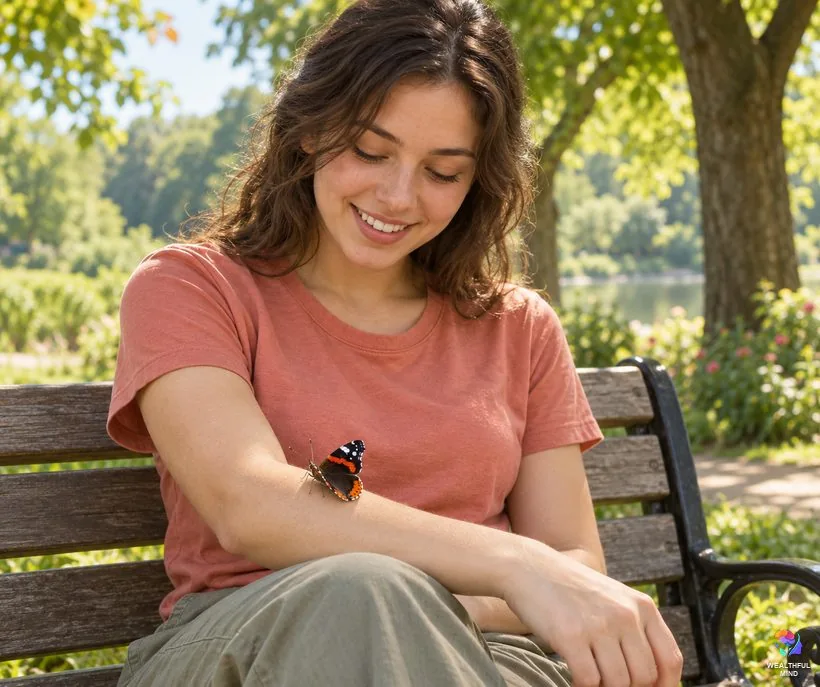
A butterfly settles on your hand, a ladybug crawls onto your knee, and a week later it happens again. You start to wonder whether insects have chosen you.
Many people would say they have, in a way. You might take it as a sign that you are calm and safe to be near, that a loved one is saying hello, or that you needed to slow down for a minute.
Butterflies, at least, have an everyday reason as well. Nectar lacks sodium, and UGA Cooperative Extension notes that butterflies “have even been known to visit human sweat and tears to obtain sodium.” On a hot day, you are a salty, sunny place to rest.
One Reddit user had a butterfly land on the tattoo they got for their dad. Their first thought was that it liked the colors, and in the same breath they said they wanted to believe it was a visit.
We like that honesty. You can know why the butterfly landed and still feel it came for you.
If it was a butterfly on your hand, our page on what it means when a butterfly lands on you goes further.
Seeing the Same Insect Again and Again
Sometimes you get not one visit but a run of them. Ladybugs for a month, then spiders, then moths, until it feels like the insects are taking turns with you.
Two ordinary things are usually at work. The first is the season, since many insects arrive in waves as the weather changes. The second is what the linguist Arnold Zwicky named the frequency illusion on the Language Log blog in 2005: “once you’ve noticed a phenomenon, you think it happens a whole lot.”
If you want to know whether it means something for you, start a simple log in the notes app. Jot down the day, the insect and what you were thinking about, and look over it once a month has passed.
If the same worry or the same person keeps turning up next to the same insect, that pattern is yours to read.
Insects in Your House: Sign or Pest Problem?
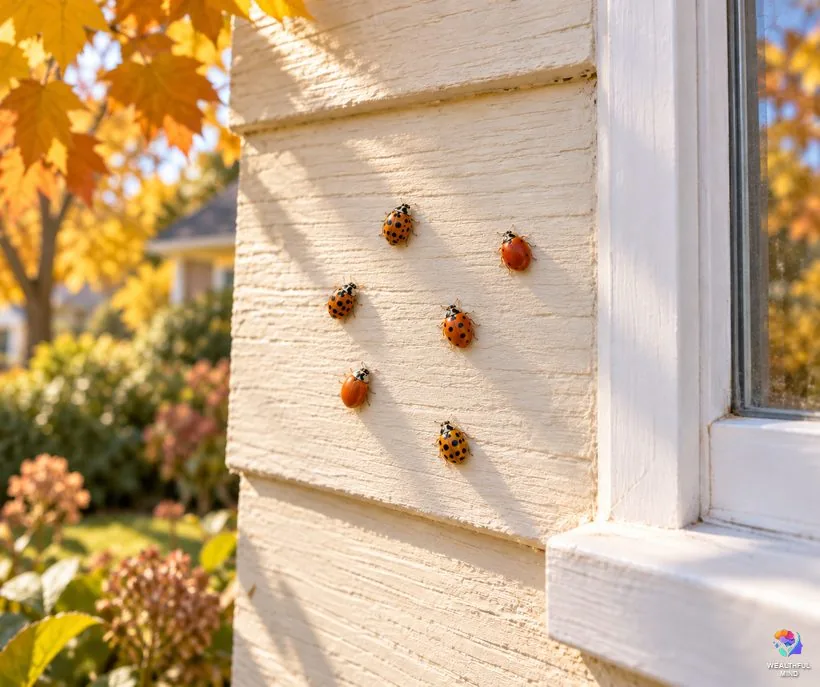
A single beetle on your windowsill or a moth on your bathroom wall can feel like a visitor. A trail of ants across your kitchen counter is a different story.
Here is our rule of thumb. Deal with a crowd of bugs first and save the meaning for later, because a crowd indoors usually means food, water or a gap somewhere. Our page on the spiritual meaning of ants in the house and other bugs gives you the practical steps and the beliefs side by side.
Some traditions do welcome one small guest. The Illinois State Museum notes that the Muskogee Creek people today believe “a spider in the house means good health and good fortune.”
Insects After a Death

An insect that appears after someone dies can stop you in your tracks. For many of you, it is the first moment since the funeral that felt like a hello.
Butterflies lead these stories, with dragonflies close behind. In one grief thread on Reddit, where a man kept seeing the same butterfly after his brother died, the most-liked reply asked him a simple question: “does it bring you joy and comfort? Then it is real, lean into it a bit.”
The belief behind it is old. Several traditions in the list above, from the Greek psyche to Lady Wilde’s Irish tale and the Obon dragonflies, tie a flying insect to the soul or to someone who has gone.
Timing plays a part too. The National Wildlife Federation describes how monarchs reach their winter forests in Mexico by late October, just before the Day of the Dead on November 1 and 2, when the souls of the dead are said to return.
So if a butterfly settled beside you at the cemetery, generations of grieving people would understand exactly what you felt. Our page on white butterflies and grief stays with that moment.
Birds are the other hello you will hear about most, and our guide to what it means when a bird visits you covers them.
○ If You Have Not Seen a Sign
Maybe you have watched every butterfly in the garden and felt nothing. That is alright, and it says nothing about the bond you shared.
Grief does not come with a schedule of signs. Your person lives on in the jokes you still repeat and the way you make their recipe, and that counts just as much.
If missing them gets too heavy to carry alone, talk to someone in your family, a friend, a doctor or a counselor.
Lucky and Unlucky Insects
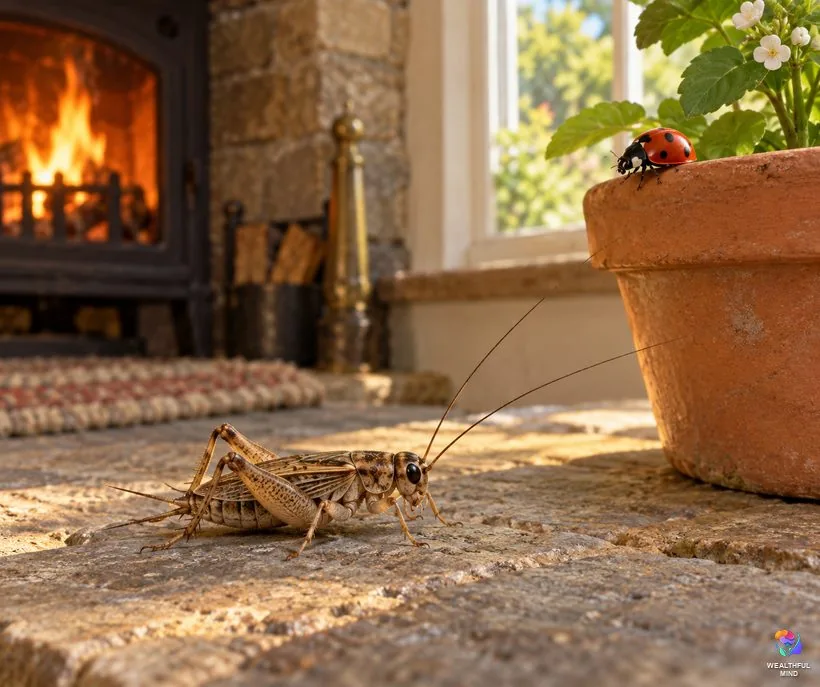
If you want to know which insect is the best omen, we would name the ladybug. It is read as luck almost everywhere, and you will not find a bad reading of one in this guide.
These lucky insects have real roots:
- A cricket on the hearth. Charles Dickens built a whole Christmas story around the line “To have a Cricket on the Hearth, is the luckiest thing in all the world!” (1845).
- A spider in your house, for the Muskogee Creek (see the house section above).
- Bees that you keep in the family news, as in the Cambridgeshire custom of telling the bees.
And one old omen sits on the unlucky side. The Woodland Trust says the rhythmic tapping of the deathwatch beetle in old timber “was believed to be an omen of death,” and its name comes from the vigil kept beside the dying.
The Woodland Trust also gives you the real cause. The tapping is a male beetle bumping his head or jaws against the wood to call a mate.
Some families also feel uneasy about a moth or butterfly indoors, because so many traditions tie them to souls. But most readings today are kind ones, and we see no reason for you to fear any insect’s visit.
When an Insect Scares You
Some of you describe the opposite of a gift: the one creature you fear most keeps finding you. For some it is spiders, for others centipedes or wasps.
Spiritual readers often say it means it is time to face that fear. You do not have to do it all at once, and you do not have to do it alone.
If the fear stops you sleeping, eating or going into a room, it may be a phobia, and the NHS says that treatment can help. Telling your doctor is a good place to start.
○ If You Killed One
You may feel awful after killing a spider or a butterfly, especially if you thought it was a messenger. In none of the traditions we traced is killing a single insect a curse on you.
We all crush tiny creatures every time we walk across a lawn. Feeling sorry shows you care, and that is a good thing to keep.
Next time, try a glass and a piece of card. Slide the card under the glass, then carry the insect outside.
○ Stings and Spider Bites
A few insects can hurt you, so here is one kind word on safety. The CDC names bees, wasps, hornets and fire ants as stinging insects, and calls anaphylaxis a severe allergic reaction “that requires immediate emergency care.” If you or a friend has loss of breath, serious swelling or severe chest pain after a sting, phone your local emergency number at once.
In the US, the CDC says the venomous spiders to know are the black widow and the brown recluse. Spiders are usually not aggressive, the CDC adds, and most bites happen when one is trapped or touched. So never pick up a spider you think might be one of these.
Insects in Dreams
Dreams about insects are mostly unpleasant, and it helps to say so plainly. You might dream of bugs in your mouth, bugs across your bed or one insect growing huge.
We could not trace any old tradition behind modern insect dream meanings, so read them as your own mind talking. A swarm often mirrors feeling overwhelmed, while a single calm butterfly is usually read as hope. To read any dream this way, our page on how to read your own dreams starts with the feeling you woke up with.
Spiders are the dream visitors you ask about most. Our page on spider spiritual meaning and spider dreams covers them.
Insect by Insect: Where to Read More

Every insect below has its own full page. Find yours, read its meaning in a line or two, and go straight to the full story.
○ Butterflies and Moths
A butterfly is the classic sign of change and of the soul, and the insect grieving people mention most. Our guide to butterfly spiritual meaning for every color covers the monarch, a black butterfly and one that crosses your path.
If you saw a white butterfly, the usual reading is someone you have lost, close for a moment, and some people see a clean slate or new love in it. Read the white butterfly spiritual meaning, twin flames included.
A yellow butterfly is read as hope after a hard stretch, or as joy on its way to you. See yellow butterfly spiritual meaning for the old island story behind it and the real yellow butterflies you are likely seeing.
A moth is most often read as a soul close by, often a loved one who has died, and you can also take it as change happening quietly, out of sight. Our page on moth spiritual meaning explains moths in your house, their colors and what one at your lamp is really doing.
○ Ladybugs, Bees and Ants
A ladybug means good luck, and you can also read it as protection, love or a baby on the way. Find out where the luck comes from on our page about ladybug spiritual meaning, including what a houseful of them in fall really is.
A bee stands for hard work, community and the sweetness that comes from both. Our bee spiritual meaning page covers bumble bees, a bee landing on you, bees in your house and stings.
Ants mostly stand for hard work and saving for later, with patience and family close behind, but a trail in your kitchen calls for a sponge before a prayer. Read what ants in the house mean spiritually for both sides.
○ Dragonflies, Grasshoppers and Praying Mantises
A dragonfly is mostly about change, lightness and seeing clearly, and if you are grieving, you may feel a loved one near when one hovers close. Read the full dragonfly spiritual meaning for colors, landings and the stories from Japan.
A grasshopper tells you to move: make the jump you have been weighing, and trust the landing. Our page on grasshopper spiritual meaning also checks the popular claim that it can only jump forward.
A praying mantis asks you to be still, wait for your moment and trust your gut. Our page on the praying mantis spiritual meaning explains why one seems to stare right at you.
○ Spiders
Spiders get the most mixed readings in this group. Some people see a patient, inventive builder that starts again whenever its web breaks, others a trap or a warning, and you may feel both at once.
Read what it means when you see a spider, from webs to a spider in your home.
○ Other Insects Without Their Own Page
These do not have a page of their own yet. The readings below are modern ones, since we could not trace an older tradition for most of them.
- Fly. Often read as a nudge to clear out what has gone stale in your life. Indoors, it usually means food has been left out.
- Wasp. Boundaries, and standing up for yourself. Give it space, because wasps can sting.
- Cricket. Luck at home, and the one insect here with an old saying behind it (see the lucky list above).
- Cockroach. Survival and toughness. In your house, it is a pest problem first.
- Stink bug. Patience through a hard season, since stink bugs come indoors to wait out the cold.
- Beetle. Steady effort and protection, thanks to its hard shell.
Common Questions on Insect Spiritual Meaning
What insect symbolizes healing?
The honeybee has the strongest claim, because a holy book says so directly. In the Quran, chapter 16, verses 68 and 69, God inspires the bees, and the honey they make is described as holding healing for people. Many people also read a bee as a sign that hard work and patience are about to pay off. If you need actual healing, though, treat the bee as encouragement and see a doctor for the rest.
What insect is considered a good omen?
We would say the ladybug. It is read as good luck almost everywhere, and many people add protection, love or a baby on the way. The cricket comes a close second, thanks to the old saying Charles Dickens used in The Cricket on the Hearth that a cricket by the fire is the luckiest thing in all the world. Among the Muskogee Creek, a spider in the house is said to bring good health and good fortune.
What does God say about insects?
In both the Bible and the Quran, insects are teachers and pictures rather than personal messages. Proverbs points the sluggard to the ant as a model of hard work, and counts ants and locusts among the wise small creatures of the earth. Jesus uses moths to show how earthly treasure gets eaten away. The Quran says God inspired the bees, tells of an ant that warned its colony, and uses the spider’s web as the flimsiest of shelters.
Are insects signs from heaven?
Many people believe they can be, especially butterflies, moths and dragonflies that turn up after someone dies. The idea is old: in ancient Greek, psyche could mean a soul or a butterfly, an Irish tale collected by Lady Wilde calls butterflies the souls of the dead, and at the Japanese festival of Obon the ancestors are said to ride home on dragonflies. No one can prove where a sign comes from. Comfort you feel is still worth keeping, and nothing is wrong if you never see one.
Is killing an insect bad luck?
In none of the traditions we traced is killing one insect a curse on you. Plenty of people feel guilty afterwards, especially if they took the insect as a messenger, and that guilt simply shows that you care. Next time, trap it gently under a cup, ease a sheet of paper beneath and set it free outdoors. Leave any spider you think could be a black widow or a brown recluse alone.
What does it mean when bugs keep landing on you?
Many people read it as a sign that you are calm, gentle and easy to be near, or that a loved one is saying hello. There is often a plain reason too. Butterflies look for the sodium that nectar does not give them, and they will even sip human sweat, so on a warm day your skin is a good place to land. You can know that and still enjoy the moment.