Turtle spiritual meaning centers on patience, protection and home. To most people, a turtle is a sign to slow down, guard your energy and trust your own pace. We think it is one of the easiest animal signs to trust, because each of those meanings comes straight from how the real animal lives.
It carries its shelter on its back and gets where it is going at its own speed. If a turtle is in front of you right now, on a road or digging in your garden, read what to do when you see a turtle first. The meaning will keep.
Turtles are one of many animals people read as messages, and our guide to animal spiritual meanings covers the rest. If signs in general are new to you, signs from the universe shows how people notice and read them.
What Does It Mean When You See a Turtle?

Almost every reading you will find comes back to one of four ideas. Each one grows out of something the animal really does.
- Slow, steady progress. A turtle cannot hurry, but it keeps going and it gets there. Many people take one as a sign that you are pushing too hard, or that a slow season in your life is not a wasted one.
- Protection. A turtle carries its own armor everywhere. People read that as a nudge to guard your time and energy, and to pull back from whatever is draining you.
- Home and grounding. A turtle is never far from home, because its home is on its back. That is why it is tied to family, settling in and feeling safe in your own skin.
- Long life and quiet wisdom. Some reptiles can live for a very long time, the CDC notes. An old, unhurried animal easily becomes a picture of patience that was earned.
To find the one meant for you, think about your own speed in the days before the turtle showed up. Were you rushing toward something, or hiding from it?
Rushing points to the first reading, and hiding points to the second.
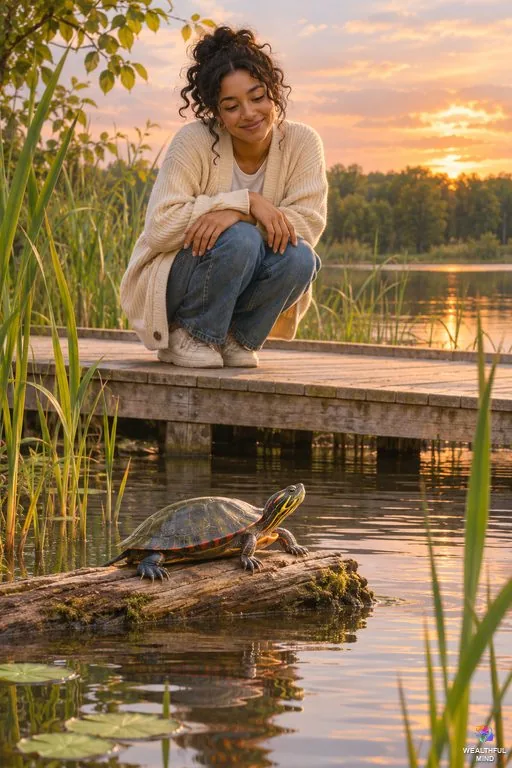
Picture three weeks of exam cramming, then a walk by the lake to clear your head. A turtle is sunning itself on a log, and it does not move for the whole ten minutes you stand there. Most people would take that as permission to stop and rest, and so would we.
○ Is a Turtle a Good Omen?
Yes. In the traditions we could trace, the turtle holds up the world or steadies it, and none of them treats it as a warning.
Some sites list a “negative” turtle meaning too, usually being stuck or afraid of change. We see it more gently. Say a turtle turns up while you are tucked away in your shell (putting off a call, a talk or a choice), and take it as an invitation to put your head out, not as bad luck.
○ When a Turtle Turns Up on a Hard Day
People describe this moment online again and again. A rotten day, a few quiet minutes by a pond, and then a baby turtle paddling past as if it had somewhere important to be.
Many of them read it as “baby steps”, and we like that reading a lot. You do not have to fix the whole week. You only have to take the next small step, then the one after it.
If the bad days have been stacking up, a turtle is a sweet sign, but a person is better company. Talk to a friend, a parent or a counselor you trust.
○ Seeing Turtles Again and Again
If turtles keep crossing your path, check the calendar before you look for a message. In late spring and early summer, many adult female turtles leave the water to lay their eggs on land, the Vermont Fish and Wildlife Department explains. So in many places, May and June are simply turtle season near ponds and rivers.
That does not empty the sighting of meaning.
Jot down when each turtle appears and what was on your mind at the time. If the same person or the same worry keeps showing up beside the turtles over a few weeks, that is the part to pay attention to.
What to Do When You See a Turtle

Ask on any turtle forum and you will see that people rarely want to know what a turtle means. They want to know what to do with it, and the honest answer is usually less than you think.
○ A Turtle Crossing the Road
The turtle in front of you is most likely going somewhere on purpose. Many female turtles travel to find good places to lay their eggs and will often cross roads on the way, the US Fish and Wildlife Service explains.
Your safety comes before the turtle’s. Parks Canada puts it simply in its turtle advice. Pull over where it is safe, use your emergency lights and watch for cars, because your safety is most important.
If you are a passenger, ask the driver to find a safe place to stop. Never run into traffic for a turtle.
Once the road is clear, here is how to help.
- Stand guard first. The US Fish and Wildlife Service says it is sometimes best to simply watch while the turtle crosses on its own. We think this is the right first choice for most people, because you never have to touch it.
- Carry it the way it was heading. If it needs a lift, Parks Canada says to move it in the direction it was going and set it down a safe distance from the road. (It was going there for a reason.)
- Hold the shell, never the tail. Picking a turtle up by its tail is painful for it and can break its spine, Parks Canada warns.
- Try a car mat. The US Fish and Wildlife Service suggests sliding the turtle across on one, so you do not have to pick it up at all.
- Let it go. The US Fish and Wildlife Service asks helpers to focus only on getting the turtle safely to the other side. So please do not take it home, or to a pond you like better.
A big turtle with a rough, ridged shell, a long tail and a large head may be a snapping turtle. Parks Canada suggests moving one with a paddle, a shovel or another tool from your car. You will find a safe hand hold in the snapping turtle section below.
Do not worry if the turtle pulls in its head and freezes once you set it down. Hiding in its shell is how it stays safe until you leave, so walk away and give it a few quiet minutes.
○ A Turtle in Your Yard or Driveway
A turtle in your yard in late spring or early summer is very often a mother looking for a place to nest. The Vermont Fish and Wildlife Department says these females look for ground that is sunny, well drained and fairly loose. Your garden bed, gravel driveway or sandy lawn edge can suit them perfectly.
Here is what the Vermont department advises, step by step.
- Leave her alone. Vermont Fish and Wildlife says it is best to let a nesting turtle lay her eggs where she chose, and that nesting may last several hours. Keep dogs and little ones inside and watch from a window.
- Do not carry her to a pond. It is tempting, but the Vermont department says a pregnant turtle is set on laying her eggs and will likely return if you move her to water.
- Move her only if she is in real danger, such as on a busy road. Then, Vermont Fish and Wildlife says, carry her as short a distance as possible to a safer spot on the same side of the road.
- Leave the nest alone afterwards. The Vermont department says it is always best to stay away from turtle nests and keep activity above them to a minimum.
If a nest really has to be moved, Vermont Fish and Wildlife asks people to contact the department first for guidance. Outside Vermont, call your own state wildlife agency before you dig, because some turtles are protected (Vermont lists the Spotted Turtle as state endangered, for one).
Tiny turtles have their own season. In Vermont, eggs typically hatch in late summer and early fall. The department says a hatchling on its own is normal and should be left alone unless it is in danger.
○ Is It Safe to Touch a Turtle?
Yes, with a little care. Salmonella is the most common germ that reptiles carry, and even a healthy one can carry it, the CDC says. Wash your hands with soap and water after you touch a turtle, or use hand sanitizer with at least 60% alcohol until you can, as the CDC advises.
Keep younger brothers and sisters away from it, though. The CDC says children under 5 should not handle reptiles at all, because they are at higher risk of serious illness.
Turtles can bite, too. Most have no teeth, but the CDC notes that their bites can still be painful, so keep your fingers well away from the head.
If you are tempted to keep a baby turtle, do not. A wild turtle belongs where you found it.
○ A Turtle That Looks Hurt
If a turtle has a cracked shell or is bleeding, do not try to fix it yourself. In the US, Animal Help Now serves the entire country and offers help with any wildlife emergency. In Ontario, Parks Canada asks you to call the Ontario Turtle Conservation Centre at 705-741-5000.
Anywhere else, a local wildlife rescue or your wildlife agency is the right call.
A Turtle Crossing Your Path
A turtle crossing your path is usually read as a sign that you are on the right road and only need to keep going at your own speed. It does not hurry, and it does not turn back.
The road advice above has a nice echo here. Parks Canada asks you to carry a turtle the way it was already heading, never back where it came from. Many people read their own sighting the same way, as a nudge to finish what you started instead of turning around.
When a Turtle Visits Your Home
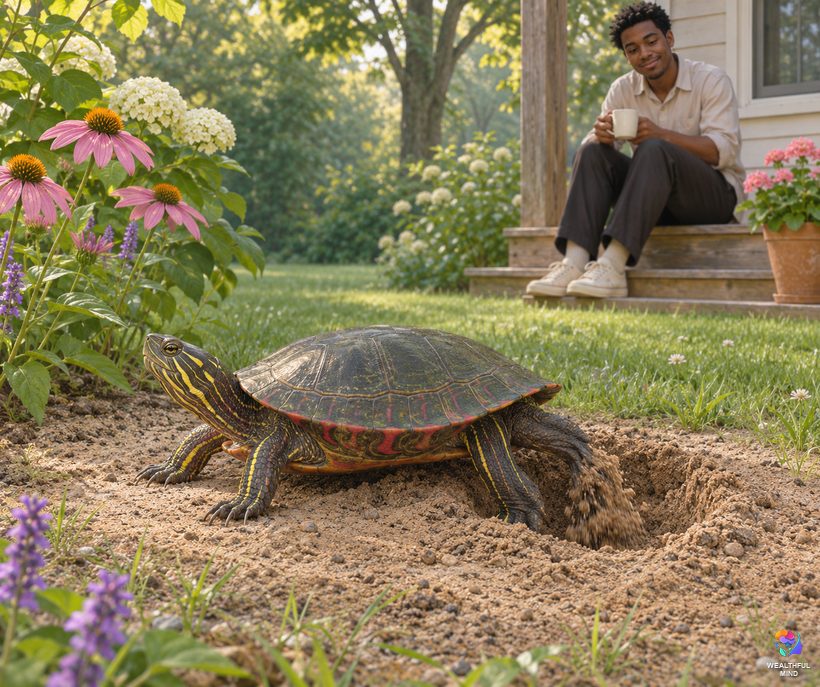
If a turtle turns up on your porch, at your door or in your garden, many people would call it a blessing on the home itself. Since the turtle carries its house wherever it goes, a visit is read as a sign of safety, a steady family life or a good time to settle somewhere new.
The everyday reason is usually a mother turtle hunting for nesting ground. Give her space and enjoy the visit from a distance.
You may also hear a visit read as a sign of fertility or a fresh start. We found no old tradition behind that one, though a nest beside your flower bed in June shows where the idea comes from.
Snapping Turtle Spiritual Meaning
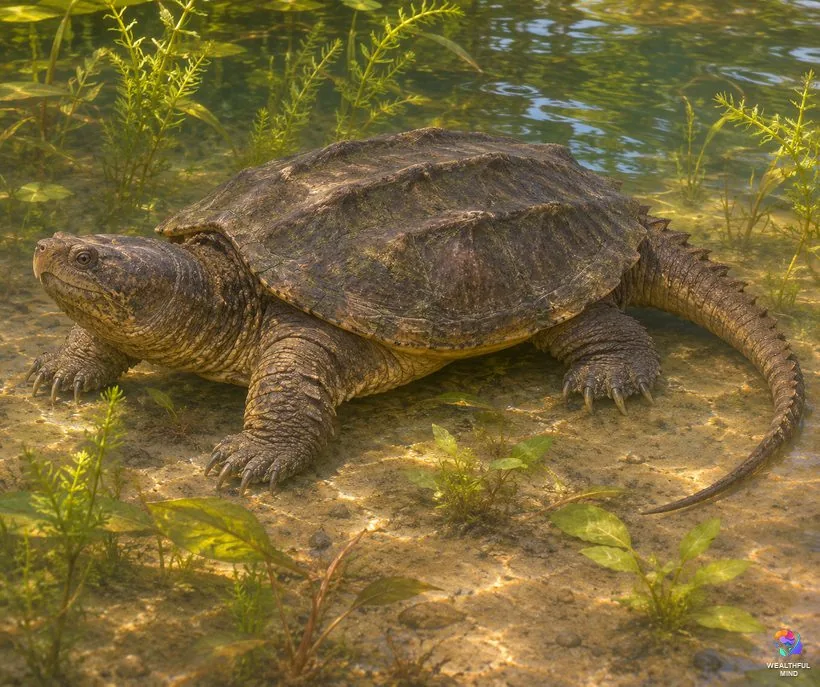
The snapping turtle spiritual meaning is about boundaries. A snapper does not apologize for defending itself, so people read one as a sign to say no clearly and protect what matters to you.
We could not find any old tradition behind that reading. It is modern, built on the animal’s reputation, and we still think it is a useful one, especially if you find it hard to stand up for yourself.
Snappers deserve respect up close.
A frightened turtle may try to bite, and the US Fish and Wildlife Service names snapping turtles as the example. If one has to be moved, Parks Canada suggests a shovel or a paddle.
The Parks Canada hand hold works too. Slide one hand under the turtle past its tail, then grip the back of the shell with your other hand so the head cannot reach you.
Tortoise Spiritual Meaning

The tortoise spiritual meaning is the turtle’s meaning brought down to earth. It stands for patience, a steady home and slow, sure progress, with even more weight on the ground under your feet.
Every tortoise is a turtle. Britannica counts tortoises among the turtles, and true tortoises live only on land.
In North America, people often call land turtles such as box turtles and wood turtles “tortoises” too, Britannica adds. So the “tortoise” in your garden may well be a box turtle, and its meaning is the same.
The old fable of the tortoise and the hare is why “slow and steady wins the race” comes to mind first. In Hindu tradition, a god took the form of a tortoise to hold up a mountain, a story you will find further down.
A pond turtle or a sea turtle is often read as a sign about feelings and going with the flow. A tortoise tends to be read as a sign about practical things, like your home, your work, your money and your health.
○ Sea Turtle Meaning
If you keep meeting sea turtles, most people would read it as a sign of long journeys and of trusting the current. The leatherback lives in the open ocean but comes ashore to lay its eggs, Britannica explains. It is easy to see it as a traveler who still comes back to land when it matters most.
If you meet one while swimming or on a beach trip, give it plenty of room and let it go about its day. Many sea turtle populations are now endangered after years of hunting and egg collecting, Britannica says.
What the Turtle Shell Symbolizes
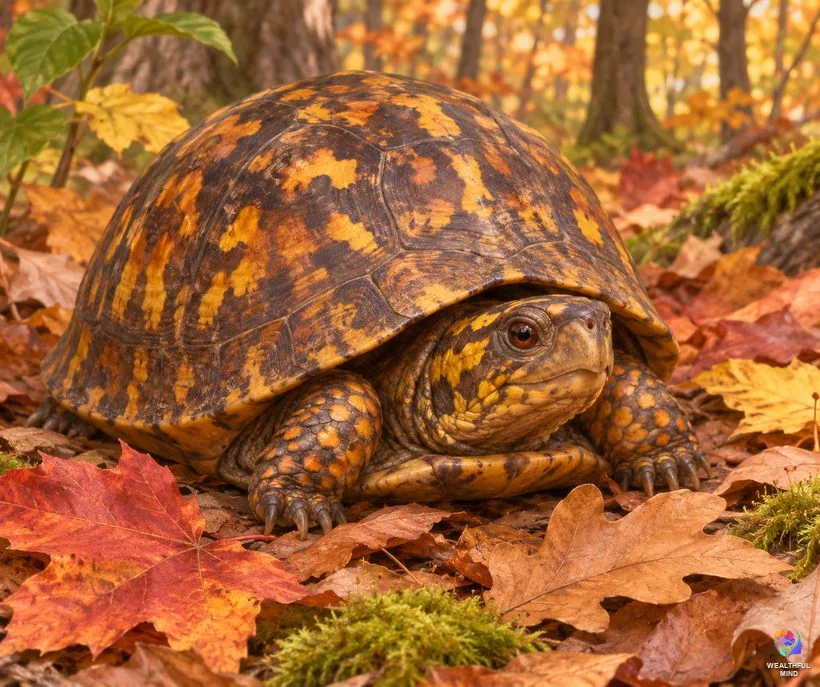
The turtle shell stands for protection, boundaries and a home you carry with you. Here the symbol and the science line up neatly. Britannica describes the shell as an adaptation that protects the turtle from predators and makes up for its slow crawling speed.
The shell is not a coat the turtle can take off, either. Its top half is built from 10 trunk vertebrae and their ribs, fused to bony plates, Britannica explains. So a turtle’s home is part of its own skeleton, and we love that picture, because the safety you build inside yourself goes everywhere with you.
If you would like a turtle shell for an altar or a shelf, choose one carved from stone, wood or clay. Before plastics, real tortoiseshell came from the hawksbill sea turtle, Britannica notes, and we would rather shells stayed on their turtles.
Turtle Spirit Animal

If the turtle is your spirit animal, people would describe you as patient, steady and loyal to your own pace. You may take a while to open up to new people, you probably love your home, and once you start something you tend to see it through.
The shell is the catch. A turtle person can stay tucked away for too long, so part of your lesson is knowing when to come back out.
You do not need a quiz for this. If turtles keep turning up for you, in real life, in dreams or simply in what you are drawn to, that is the sign most people go by. Our animal guide explains how people read animal signs more widely.
Where the Turtle’s Meaning Comes From

You can trace three turtle stories to solid ground. One comes from North America, one from India, and one turns out not to be about turtles at all.
○ Turtle Island
Turtle Island is a name for the continent itself. The Canadian Encyclopedia says many peoples who speak Algonquian and Iroquoian languages use it, mainly in the northeast of North America. In various Indigenous origin stories, the encyclopedia adds, the turtle is said to support the world and is an icon of life itself.
You will find that the telling changes from one people to the next.
In many Haudenosaunee versions, The Canadian Encyclopedia says, a pregnant Sky Woman falls through a hole under the roots of a tree. Birds guide her gently down onto a turtle’s back. In some versions, her gratitude is so strong that the earth begins to grow around her, forming Turtle Island.
In some Ojibwe tellings, the world begins flooded, and Nanabush asks the animals to dive for soil to remake it. The muskrat finally comes up with some in its paws. Nanabush puts it on a willing turtle’s back, which becomes Turtle Island, “the centre of creation”, as The Canadian Encyclopedia tells it.
The Canadian Encyclopedia is careful to say that these examples do not cover every version of the tale, and that not all Indigenous creation stories feature a turtle. So when a page tells you what “Native Americans believe” about turtles, it is speaking for many different peoples at once. We would rather you hear a story from the people it belongs to.
○ Kurma, the Tortoise Avatar of Vishnu
In Hindu tradition, Kurma is one of the 10 avatars of the god Vishnu, tied to the churning of the ocean of milk, Britannica explains. Mount Mandara is torn out to serve as the churning stick, with the great serpent Vasuki as the rope. The mountain needs a firm base, so, as Britannica tells it, Vishnu takes the form of a tortoise and holds it on his back.
In this telling, the tortoise is the steady base that lets everyone else do their work. If you are usually the calm one holding things together while others pull, Kurma is a good picture to keep.
○ The “Turtle” in the Bible
You may read that the Bible talks about turtles. The King James Version does use the word, but its turtles are birds.
In the King James Bible, Leviticus chapter 12, verse 8, a woman who cannot bring a lamb brings “two turtles, or two young pigeons” as her offering. In the Song of Solomon, chapter 2, verse 12, the same Bible says “the voice of the turtle is heard in our land”, right after “the singing of birds”. (The reptile is not much of a singer.)
So a turtle meaning built on these verses rests on a misread word.
If a turtle still feels like a small gift from God to you, nothing here takes that away.
○ Turtle Colors and Other Untraced Meanings
You will also see turtle meanings credited to Celtic, Norse, Egyptian, Japanese and Chinese lore, along with charts for white, black, golden or red turtles. We looked for a reference source behind each one and found none we could check, so they stay off this page. “Turtle twin flame” readings are newer still, with no tradition behind them at all.
A Turtle in Your Dream

The dream meanings you find for turtles are modern, and each dream site writes its own list. So start with how the dream felt when you woke up.
A calm turtle, or one that sheltered you, is usually read as comfort and safety. A turtle hiding in its shell can mirror something you have been avoiding. A snapping turtle often points to anger, yours or someone else’s, or to a boundary that needs saying out loud.
Let the Turtle Set Your Pace
Whatever brought you here, a turtle in the road, a nest by your fence or a small head in a pond on a hard day, the advice is much the same. Go at your own pace, and come out of your shell when you are ready.
And then, of course, wash your hands.
Questions People Ask About Turtles
Are turtles a good omen?
Yes. In the readings people share today and in the traditions we could trace, a turtle is a gentle, good sign, usually of patience, protection and steady progress. None of them treats it as a warning. At most, a turtle that shows up while you are avoiding something can be a nudge to stop hiding and take the next small step.
Are turtles considered wise?
Many people see them that way. A turtle looks old, unhurried and hard to rattle, and the tortoise wins the old fable of the tortoise and the hare by being steady. In Hindu tradition, Britannica explains, the god Vishnu took the form of a tortoise, Kurma, to hold up a mountain on his back, which is a picture of calm strength more than cleverness.
What does a turtle shell symbolize?
Protection, healthy boundaries and a home you carry with you. The meaning matches the animal. Britannica describes the shell as an adaptation that protects the turtle from predators and makes up for its slow crawl, and the top of the shell is built from the turtle’s own backbone and ribs, so it can never leave its home behind.
What does it mean when a turtle visits your house?
Many people read it as a blessing on the home, a sign of safety, a steady family life or a good time to settle. The everyday reason is often nesting. The Vermont Fish and Wildlife Department says many female turtles leave the water in late spring and early summer to lay their eggs on land, so let her be and watch from a distance.
Can I move a turtle I find on the road?
Only if you can do it safely. Pull over somewhere safe first, and remember that you can simply stand guard while it crosses. If you do move it, carry it by the shell in the direction it was already heading and set it down well away from the road, as Parks Canada and the US Fish and Wildlife Service advise. Never lift it by the tail, and never take it home.
Do turtles carry germs?
Yes. The CDC says even healthy reptiles can carry Salmonella, so wash your hands with soap and water after touching a turtle, or use hand sanitizer with at least 60 percent alcohol until you can. The CDC also says children under 5 should not handle reptiles at all.