The crow spiritual meaning, in most traditions that tell of it, is a messenger: a bird that brings you news, carries food to your ancestors or shows you the way. Its name as a bad omen comes mostly from old folklore in New England and eastern Canada, much of it borrowed from British magpies, so the crow you saw is not a sign of death on its own. And because crows really do learn your face (more on that below), meeting one can feel very personal.
Quick pick
What Did the Crow Do?
Find your moment, then jump to what it means and the real reason behind it.
- Cawing at you again and again? A scold, an alarm or a nest nearby; some say a guest is coming
- Following you around? It knows your face, or your snacks; many read it as guidance
- Saw three crows together? A wedding, in the oldest crow counting rhyme
- Crows gathered round a dead crow? A danger lesson, so keep back and never touch it bare-handed
- Crows after someone died? In Hindu tradition, crows carry food to the ancestors
- Worried it’s a bad omen? Mostly not. Read the situation, not the bird
Keep reading below What a crow means The counting rhyme Crows in world traditions Crow or raven? Questions
You will find the other birds in our guide to what birds mean. If reading signs is new to you, start with signs from the universe, which gives you a simple four-step method that works for crows too. If your bird was bigger than you expected, with a deep croak, check Crow or Raven? first.
Crow Spiritual Meaning: Four Things a Crow Can Stand For
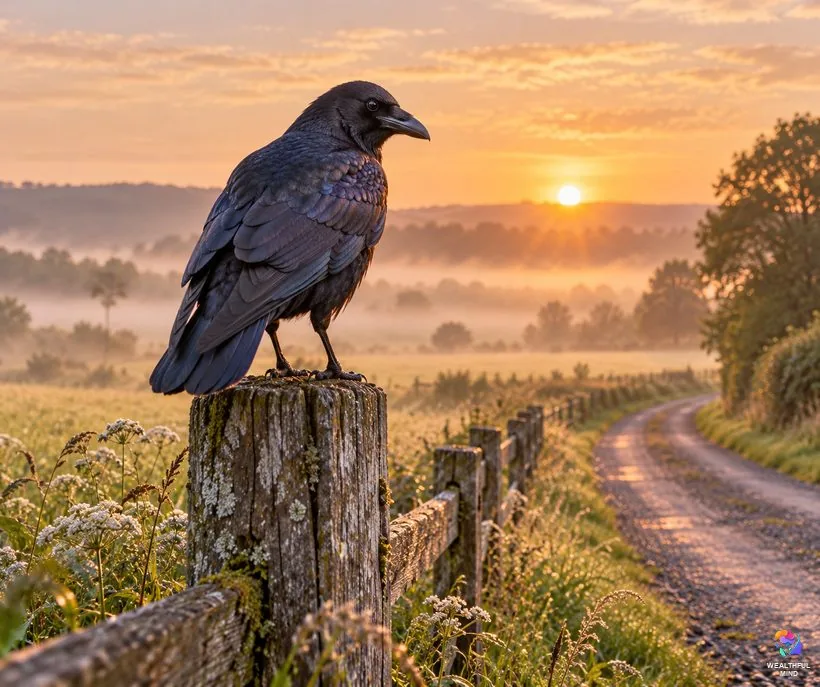
Readings of the crow change from one tradition to the next, but most come back to one of four ideas.
○ A Messenger
The most common reading is that a crow brings you news. In a folk belief from Pakistan and India, a crow that sits in front of your house and caws hard means a visitor is on the way. Some take it as an unwanted guest, while others are delighted.
In 1890s New England, the news was usually bad. People there said a cawing crow meant misfortune.
○ A Link to Your Ancestors
In Hindu tradition, crows stand for the departed, and feeding them is like feeding your ancestors. If you grew up in an Indian family, you may have watched someone set food out for the crows after a death. We explain that rite in Crows After Someone Dies.
○ A Guide
In the Kojiki, an early Japanese chronicle, a heavenly deity sends a giant crow to guide Emperor Jimmu and tells him to follow it as it goes. So if a crow seems to lead you somewhere, this reading says it is showing you the way.
○ A Teacher
In the Quran (chapter 5, verse 31), God sends a crow to scratch at the earth and show a man how to bury the brother he has killed. The man wails that he has failed to do even what this crow did, and regret takes hold of him.
If a crow makes you stop and think about something you have done, this is the reading that fits.
You may also see the crow called a “keeper of sacred law” on spirit animal sites. We could not trace that to any named people’s tradition, so we leave it out.
Is Seeing a Crow a Good or Bad Omen?
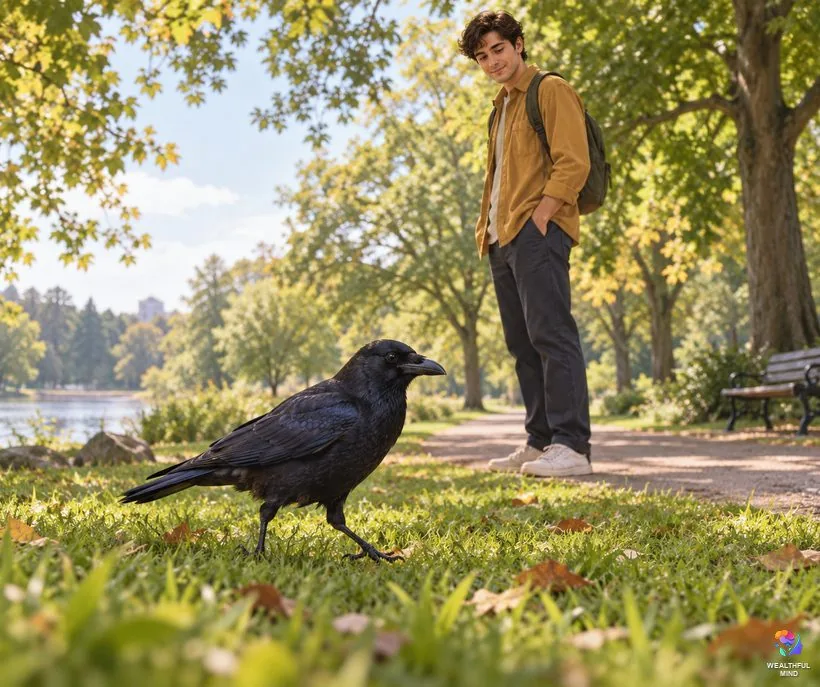
It depends on whose tradition you ask, and the good readings outnumber the bad ones.
On the good side, you have the guest who is coming and the ancestors who accept your offering. In Japan, the Shinto scholars at Kokugakuin describe “Karasu Kanjo” rituals where people offer rice cakes to crows to foretell the harvest, and it calls crows “auspicious birds that can lead people to happiness and good fortune”.
Most of the warnings come from one place and time. In the 1890s, people in New England and eastern Canada said a flock of crows around a house was a bad sign, and four crows flying together meant death.
If the “bird of death” idea worries you, here is the plain side. Carrion is only a very small part of a crow’s diet, and its bill cannot even break through a gray squirrel’s skin.
So here is our view: read your situation, not the bird. A crow crossing your lawn is just living where crows live. A crow that keeps doing something unusual, right when something big is happening in your life, is worth a closer look.
What Does One Crow Mean?
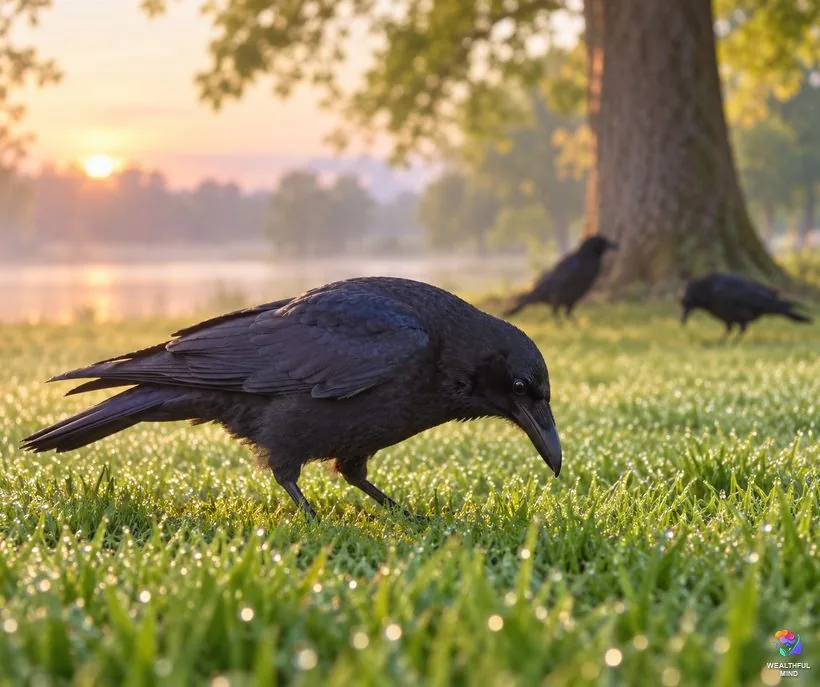
If one crow on its own made you uneasy, that worry probably started with a magpie. In Britain, magpies have been seen as a bad omen since the early sixteenth century, and many people there still greet a lone magpie politely.
Crows picked up a version of it. In old New England, meeting a lone crow was said to bring bad luck to a fisherman.
But a lone crow is rarely alone. American crows are more often seen in groups than alone, and their families often stay together all year. The one you saw was most likely a family member foraging a little way off.
If you take a single crow as a sign, read it as a quiet nudge to pay attention. We would not read sorrow into it.
Two, Three or More Crows: What the Number Means
○ Where the Counting Rhyme Comes From
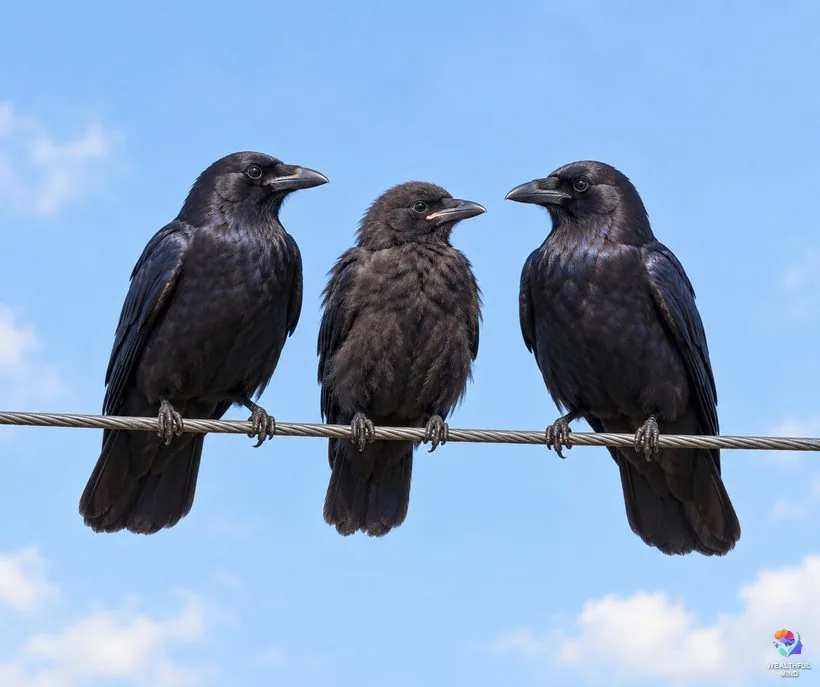
The counting rhyme started with magpies. A 1780 supplement to an edition of Shakespeare’s plays records that in the west of England, the number of magpies seen together meant this: “One for sorrow: Two for mirth: Three for a wedding: Four for death”.
By the 1890s, people in Maine and New Brunswick said it about crows flying overhead. Fanny Bergen printed it as “One crow, sorrow, Two crows, mirth. Three crows, a wedding, Four crows, birth”. She also noted that rhymes like this came over from Great Britain, where people said them about magpies.
So if you counted four crows, the crow rhyme promises you a birth, while the magpie one warns of a death. A chart that goes on to five, seven or nine crows has no old source we could find.
The crows might agree with stopping at four. In a 2024 study in Germany, three carrion crows learned to caw one to four times on cue, and they got one right every time but three only about half the time.
○ What Three Crows Mean
In the oldest crow version of the rhyme, as Fanny Bergen recorded it, three crows mean a wedding. The “good luck” and “spiritual awakening” readings you see elsewhere have no source behind them.
If you read three crows as a sign, the wedding points to a union: a relationship, a friendship or your family coming together.
On the bird’s side, crows in spring and summer usually travel in family groups of two to eight. So the three crows you saw in summer may well be two parents and one of their young. We think that fits the wedding reading rather nicely.
○ A Big Group of Crows
A big group of crows is called “a murder”, and you will often read that the name comes from crows gathering around death. The real history is sillier. The oldest use, “a morther of crowys”, dates to about 1475, and it is one of many made-up group names in medieval word lists, a game for people who wanted to sound clever at court.
You can read a flock as community, or as big news on its way. If a whole crowd has moved into your street, the season is the likely reason (see Crows Suddenly Everywhere).
What Was the Crow Doing?
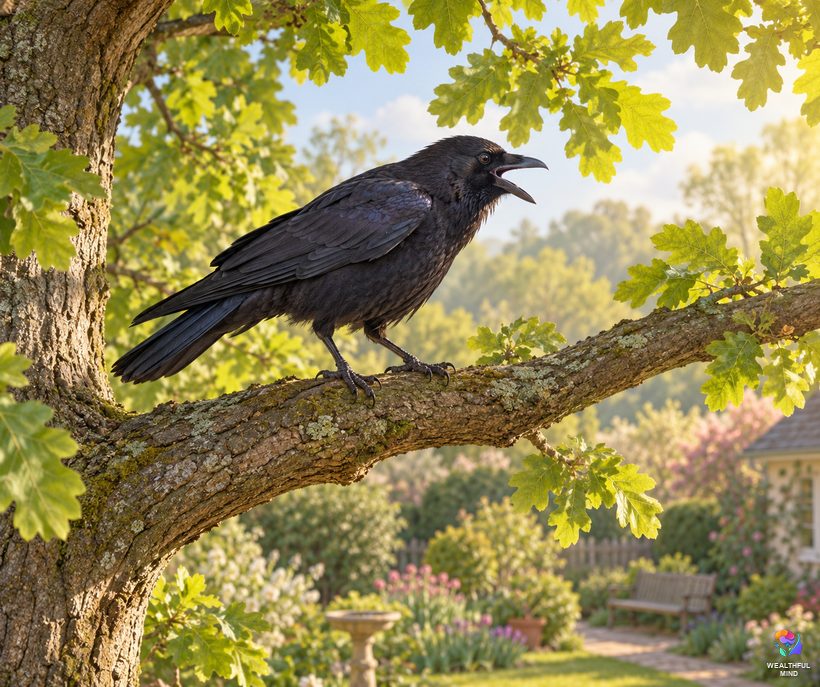
This is where your real answer usually sits. For each situation below, you get the bird’s side first, then what traditions say.
○ A Crow Cawing at You
If a crow caws at you again and again, it usually has a reason you can work out.
- It may be scolding you. Crows remember the faces of people they see as a threat.
- It may be warning about a predator. Crows mob owls, hawks and eagles all year, and their loud calls can lead you to a bird of prey. If you find an owl, here is what an owl means.
- It may be a sentry. Feeding flocks post lookouts that warn the others of danger, and you can count as danger.
- It may be a young crow begging its parents for food.
- It may be guarding a nest. Adults go quiet for about a month while they nest, then turn noisy once the eggs hatch.
In spring and summer, parent crows may swoop at creatures many times their size to protect their young. If that happens to you, keep away from the nest until the young are flying, about three to four weeks after hatching. If you must walk past, wave your arms slowly overhead, wear a hat or carry an umbrella.
Crow fans on Reddit also warn that the crow calls sold to hunters make a distress sound, so crows that come and find no crow in trouble grow suspicious of you. Never use one to call your crows.
As for meaning, this is the crow from the “a guest is coming” belief. Our own reading is simpler: a crow that caws at you every day either wants something from you or wants you to move along.
○ A Crow Following You
Crows really can tell you apart from other people. In 2006, University of Washington researchers wore rubber masks while they caught and banded crows, the National Wildlife Federation reports. Afterwards, the crows scolded that one mask, whatever clothes went with it, and the share of crows joining in roughly doubled over the years, even though most had never been caught.
So if a crow seems to know you, its family may know you too. The scolding peaked in 2013, and by September 2023 not one crow scolded on a masked walk. People who wore a “neutral” mask while feeding the crows drew no anger at all.
A crow that follows you may simply have learned that you are the person with the snacks. Peanuts left out in the open are a good way to attract crows.
If the crow is unusually tame, look at its eyes. Crow keepers on Reddit point out that a young crow has blue eyes and fleshy skin at the base of its beak, and it does not yet understand that people can be dangerous. Its parents are usually close by, so give it space.
In spiritual terms, a crow following you fits the guide reading, like the crow that led Emperor Jimmu.
○ A Crow at Your Window or Door
In breeding season, many birds see their reflection in a window or car mirror and try to drive the “rival” away. Audubon’s examples are cardinals and robins, but it says they are not the only species that do it. To stop it, block the reflection from outside with a sheet or some cardboard, since a cover on the inside will not help.
In towns, crows sometimes nest on window ledges. If a young crow is at your door and an adult is cawing nearby, it is usually a fledgling with a worried parent, so do not try to rescue it.
As for meaning, an Indian folk belief says a crow cawing outside your window means you should expect a guest. You might also read it as a message that has been trying to reach you.
○ Crows Gathered Around a Dead Crow
If you have seen crows gather loudly around a dead crow, you have seen what people call a crow funeral. In a University of Washington study, Kaeli Swift found that crows mobbed and fed less when a stranger stood with a dead crow or a hawk, but not with a dead pigeon.
“By participating in these funerals, crows can get information about new dangers without taking the risk,” Swift told KQED. So the crows are not mourning the way you do. They are learning what to fear, and KQED reports they may link that spot with danger.
Whatever the crows are doing, keep your own skin off the body. The CDC has no evidence that people catch West Nile virus by handling birds, but it still wants something between your hands and any dead animal, so wear gloves, or slip a plastic bag over your hand like a mitten.
Crows and jays often die of West Nile, and the CDC adds that a dead-bird report to your state health or wildlife office can help spot West Nile and bird flu early. Outside the US, ask your local wildlife office.
For what finding the dead crow itself may mean, see what a dead bird means.
○ A Crow Leaving You Gifts
Yes, this really happens. Audubon reports that crows sometimes leave keys, lost earrings, bones or rocks for the people who feed them, and researcher John Marzluff has no doubt it happens, though it is not well studied. Kaeli Swift is more careful. A gift could start by accident: a crow drops something where food is put out, the delighted human puts out more food, and the crow learns that leaving objects means a bigger meal.
You can read a gift as thanks, or as a sign of a real bond with the bird. We think you can enjoy the moment without knowing which it is.
○ Crows Suddenly Everywhere
If crows seem to have appeared out of nowhere, the season is the likely reason. From late summer through winter, crows gather from many miles around to sleep in shared night roosts. These roosts can hold a few hundred crows or as many as two million, and in recent decades some have moved into towns.
So a stream of crows over your street at dusk is most likely heading home for the night. In spring, a small group that stays in one spot day after day may be about to build a nest.
You might read a sudden crowd of crows as a sign that change is coming. Often, the change you are seeing is the season itself.
Crows After Someone Dies
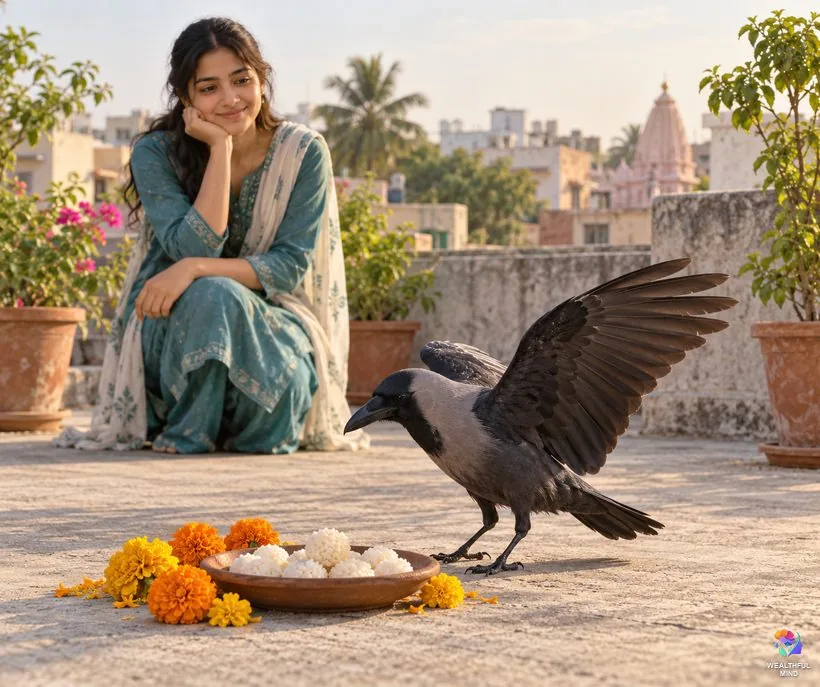
The strongest tie between crows and death is a loving one, and it comes from Hindu ancestor rites.
Shraddha is a rite meant to nourish, protect and support the spirits of a family’s dead parents, grandparents and great-grandparents. It is held between 11 and 31 days after a death, depending on caste traditions, and at regular times after that.
Every year, in the fortnight before the new moon of Ashwin, Hindu families make food offerings to their ancestors, often by placing the food outside for crows. Many set it on a roof, for the crows that are believed to carry it to the ancestors.
The crow’s response matters too. Frontline’s essay cites historian David Knipe on a rite at the Ramakunda in Nashik, where the family watches whether the first crow eats the offering without hesitation. If it struts away, the mourners take it that the person who died is unhappy with them.
If you are the one watching and the crows do not come, please be gentle with yourself. Tradition reads the crow’s choice as the ancestor’s answer. But crows also skip food for plain reasons, such as a spot where they have seen danger.
Outside these rites, you may notice crows in the days after a loss, as many grieving people do. A crow does not cause a death or predict one. But if a crow felt like a hello from someone you love, that comfort is yours to keep.
And if no crow comes, and no sign of any kind, that is alright. Your bond with them never depended on a bird.
Crows in World Traditions
○ Ireland: The Battle Crow
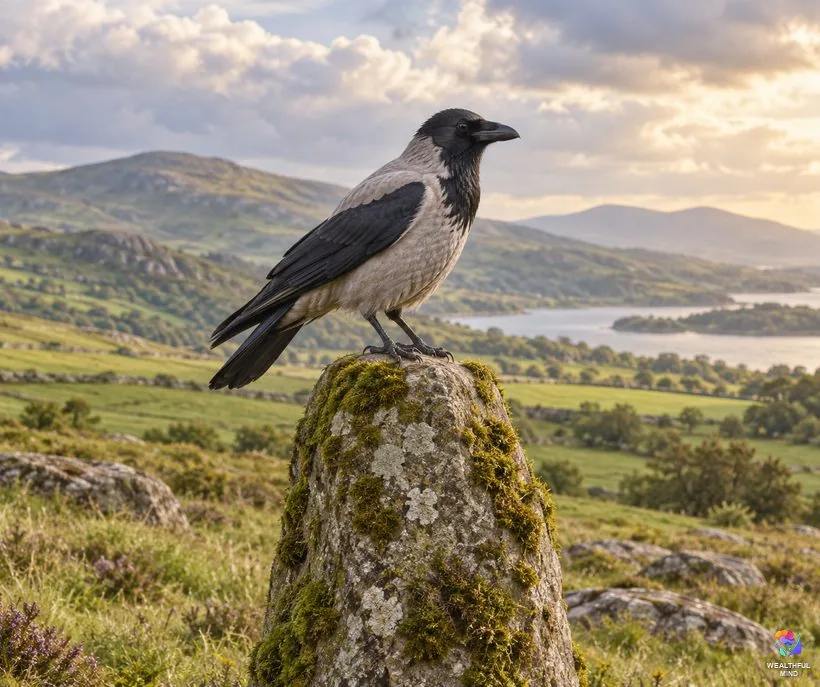
In Irish saga, the war goddess Morrigan is called the Battle Crow. In Lady Gregory’s retelling of the Cuchulain stories, “the War-goddess, the Battle Crow, the Morrigu” sits on a pillar-stone to warn the Brown Bull. Later, a strange woman speaks with Cuchulain and vanishes, and all he sees is a black crow on a branch, so he knows it was the Morrigan.
You will often read that a crow landed on Cuchulain’s shoulder as he died. In Lady Gregory’s text, it is only “a bird”.
○ India: The Crow That Pecked Sita
In the Valmiki Ramayana (Sundara Kanda, chapter 38), Sita tells Hanuman about a crow that kept pecking her. Rama sends a blade of grass from his bed chasing it across the sky, and Sita says the crow seems to be a son of Indra.
You will also read that the crow carries Shani (Saturn). It is widely repeated, but we found no source we could check.
○ Japan: Yatagarasu
The Kojiki’s guide crow is called Yatagarasu, and you will often see it drawn with three legs, including on the Japan national football team’s emblem. But Kokugakuin’s Shinto scholars say the name simply means “large crow”, and the myths never give it three legs. The legs are believed to come from a Chinese legend about a three-legged crow in the sun.
○ Greece and Rome: The Crow Who Warns
In Ovid’s Metamorphoses, the crow is the bird who warns. When Apollo’s raven flies off to report a secret, the crow follows and tells it the trip will do it no good, since telling a secret once cost her Minerva’s favor. It is the raven, punished for talking, whose white feathers turn black.
○ Aesop: The Crow and the Pitcher
In Aesop’s fable, a thirsty crow drops stones into a pitcher to raise the water. A 2014 study in PLOS ONE found that New Caledonian crows dropped stones into water rather than sand and chose sinking objects over floating ones. The researchers compared their understanding to that of children aged 5 to 7.
○ North America: A Word of Caution
You will often read that “Native American tribes” see the crow as a sacred teacher. Those lines almost never name a people or a source, so we do not repeat them.
Even the Crow Nation’s name is not what you might think. Montana’s tribal directory says its own name, Apsaalooke, means “children of the large-beaked bird”, and that white men later misread it as “crow”.
What Does the Bible Say About Crows?
The Bible never names a crow. The closest, in the King James Version’s list of unclean birds, is “every raven after his kind” (Leviticus, chapter 11, verse 15), as you can see on Bible Gateway. The Bible’s black birds are ravens, so their stories belong on our raven page.
White Crow and Black Crow Meaning
A white crow is rare enough that most people read it as a sign. In 1890s Kansas, a white crow flying over your head meant very good luck would follow you. Many people today read one as something special on its way, or as a message from someone they have lost.
We have not found a reliable source on why the odd crow is white, so we will not guess. If you see one, enjoy it, and think twice before you post its exact location online.
If your crow was black, it was simply a crow. Black is the everyday color of the crows most of us see, so everything on this page applies to you.
Crow Feather Meaning (and the Law)
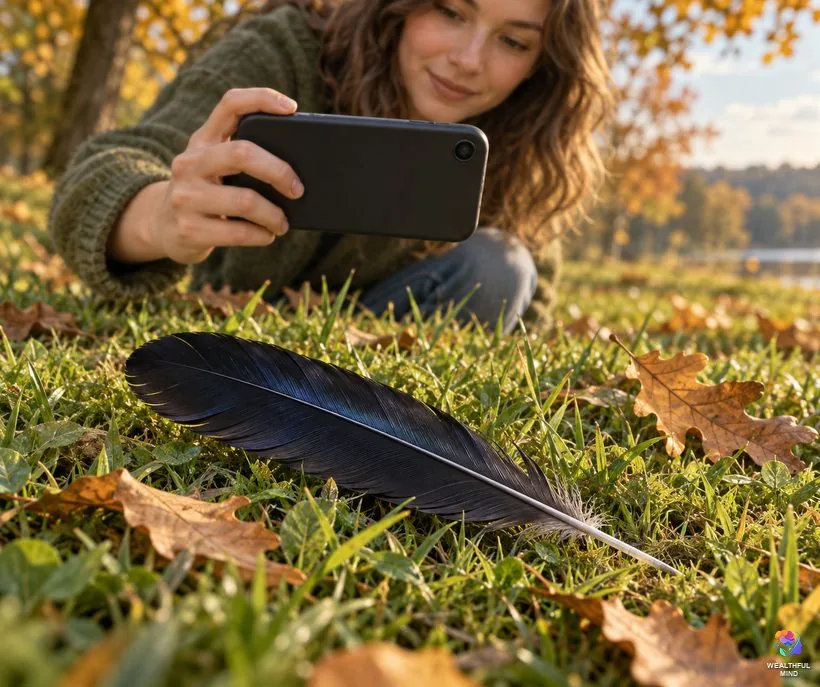
Many people take a crow feather as a message: protection, a hello from someone who loved you, or a nudge to trust what you already know.
In the US, though, that feather is not yours to keep. The Migratory Bird Treaty Act says you need a permit to hold any part of a native North American bird, the US Fish and Wildlife Service makes clear, and a feather dropped in a molt or taken from a bird hit by a car or a window is no exception. Let a photo be your keepsake, and leave the feather on the ground. Other countries have their own rules, so check yours.
Our page on feather meanings goes further into what finding a feather means.
Crow or Raven?
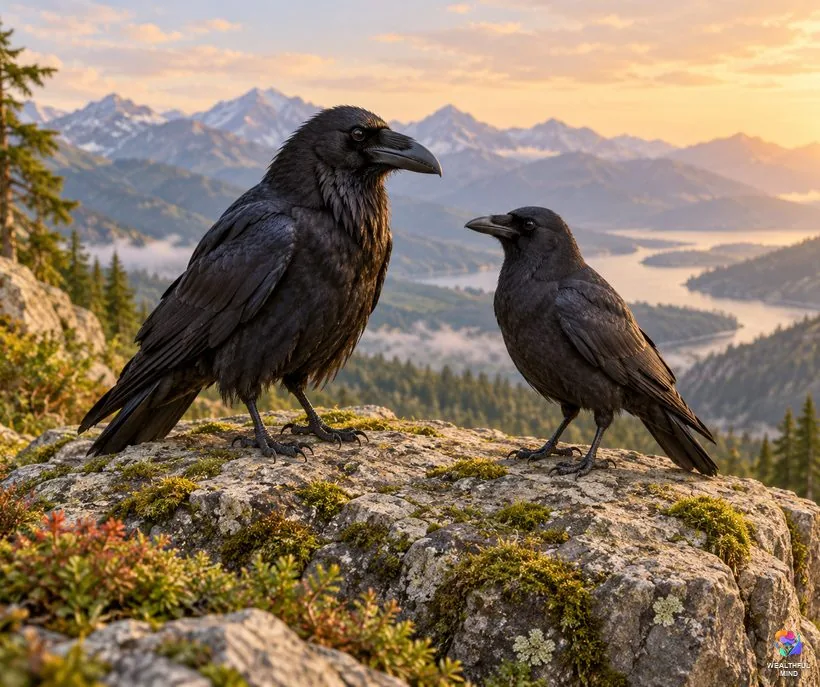
Listen first, because Cornell’s bird guide calls the voice the best clue: a crow caws, harsh and strong, while a raven gives a deep croak from the throat. A raven is also far heavier than a crow, with a very large bill. And when the bird flies over, a crow’s tail opens like a fan, while a raven’s ends in a wedge.
If yours was a raven, read what a raven means next.
How to Read Your Crow Sign

You can use the four steps from our signs page with crows too, adding one question before the last step: what was the bird doing?
Say you have just moved to a new city. On your first three mornings, a crow lands on the railing outside your window, caws twice and watches you drink your tea.
- Write down the situation. A new home, nobody you know yet.
- Name your first feeling. Maybe a small thrill of company, maybe nerves.
- Count the repeats. Three mornings, the same rail, the same time.
- Check the bird’s side. Is a neighbor leaving food out? Is there a nest close by?
- Check the tradition. In Indian folk belief, a crow at the window says a guest is coming.
Put together, your reading might be that you will not be lonely here for long. If it feels like a welcome, let it be one.
Say good morning to the crow tomorrow. It is probably learning your face already, and whatever your crow meant, it noticed you too.
Frequently Asked Questions About Crows
What does it mean when a crow caws at you?
Usually the crow is telling you, or other crows, something. It may be scolding a face it distrusts, sounding the alarm about a hawk or owl nearby, begging as a young bird, or guarding a nest in spring. In Indian and Pakistani folk belief, recorded by the USC Digital Folklore Archive, a crow cawing hard in front of your house means a guest is coming.
What does it mean when a crow follows you?
Crows recognize human faces, as University of Washington research has shown, and they often follow people who feed them. A young crow may also follow you simply because it has not yet learned to be wary of people. Spiritually, many people read it as guidance, like the crow that guides Emperor Jimmu in Japan’s Kojiki.
What do three crows mean?
In the oldest crow counting rhyme, recorded in Maine and New Brunswick in the 1890s, three crows mean a wedding. Many people read that as a sign of a union of some kind. In summer, three crows together are often two parents and one of their young.
Are crows a sign of death?
Not in themselves. Some 1890s folklore from New England and eastern Canada said four crows flying together meant death, but most traditions tie the crow to messages, ancestors and guidance. A crow does not cause a death or predict one.
Why do crows suddenly appear?
Usually it is the season. From late summer through winter, crows gather in large shared night roosts and fly up to 40 miles a day to feed, says Birds Connect Seattle. In spring, a small group that stays in one spot may be about to nest.
Do crows warn you of danger?
They warn each other, and you can listen in. Feeding flocks post lookouts, and crows mob owls, hawks and eagles with loud calls that can lead you to the predator. Many people also believe a crow can carry a warning meant for them.
Why shouldn’t you feed crows?
You can feed them, but do it with care. Cornell’s All About Birds guide notes that peanuts, compost, garbage and pet food all draw crows, so food left out can bring a crowd, other animals and unhappy neighbors. Put out small amounts, keep the spot clean, and never use a hunter’s crow call to bring them in.
Do crows really remember faces?
Yes. In a University of Washington study that began in 2006, crows scolded one dangerous-looking mask for years, and the grudge spread to crows that had never been caught. By September 2023, the scolding had faded away completely.