The most common white feather spiritual meaning is a quiet sign that an angel, or someone you loved who has died, is close. Many people take it to mean you are protected and on the right path. It is a belief and not proof, and a feather means most when it turns up at a moment that matters to you. Black feathers are read as protection, gray as calm, blue as speaking your truth and brown as grounding. In the US, photograph a wild bird’s feather instead of keeping it, because federal law protects most of them.
Quick pick
What Did Your Feather Do?
Find your moment below and jump straight to what it is said to mean.
- Found it soon after someone died? Many take it as a hello from them
- Found it inside the house? Read as a message just for you, once the pillows are ruled out
- Watched it float down in front of you? Read as perfect timing, an answer to what you were thinking
- Is it black? Protection and a pause, not a bad omen
- Gray, blue, brown or two colors? See the color chart and what each one means
- Want to keep it? In the US, take a photo instead, because most feathers are protected
Keep reading below What a white feather means Other feather colors Faith and history Can you keep it? Questions

This is the feathers page in our series on bird spiritual meanings, and it sits under our big guide to signs from the universe. White feathers come first, then every other color, the surprising history, and what to do with the feather in your hand.
What Is the White Feather Spiritual Meaning?

A white feather is one of the gentlest signs you can find. It weighs almost nothing, it seems to come from nowhere, and white is the color most of us connect with peace.
So if you just stopped in your tracks over one, you are in good company.
Here are the four readings you will hear most often.
○ A Sign That Angels Are Close
The best known belief is that a white feather is a calling card from your guardian angel. Many people understand it as a small “I am here” in a hard week, or a reminder that you are being looked after.
We could not find anyone who has traced where this idea began. Angel books and blogs repeat it, but none of them gives a date or a source you can check. So we treat it as a modern belief (a much loved and comforting one).
Some people pair feathers with angel numbers. If you find a white feather and then see 111 on the same day, many believers would call that a double sign, and an especially strong one.
○ A Hello From a Loved One Who Died
This is the reading you will see held most tightly. You find a white feather at the funeral, beside their old chair or on the morning of the anniversary, and it feels like they are saying hello.
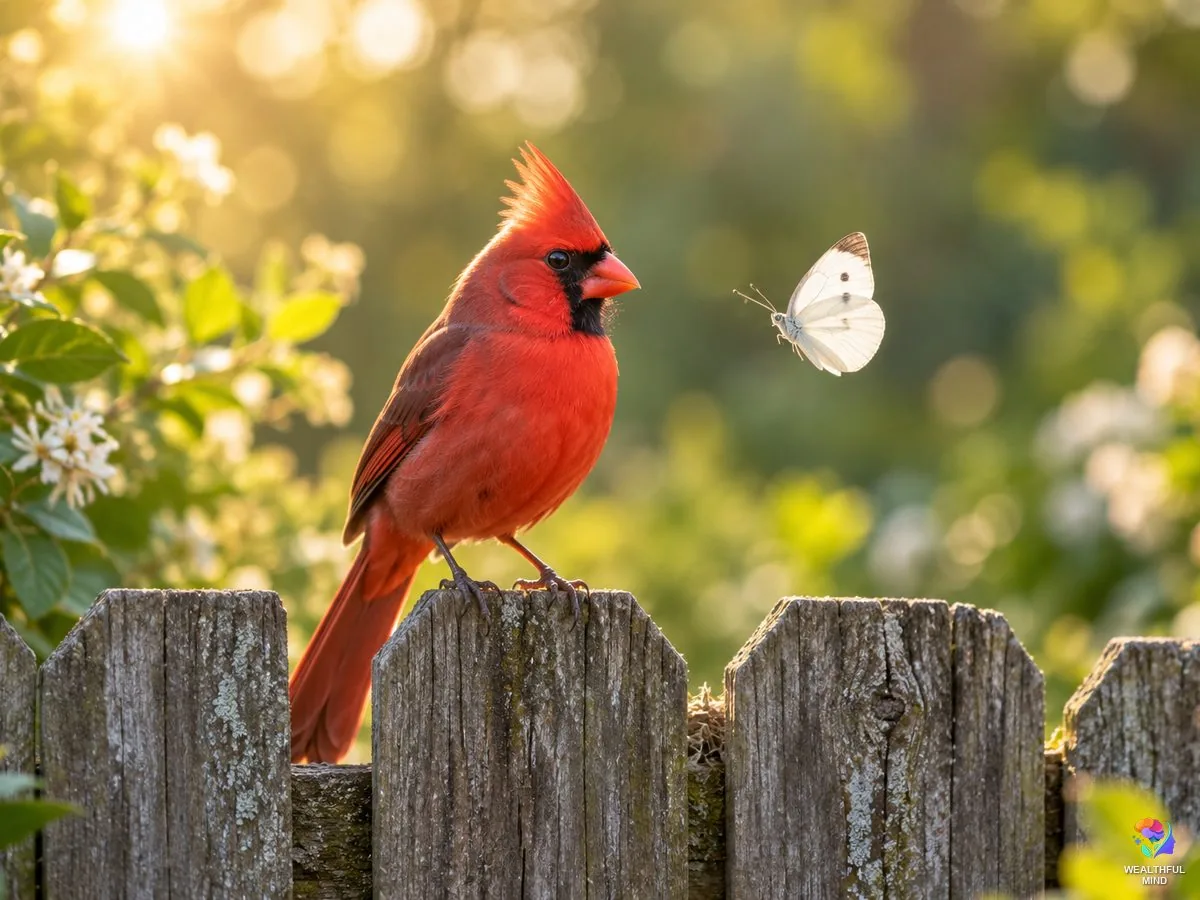
Many families read the red cardinal the same way, and our page on what a cardinal means when it visits covers that sign. There is a full section on grief and feathers further down this page.
○ Peace and a Fresh Start
Because white stands for peace in so many places, a white feather is also read as a sign that a fight is ending or a new chapter is beginning.
You might find one after a breakup, a move or a big exam result. Many people take it as permission to start again, gently and without guilt.
○ A Yes When You Asked for a Sign
Some people ask for a white feather on purpose. You ask out loud, or note it in your journal: if this is the right choice, show me a white feather by Sunday.
If one turns up, many believers read it as a yes. If Sunday comes and goes with no feather, plenty of people take that as a gentle “not yet”, and then make the choice with their own good sense.
One honest tip. White feathers are common in a lot of places, so they make a difficult sign to test.
If you want a clearer answer, ask for something rarer, like a yellow feather.
Where You Found It Changes the Message

Where you found the feather can matter as much as its color. A feather that seems placed just for you feels very different from one in a park full of geese.
○ A White Feather in Your Path
A feather lying right where you are about to step is read as a sign that you are on the right road. Many people take it as encouragement to keep going with whatever was on your mind at that moment.
So pause and notice what you were thinking just before you saw it. Believers say that thought is the real message.
A feather on your car, your doorstep or your door handle is read the same way, only more personal, because it landed on your things.
○ A Feather Inside the House
A feather indoors, where no bird could have got in, can feel like the strongest sign of all. Believers say it is a message meant only for you, often from a loved one who knew that home.
Before you settle on that, check the everyday explanations. Down pillows, comforters, puffer coats and feather cushions all shed now and then, and a breeze through an open door can carry a feather a surprisingly long way.
You can hold both at once.
Plenty of people work out that the feather came from the couch, and they still take its timing as a sign.
○ A Feather Floating Down in Front of You
A feather drifting down out of a clear sky, right in front of your face, is read as perfect timing. Many people interpret it as a direct answer to the question you were carrying, or a sign that someone is watching over you right now.
Look up, too. A bird preening on a roof or a wire above you is the usual source, and noticing it does not have to take the magic away.
○ Small White Fluffy Feathers
Tiny, fluffy white feathers are down, the soft layer that keeps a bird warm under its outer feathers. Because they are so soft, many people read a small white feather as love and reassurance, like a hug from someone who cannot be there.
Down is also what fills pillows and winter coats.
So if you find a small fluffy feather on your bed, start by checking your pillow.
○ Feathers Everywhere
If you find feathers every day for a week, believers say a message is trying hard to reach you. It is a beautiful thought, and it has a practical partner.
Birds swap out worn feathers all the time, and in molting season every lawn and hedge has a few lying in it (there is more on molting further down).
That is why a pile of feathers in one week means less than a single feather at the exact moment you needed it.
Does a White Feather Mean a Loved One Is Near?

Many people believe it does, and for them the feather is a real comfort during a terrible time.
On grief forums the same moments come up again and again. A white feather by the hospital bed, one floating down at the graveside, one on the doorstep on the first birthday without them.
If that is you, you do not have to prove anything to anyone. A feather that helps you feel close to them has already done something good. Some people feel that closeness as a ringing in the ears, and our page on whether your ears ring when a spirit is near explains where the belief comes from.
You might be wondering what to do with it next. Grieving people often keep the moment rather than the feather: a clear photo saved with their pictures, a quick sketch with the date and place, or a short note to the person describing what happened, as if they could read it.
A feather you are allowed to keep, like one from a pillow or a city pigeon, can go in a small jar, a locket or a frame. In the US, a wild bird’s feather is better kept as a photo (the law section below explains why).
Not everyone finds feathers, and some people find them constantly, wherever they go.
One woman on a grief forum laughed and cried at once when she was told white feathers mean a loved one is thinking of you. She lives among white ibis and cockatoos, and sees white feathers every single day.
So if you never find one, nothing is wrong with your love for them or with how you are coping. A feather can bring comfort on a hard day. It cannot take the grief away, and it does not need to.
If grief is making it hard for you to sleep, eat or get through the day, please talk to someone you trust, or to your doctor.
Some people notice white butterflies in the weeks after a loss as well, and the white butterfly spiritual meaning has a page of its own. For others it is a yellow one, and our page on a yellow butterfly after someone dies shares their stories.
Black Feather Meaning
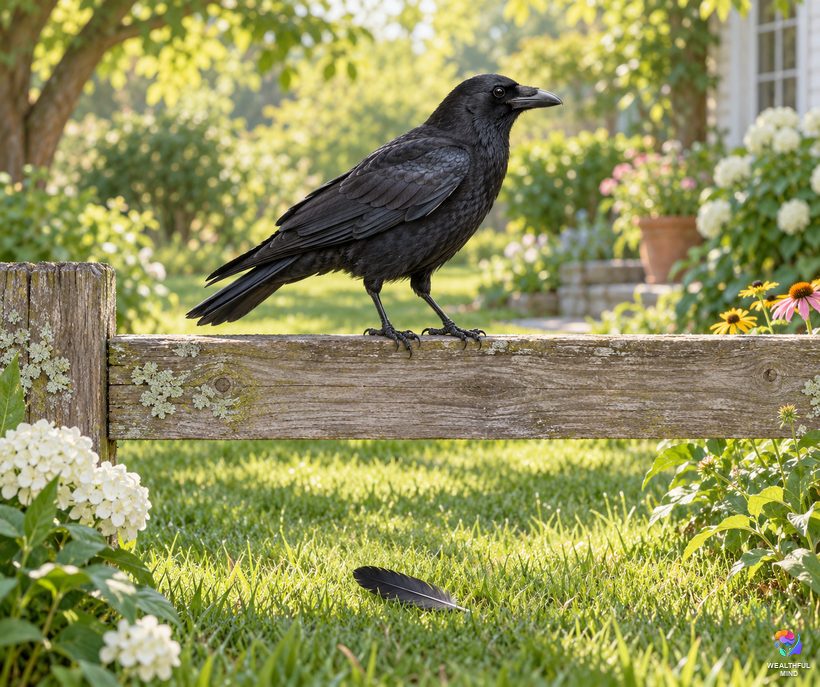
A black feather is read as protection, not bad luck. Many people understand it as a sign that you are shielded during a difficult time, or a call to pause and look after yourself before you move on.
You may have heard that a black feather is an omen of death. We would not read it that way.
Most black feathers come from the most ordinary birds around you, like crows, grackles, starlings and blackbirds.
There is a wonderful real fact here. The Cornell Lab of Ornithology says feathers with melanin, the pigment that makes them dark, are stronger and wear out more slowly than feathers without it.
So the black feather in your hand really is the tough one, which fits its meaning of protection.
Crows carry a whole collection of beliefs of their own. If a crow dropped yours, read our page on crow symbolism and what a crow sighting means.
Other Feather Colors and What They Mean
The color meanings you see online are not an old tradition. They follow a modern system built on chakra colors and color therapy, and the writer of Beliefnet’s angel feather guide says openly that the list there was put together that way. If chakras are new to you, our guide to the seven chakras explains the colors.
That does not make the meanings useless. It means they are a tool you can try, not a rule you have to follow completely.
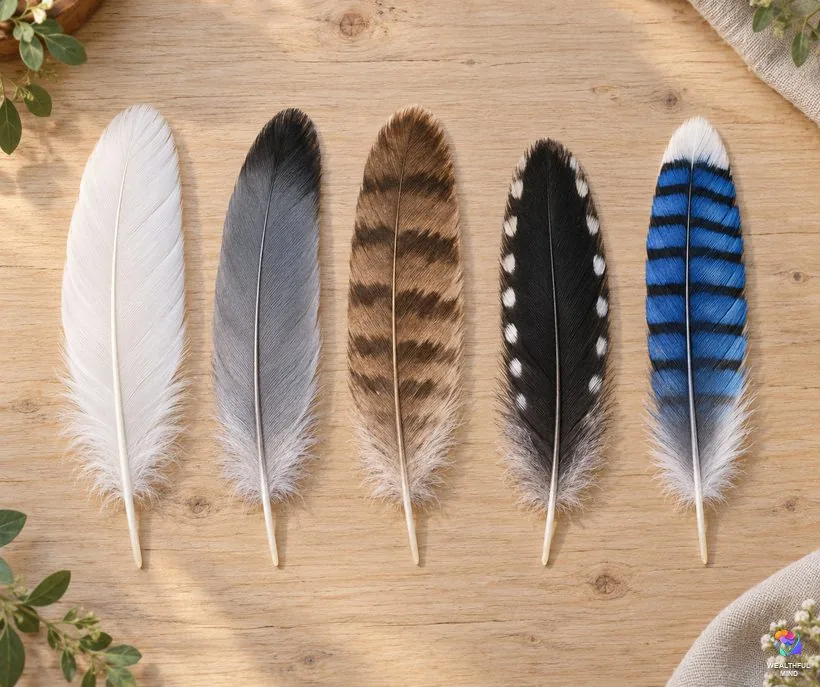
Here is the quick version, color by color, with one small way to use each meaning:
- White: angels, a loved one nearby, peace. Try this: think of who was on your mind.
- Black: protection, a pause. Try this: rest before your next big step.
- Gray: calm, peace in the middle of a mess. Try this: slow down for a day.
- Blue: speak your truth, calm talk. Try this: say the thing you have been holding back.
- Brown: grounding, home, feeling steady. Try this: spend time outside or with family.
- Black and white: balance, two sides coming together. Try this: look for the middle way in a choice.
- Pink: love and kindness. Try this: send someone a kind message.
- Red: courage and energy. Try this: do one brave thing this week.
- Orange: creativity and a fresh burst of energy. Try this: start the project you keep putting off.
- Yellow: joy and a sunny mood. Try this: write down what made you smile.
- Green: growth, money, new beginnings. Try this: pick one goal to grow this month.
- Purple: intuition, spiritual sight. Try this: trust your gut on a small choice.
If you find a bright pink, orange or purple feather in town, it is usually from craft supplies or a costume (a party boa sheds a lot). Its meaning can still feel personal and real to you.
○ Gray Feather Meaning
A gray feather is read as calm, and as peace in the middle of a messy time. Many people take it as a sign to stop rushing and sit with things for a while before you decide anything important.
Gray (or grey, if you spell it the British way) is also the color of the city pigeon. Rock pigeon feathers are one of the few kinds the federal feather law does not cover, so a gray pigeon feather is one you can usually keep. The full rules are in the section on keeping a feather, below.
○ Blue Feather Meaning
A blue feather is read as a sign to say what you really think, and as calm, honest talk with the people you love. Some people also take it as a reminder that you are protected while you say something uncomfortable.
Here is a fact we love. Blue feathers almost never hold blue pigment.
Tiny air pockets inside the feather scatter the light so it looks blue. The Cornell Lab of Ornithology notes that a blue jay feather held up against the light looks brown.
If you live in North America, a blue feather you find is very likely from a blue jay. Our page on the blue jay spiritual meaning covers that bird.
○ Brown Feather Meaning
A brown feather is read as grounding. Many people interpret it as a sign to look after home, family and your body, or to keep your feet on the ground during a big change.
Brown feathers are everywhere, from sparrows and wrens to hawks, owls and female ducks.
So a brown feather on its own is ordinary, and its timing is what deserves your attention.
○ Black and White Feather Meaning
A black and white feather is understood as balance, the light and the dark sides of a situation coming together. In twin flame circles it is also taken as a sign of two souls who belong together.
You may read that black and white feathers in the Bible stand for good and evil. No Bible verse says that. It is a modern reading, and fine to keep as one.
If you are in North America, these feathers often come from magpies, chickadees, downy woodpeckers and loons.
○ Gray and White, Brown and White Feathers
Gray and white is read as peace and calm together, a sign that a stressful time is settling down for you. Brown and white is read as a fresh start with your feet on the ground, like a new job or a new home that feels safe.
A feather with an odd white patch can even come from a dark bird. Canada geese, American crows, dark-eyed juncos, common grackles and house sparrows are among the birds that often show stray white patches.
White Feathers in Faith and History

White feathers have meant very different things to different people. Some of these meanings are thousands of years old.
One of them is not kind at all.
○ What Does the Bible Say About White Feathers?
The Bible never mentions a white feather. Search the King James Version for feather and feathers, and no verse that comes up says anything about white ones.
The best known feather verse is Psalm 91, verse 4, which reads in that translation: “He shall cover thee with his feathers, and under his wings shalt thou trust.” There the feathers are a picture of God’s protection, like a mother bird sheltering her chicks.
Other feathers in the Bible belong to an ostrich in Job chapter 39, verse 13, and to eagles “full of feathers” in Ezekiel chapter 17. Psalm 68, verse 13 gives a dove covered in silver, “her feathers with yellow gold”.
Christians do not agree about feather signs. Many find genuine comfort in them.
Others are wary. The Catholic ministry Women of Grace calls the white feather idea “nothing more than folklore”, and suggests letting a feather remind you to pray for the souls of those you have lost.
If signs sit uneasily with your faith, that prayer idea is a good middle path. You can read Psalm 91 and let the feather simply remind you of it.
○ The Feather of Maat in Ancient Egypt
In ancient Egypt a feather stood for truth. In the Book of the Dead of Hunefer, held by the British Museum, the dead man’s heart sits on one side of a set of scales. On the other side is the feather that symbolizes Maat, the British Museum explains.
Maat meant truth and the right order of things. The museum does not say the feather was white. So if you see this one quoted as a white feather sign, remember it is a feather of honesty, not comfort.
○ The Raukura, a White Feather of Peace in New Zealand
If you want a white feather that truly means peace in a living tradition, this is it. The raukura of Parihaka in Taranaki is a single albatross feather worn by the people, and it symbolizes peace. It is understood as a sign of the Holy Ghost’s blessing at Parihaka’s founding.
The prophets Te Whiti-o-Rongomai and Tohu Kākahi led Parihaka as a center of non-violent resistance to settler laws until both men died in 1907.
The Port Nicholson Block Settlement Trust calls the raukura an important symbol to the tribes who affiliate to Taranaki, in the form of a white feather or a plume of white feathers. The Trust says it is worn on the head, held in the hand or placed on the chest. A plume of three recalls Luke chapter 2, verse 14: “Glory to God on high, Peace on earth, Goodwill to all mankind.”
○ What About Native American Feather Traditions?
Plenty of feather pages claim that “Native Americans” see white feathers as peace and purity.
None of them names a Nation or gives a source, and our own search found nothing either. Until someone can show where it comes from, we are leaving that claim out.
What is well documented is the eagle feather. Native Americans have long used eagle feathers in ceremonies and regalia, and the federal government runs a National Eagle Repository that sends bald and golden eagle feathers to enrolled members of federally recognized Tribes for religious use.
○ Why a White Feather Meant Cowardice in World War I Britain
In Britain, a white feather once meant you were a coward. An 1811 edition of Francis Grose’s slang dictionary traces it to the gamecock, where a white feather was taken as proof the bird was not of the true fighting breed.
The campaign itself began on 30 August 1914, when Admiral Charles Penrose Fitzgerald asked thirty women in Folkestone to hand white feathers to men not in uniform. The historian Nicoletta Gullace shows that the idea was borrowed from A. E. W. Mason’s 1902 novel The Four Feathers, and that the feathers often went to wounded soldiers recovering in ordinary clothes.
The idea spread quickly. The Order of the White Feather encouraged women to pressure their family and friends into enlisting, and feathers went to young, fit men who had not volunteered, as a way of calling them cowards.
Official badges followed, so that men serving their country in other ways, such as war work, could prove it. A Silver War Badge went to men discharged because of wounds or sickness.
The need for those badges faded after conscription began in 1916, and the white feather campaign faded with it. Even so, Gullace found feathers were still being handed out now and then as late as 1918.
Wolverhampton City Archives holds a white feather sent with a mocking letter to a local architect, who had been excused from service on medical grounds. The Archives believe it is one of only two known to survive.
So if an older relative in Britain frowns at a white feather, this history is probably why.
Why Feathers Turn Up in Everyday Life
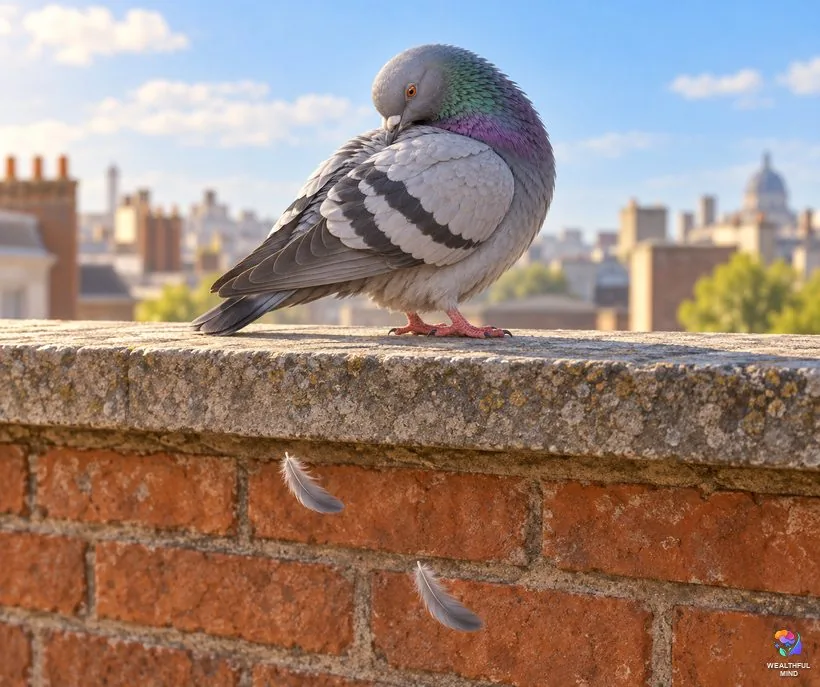
Feathers turn up because birds lose them constantly. A feather is a dead structure, like your hair or nails, so a damaged one cannot heal and has to be replaced in a molt.
A molt can replace every feather or only some, and the pattern changes by species, by bird and even by year. A bird that loses a whole feather also starts growing it back straight away. That is why you can find a feather in almost any season.
White feathers have their own quiet story.
Feathers with no pigment are the weakest of all, which is why many all-white birds have black wingtips, where the wear is hardest. So the softest, most delicate feather is the one people read as the gentlest sign.
Indoors, the pillows and coats from earlier are the usual source, along with pets and a breeze through an open window.
None of this cancels the meaning, and nothing here is meant to. In our view the most honest way to read a feather is to know where it probably came from, and then ask why it found you today.
Should You Keep a Feather You Find?

In the US, usually not.
This surprises a lot of people, including many in spiritual communities who have kept feathers on their altars for years.
○ What US Law Says
When people ask whether they can keep a feather they found, the US Fish and Wildlife Service puts it plainly: “The simple answer is no.” The Migratory Bird Treaty Act bans owning the feathers of native North American birds without a permit, however you came by them. That includes feathers a bird shed on its own and feathers from birds killed by cars or windows. Permits go to museums and universities for research or teaching, and only rarely to individuals who want to keep feathers.
The Act protects over 1,100 species of birds, and bald and golden eagles have a separate law of their own. That reaches most of the birds people find feathers from, like cardinals, blue jays, crows, owls, hawks, gulls and egrets. The exceptions are narrow: feathers from legally hunted waterfowl and other migratory game birds, and the use of feathers by Native Americans.
A few common birds fall outside the Act. The rock pigeon, the mute swan and the domestic goose are on the federal list of introduced birds it does not cover. House sparrows and European starlings are outside it too, because their bird families are not in the treaties.
Even for those birds, you still have to follow your state’s rules. And because it is hard to tell which bird a feather came from, the US Fish and Wildlife Service sums it up as “if in doubt, do not keep it.” That matters for white feathers in particular, because yours might be from a mute swan, which the Act does not cover, or from a native swan, egret or gull, which it does.
The rules are also under review. In September 2024 the Service asked federally recognized Tribes for input on questions like “who can pick up molted feathers?” So check the current federal rules before you keep anything. Readers in other countries have their own wildlife laws, so check those first.
○ Handle It Safely
Leave any feather that is lying near a sick or dead bird. The CDC advises avoiding direct contact with sick or dead wild birds and watching them only from a distance.
After you touch any feather, wash your hands with soap and water. The UK government says bird flu can pass to people through close contact with infected birds, “their feathers or poo”, and advises washing your hands after touching feathers. New Jersey’s health department gives the same handwashing advice.
If you found the feather beside a bird that has died, our page on finding a dead bird and what it means covers that moment too.
○ What to Do Instead
You can keep the meaning without keeping the feather.
- Take a photo. Get close, use natural light, and save it in an album with the date.
- Draw it. A quick sketch in your journal often means more than the feather itself would.
- Write the moment down. Note where you were, who you were thinking about and how you felt.
- Say thank you. Many people say a small thank you out loud, to God, their angels or their loved one.
- Leave it where it was. Some people like to think of the feather going back to the earth, still doing its job for nature.
How to Read Your Feather in Four Steps

Our signs guide has a method you can use for any sign. Here it is shaped especially for feathers.
- Note where and when. Was it inside or outside, in your path or floating down, and what was on your mind right then?
- Name your first feeling. Write it down before you look up any meaning, so a list online does not talk you out of it.
- Check the everyday side. Look for a pillow, a coat, a bird above you or a molting season, so you know what you are working with.
- Choose one small action. Ask what the feather would be telling you if it were a message, then do one small thing about it today.
Here is how that looks in real life. Say you find a small white feather on your bedroom floor the night before your first day at a new college.
You were worried about not making friends. Your first feeling was a soft, surprising calm.
Your pillow is a feather one, so that is probably where it came from.
Your reading might still be that you are cared for and ready for tomorrow. Your small action could be to text an old friend and tell them about your first day.
A feather is light enough to blow away in a second.
What it reminds you of can stay with you for a lot longer.
Your White Feather Questions
Is a white feather a good sign?
Yes, for most people who believe in feather signs. A white feather is read as peace, protection and a hello from an angel or a loved one who has died. It is a belief rather than proof, so take the comfort it gives you and let the meaning that feels right to you lead.
What does it mean if a feather crosses your path?
A feather in your path is read as a sign that you are on the right road. Many people take it as encouragement to keep going with whatever was on your mind when you saw it, so notice that thought before you walk on.
Does a white feather mean a loved one is near?
Many people believe it does, especially when the feather turns up at a funeral, on an anniversary or in their old room. If it brings you comfort, that comfort is real. If you never find one, nothing is wrong with your love for them or with how you are coping.
What does the Bible say about white feathers?
Nothing directly. No verse in the King James Version mentions a white feather. The best known feather verse is Psalm 91, verse 4, where God covers you with his feathers as a picture of protection. Christians differ on feather signs, and some, like the Catholic ministry Women of Grace, call the white feather idea folklore.
Should you keep a feather you find?
In the US, usually not. The US Fish and Wildlife Service says the Migratory Bird Treaty Act makes it illegal to keep the feathers of native birds without a permit, even ones that fell out naturally. Feathers from rock pigeons, mute swans, house sparrows and European starlings fall outside that federal law, though state rules still apply, and if you are not sure, take a photo instead. Wash your hands after touching any feather.
What does a black and white feather mean?
A black and white feather is read as balance, two sides of a situation coming together. In twin flame circles it is also taken as a sign of two souls who belong together. In North America these feathers often come from magpies, chickadees, downy woodpeckers and loons.
Is a black feather a bad omen?
We would not read it that way. A black feather is usually read as protection and a reminder to pause and look after yourself. Black feathers also happen to be the strongest kind, because the melanin that makes them dark helps them resist wear, according to the Cornell Lab of Ornithology.
What does it mean when a feather floats down in front of you?
Many people read it as perfect timing, a direct answer to the question you were carrying, or a sign that someone is watching over you. Look up as well, because a bird preening on a roof or a wire is the usual source, and you can hold both readings at once.
Why did women hand out white feathers in World War I?
In Britain a white feather was an old symbol of cowardice. On 30 August 1914 Admiral Charles Penrose Fitzgerald asked thirty women in Folkestone to hand white feathers to men not in uniform, and the idea spread across the country. Feathers often went to wounded soldiers and war workers, so official badges were made to protect them. The campaign faded after conscription began in 1916, though the historian Nicoletta Gullace found feathers still handed out now and then into 1918.