In the oldest stories, the raven spiritual meaning is a hopeful one: the raven is mostly a messenger and a provider, not a curse. Odin’s two ravens bring him news of the whole world, ravens carry food to the prophet Elijah, and in Tlingit and Haida stories Raven sets the daylight free and finds the first people. The darker name you may have heard comes from its taste for dead animals and from writers like Shakespeare and Poe. So if a raven just crossed your path, first check that it really is a raven. Then read it by what is going on in your life.
Quick pick
What Did the Raven Do?
Find your moment below, then jump to what it means.
- Not sure it is a raven? Listen first: ravens croak, crows caw
- Worried it is a bad omen? Mostly a good or neutral bird in the old texts
- A raven following you? Ravens trail people for food; many read it as being watched over
- A raven at your house or window? Often news for you, after you check for food or a nest
- Seeing ravens after a loss? Many find them comforting; a raven does not bring a death
- Two ravens together? Usually a pair that holds the same patch all year
Keep reading below Ravens in different traditions Ravens in the Bible The Tower of London legend Feathers and safety Questions
This is one of our bird pages. If you want to know what birds in general are said to carry, start with birds as spiritual messengers. If you want a way to read any kind of sign, see our guide to signs from the universe.
Is It a Raven or a Crow?
Before you read any meaning into your bird, make sure it is a raven. Plenty of big black birds that get called ravens turn out to be crows, and the two are easy to mix up.
Here is a quick check you can do the next time it shows up.
- Listen to it. Ravens give a deep, throaty croak, while American Crows have a strong, harsh caw. The Cornell Lab of Ornithology says the voice is usually the best clue.
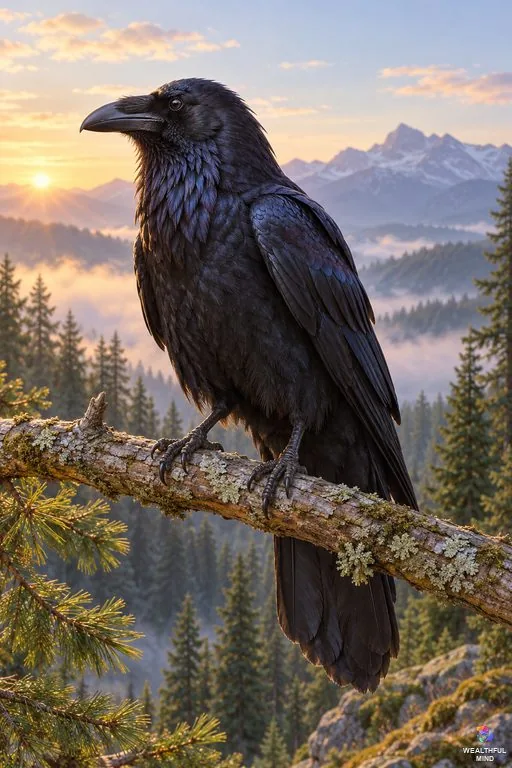
- Look at the size. The Common Raven is the largest of all songbirds, about the size of a hawk, so it will look much larger than any crow you know.
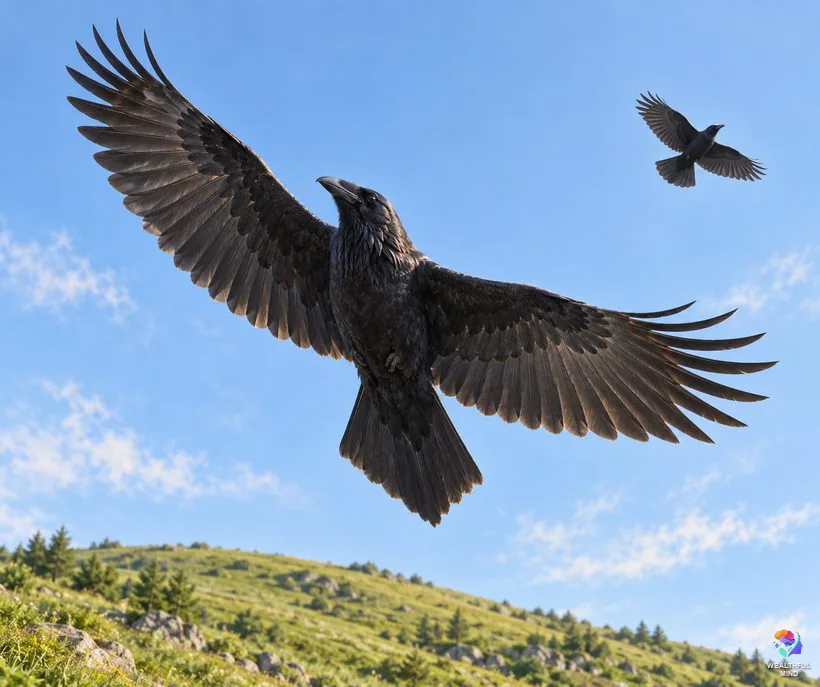
- Watch the tail as it flies. A raven’s tail is wedge-shaped, and up close you will see a very thick bill and shaggy throat feathers.
- Count the birds. Ravens are less sociable than crows, so you will often see one alone or two together.
Where you live matters too. Ravens do well around farms and isolated houses, but in larger towns American Crows often take their place. So if you see a big black bird on a city lamp post, it is most likely a crow. In the Southwest, you even have a second raven to tell apart, the Chihuahuan Raven.
If your bird turned out to be a crow, you will find its meanings in our guide to crow spiritual meaning.
What Does It Mean When You See a Raven?
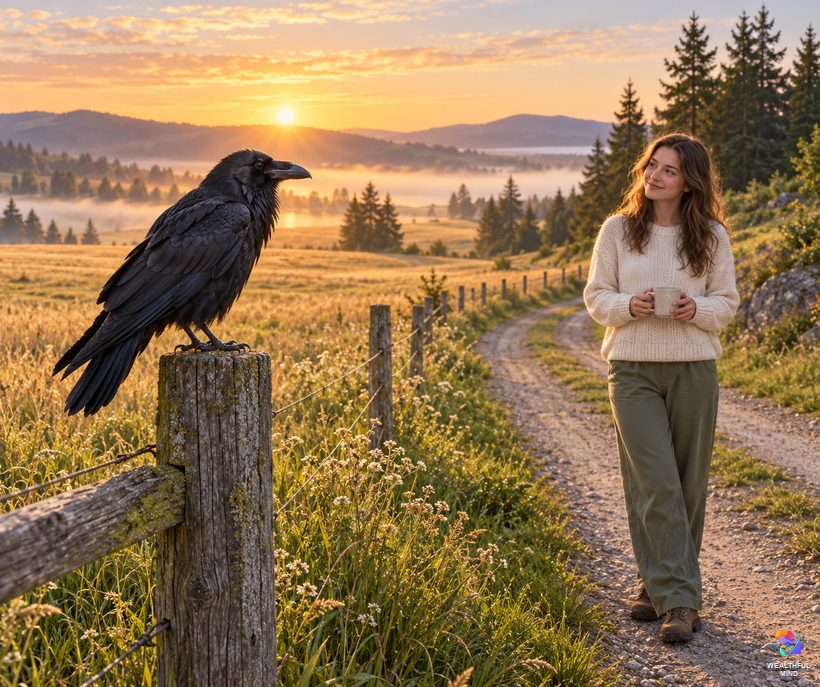
The most common reading is news. Odin’s ravens flew out over the world every morning and came back with what they had seen and heard. So if a raven lands near you, many people would say a message, an answer or some news is on its way to you.
Change is the next most common. The Aktá Lakota Museum says Lakota lore describes the raven, kȟaŋği tȟáŋka, as a creature of change that was called on in ritual so that visions could be clarified. If you are moving house, starting college or ending a friendship, a raven is often read as a sign that the change is meant to happen.
You might also take it as a nudge to think clearly. One of Odin’s ravens is named for thought (more on that below), and real ravens are among the smartest of all birds. If you have a decision hanging over you, the raven is read as a reminder to stop, gather the facts and trust what you already know.
Many people read something into the black feathers, too: mystery, the night, the part of your life you cannot see yet. Black here means the unknown, not evil. (Two of the stories below even say the raven started out white.)
Which reading fits you depends on what was on your mind when it appeared.
○ Is a Raven a Good Omen or a Bad Omen?
We think it is mostly a good omen, or at worst a neutral one. If you look at the old stories, ravens fly out from Noah’s ark, feed a prophet, bring a god his news and give the world its light.
The bad-omen side grew from two plain roots: ravens eat dead animals, and poets and playwrights made them a symbol of death. You can read that history in why ravens got a dark reputation.
We do not think a raven can tell you that a death is coming. If you saw one shortly before a loss, that is a painful coincidence, not a cause.
Raven Spiritual Meaning in Different Traditions

Plenty of pages say “Native Americans believe” or “in Celtic myth” without naming anyone. Here is what the actual texts and nations say.
○ Odin’s Ravens, Huginn and Muninn
In Norse myth, two ravens sit on the god Odin’s shoulders and tell him all they hear and see. Snorri Sturluson’s Prose Edda says Odin sends them out at dawn to fly over the whole world, and they come back by breakfast time. That is why he is called Rafnagud, the “raven-god”.
You may have read that their names mean “Thought” and “Memory”. As norse-mythology.org explains, Huginn does come from the Old Norse word for thought. But Muninn comes from a word closer to thought, desire or emotion, so “memory” is a loose fit at best. In other words, the two ravens are Odin’s own mind, flying out into the world.
You can even find the raven on a Viking battle flag. The Anglo-Saxon Chronicle, for the year 878, says the English captured a Danish war-flag “which they called the RAVEN”.
So if you follow the Norse gods, or you simply love the stories, you can read a raven as a sign that you are being watched over. It can also mean it is time to find things out before you act.
○ Raven Who Freed the Sun
If you grew up in Southeast Alaska, you may know the Tlingit story of the Box of Daylight. In the Sealaska Heritage Institute’s retelling, Raven (Yéil) was once pure white, and the world was dark. A greedy chief kept the stars, the moon and the sun in carved boxes. (The retelling notes that the Tlingit really had clan leaders, not chiefs.)
Raven turned himself into a pine needle and slipped into the cup of the chief’s daughter. She swallowed him and later gave birth to a baby boy, who was really Raven.
The baby cried until his grandfather let him play with each box in turn. One by one, Raven let the stars, the moon and the sun out into the sky. When he was trapped, he squeezed out through the smoke hole, and the soot turned every feather black.
The Smithsonian’s National Museum of the American Indian told this story in an exhibition of work by the Tlingit glass artist Preston Singletary. It calls Raven the creator of the world and the giver of the stars, moon and sun.
For many people on the Northwest Coast, Raven is not an omen at all.
He is family. The Sealaska Heritage Institute explains that every Tlingit belongs to one of two halves, called moieties: Raven or Eagle. The Tsimshian have four such groups, called phratries: Raven, Wolf, Eagle and Killerwhale.
○ Raven and the First People
The UBC Museum of Anthropology tells the Haida legend of how Raven, alone one day on Rose Spit beach on Haida Gwaii, found a clamshell with small creatures peeking out of it. He coaxed them out, and they became the first Haida.
You can see this moment in wood. The Haida artist Bill Reid carved it as a large sculpture, The Raven and the First Men, unveiled on April 1, 1980, and now a favourite with the museum’s visitors. Reid saw his Raven as a “completely self-centred, uninvolved bringer of change”, who changes the world by accident.
So if you meet Raven in these stories, keep in mind he is a trickster, not a saint. If a raven catches you off guard or makes you laugh, some people would say that is Raven’s way: change that arrives sideways.
○ Ravens in the Bible
You may be surprised to learn that the raven is the first bird out of Noah’s ark. In Genesis chapter 8, verses 6 to 7, Noah opens the window and sends out a raven, which flies “to and fro” until the waters dry up. Then he sends the dove.
The best-known raven story in the Bible is Elijah’s. In 1 Kings chapter 17, verses 2 to 6, God tells the prophet to hide by the brook Cherith and says, “I have commanded the ravens to feed thee there.” The ravens bring him bread and meat every morning and every evening.
When people ask what it means when God sends a raven, this is the story they have in mind. Most take it as a promise of being looked after in a hard season.
Jesus used ravens to calm worried people. “Consider the ravens: for they neither sow nor reap; which neither have storehouse nor barn; and God feedeth them,” he says in Luke chapter 12, verse 24. Job chapter 38, verse 41, and Psalm 147, verse 9, make the same point about God feeding the raven and its crying young.
You will find a harder side too. Leviticus chapter 11, verse 15, puts ravens on the list of birds not to be eaten, and Proverbs chapter 30, verse 17, warns that ravens will pick out the eye of a child who mocks a parent. Read as a whole, though, the raven in scripture is a bird God feeds and uses, not a bird of evil.
○ The Raven in the Quran
If you are Muslim, you may know the raven from the Quran’s telling of the Cain and Abel story. In chapter 5, verse 31, after one brother kills the other, God sends a bird to scratch the ground and show him how to cover his brother’s body. The killer cries out that he could not even be like this bird, and he is filled with regret.
Some English translations call the bird a raven, and others call it a crow. Either way, it is a teacher here, linked with burial and remorse rather than with evil.
○ Why Ravens Got a Dark Reputation
The first reason is food. Ravens regularly eat carrion (dead animals) and garbage. And you can see people noticing it more than a thousand years ago. A poem in the Anglo-Saxon Chronicle, entered under the year 938, has the winners of a battle leave the dead to “the swarthy raven”.
Stories did the rest.
In Ovid’s Metamorphoses, the raven was white until it told Apollo about Coronis, and it was turned black as a punishment for talking too much. That is the second white raven on this page, from a culture with no link to the Tlingit at all.
In Shakespeare’s Macbeth, Lady Macbeth hears doom in a raven’s croak. Then, in early 1845, came Edgar Allan Poe’s “The Raven”, with its famous line “Quoth the Raven, ‘Nevermore.'”
You may like this detail: real ravens can learn words. One raised by people was taught to say “nevermore”.
None of this makes the raven evil. It makes it a bird that showed up where death was, and writers who noticed.
○ The Tower of London Ravens: How Old Is the Legend?
You have probably heard that if the ravens ever leave the Tower of London, the kingdom will fall. The legend is real. It is just much younger than it sounds.
- What the Tower of London says: by tradition, the kingdom and the Tower will fall if its resident ravens ever leave, and Charles II ordered that at least six ravens be kept there.
- What historians found: Boria Sax found no royal decree and no mention of ravens in scholarly biographies of Charles II. He traces the earliest mention of ravens at the Tower to 1883, and the “Britain would fall” legend to the Blitz of the Second World War, when two ravens were killed. In Boria Sax’s words, the Tower ravens “are entirely a Victorian institution”. The Tower’s own historian, Geoff Parnell, found nothing earlier than 1895.
So the birds have lived there for about 140 years, and the prophecy dates from the 1940s. That does not make it a bad story, just a modern one. You can still meet the ravens at the Tower of London today, and one of them is named Poe.
○ Celtic Lore: Mostly Crows
Almost every raven page says the Irish war goddess, the Morrígan, appears as a raven. The Electronic Dictionary of the Irish Language says something a little different. Its entry for Badb, a war goddess linked with the Morrígan and Macha, gives her bird as the hooded crow, “in which form the goddess appeared”.
So in Irish lore, the battle bird is a crow.
If the Morrígan is the reason you are here, the crow page linked above is the better fit for you.
Common Raven Encounters and What They Mean
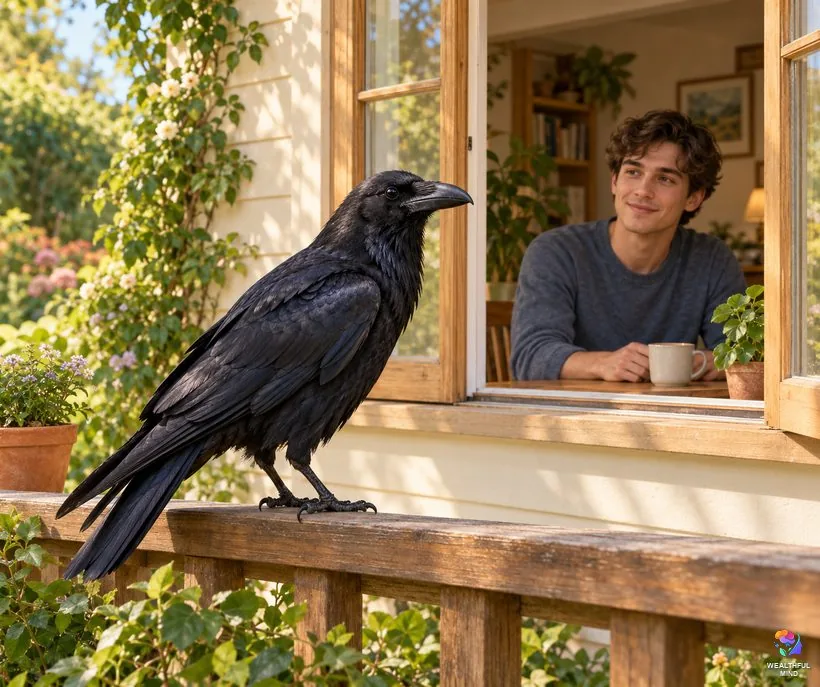
○ A Raven Following You
Picture this. You are walking home on a quiet road, worried about an exam result, and a raven flies from fence post to fence post just ahead of you, croaking.
There is a plain reason first.
If a raven follows you, it is doing what ravens have done across the Northern Hemisphere for centuries, trailing wagons, sleds and hunting parties in the hope of a quick meal. In one field experiment in Wyoming, ravens flew toward the sound of gunshots, most likely to find what hunters leave behind.
A 2026 study in Yellowstone, reported by the Max Planck Society, tracked 69 ravens and 20 wolves. It found that ravens remember where wolves often hunt and keep checking back there for food.
So a raven that keeps pace with you may simply be wondering what you will drop.
The spiritual reading sits next to that, not against it. Many people take a raven that follows them as a sign that someone is watching over them, or that they are on the right road. If you follow Odin, you may read it as the god keeping an eye on you.
○ A Raven at Your House or Window
You can draw ravens to your yard without meaning to. Seed, grain, pet food or a garbage can with a loose lid will do it. Ravens also nest on cliffs, in tall trees and on things like power-line towers, telephone poles, billboards and bridges. So if one keeps landing on your roof, check whether there is food or a nest nearby.
As a sign, a raven at the house is often read as news for the whole household, or as a visitor checking in on you. A raven at your window is read more personally, as a message meant just for you.
You might like to write a line in a journal each time it comes. After a few visits, you can look back and see what was going on in your life each day.
If a raven or any big bird gets inside, stay calm. Open a door or window wide, keep your pets in another room and step back so it can see the way out. (It may well be a crow, too.)
○ A Raven After Someone Dies
If you have just lost someone and ravens seem to be everywhere, you are not alone. Many people notice ravens after a parent, a friend or a pet has died.
One person on Reddit who lost their dad wrote that they know some people link ravens with bad omens, but they do not feel that way. They find the birds comforting and leave food out for them.
You may feel a raven is a sign that your loved one is still close, or that they are at peace. Many people take it that way. Others find the cardinal does this for them, and you can read about cardinals as signs from loved ones on its own page.
Ravens got linked with death because they eat what has died, not because they bring death. A raven did not cause your loss, and it was not a warning you missed.
Some people never see a raven after a loss, and that says nothing about them or about the person they miss.
Your grief keeps its own pace, bird or no bird.
On the days the loss feels like more than you can hold, let someone in, whether that is a friend, someone in your family or a teacher you trust. Sharing even a little of it can make the next day lighter.
○ Seeing Two Ravens Together
If you keep seeing two ravens, you are most likely looking at a couple. Breeding pairs hold a territory and try to keep all other ravens out of it throughout the year, and the pair stay together all year round.
If you are lucky, you may see them court. The two soar high together, and when they perch they touch bills and preen each other’s feathers. That patch of sky is their home, and the two you keep seeing are probably the same two.
For believers, two ravens often bring Huginn and Muninn to mind. Some read a pair as a sign of balance, or of a partnership in their own life.
If you came here wondering about love, the pair is the closest the real bird comes. We could not find any old tradition that makes the raven a love sign, though.
○ Seeing Ravens Everywhere
You might really be seeing more of them. The Common Raven disappeared from much of the eastern and Midwestern United States before 1900, and it has been spreading back in recent decades.
One study in the journal Southeastern Naturalist looked at 64,611 raven records in central and southern Appalachia, from 1950 to 2016, and found a 40% larger range. Ravens are now back in Alabama, Kentucky, Ohio and Tennessee.
If you see a whole crowd of them, there is a reason for that too. Large groups of ravens are probably young birds that have not paired up yet. In winter, young ravens that find a carcass call others in, to outnumber the local pair.
So how rare is it to see a raven? In the West and the North, not rare at all. In much of the East, it is newly common again.
If ravens suddenly fill your days, believers say a message is getting louder. Pay attention to the moments when they turn up, more than to how many there are.
How to Tell If a Raven Is a Sign for You

Ask yourself these four questions before you settle on a meaning.
- Check that it is a raven. Use the voice, size and tail check above.
- Ask whether ravens are normal where you live. In the Rockies, a raven is an ordinary sight. In a city where you have never seen one, it stands out.
- Think back to what was on your mind. The meaning usually lives in your own thoughts at that moment, not in a list online.
- Notice whether it keeps happening at meaningful moments. Once is a nice moment. Again and again, at the exact times you are worried or deciding, is worth sitting with.
For a fuller method, the signs guide linked near the top of this page walks through four steps for reading any sign, and they work for ravens too.
We cannot tell you whether a raven was sent to you. But a moment that makes you stop and look at your life has done something useful either way.
Before You Keep a Feather or Touch a Raven

A black feather on your path can feel like a gift. In the US, though, keeping it is against the law without a permit.
The Common Raven and the Chihuahuan Raven are both on the official US list of birds protected by the Migratory Bird Treaty Act. The US Fish and Wildlife Service says the Act prohibits keeping feathers of native North American birds without a permit, and there is no exemption for feathers that simply fell out.
A picture on your phone keeps the moment just as well, and the feather can stay where the raven dropped it. Our page on keeping a feather you found says more. Rules differ from country to country, so outside the US, look up your own before a feather goes home in your pocket.
Keep your bare hands off a dead raven. The CDC advises against bare-handed contact with any dead animal, and says to use gloves or a plastic bag turned inside out if you must move one. It also suggests checking with your state health department or wildlife agency about reporting dead birds.
If you are wondering what finding one means, our page on what a dead bird means covers it. A sick or hurt raven is a job for a local wildlife rescue, not for you.
Think twice before you feed ravens, too. Food left out can bring rats and other pests, and it can lure ravens that then raid other birds’ nests. Even the Tower of London asks visitors not to feed its ravens, because they can bite when they feel their territory is threatened.
When You Hear a Croak Overhead
The next time a deep croak rolls down from the sky, look up. You might catch a pair of ravens rolling and somersaulting high above you, as these acrobatic fliers often do.
Whatever you take from it, let it make you curious about your own life, not afraid of it.
Frequently Asked Questions About Ravens
When God sends a raven, what does it mean?
Most Christians think of Elijah. In 1 Kings chapter 17, God sends the prophet to hide by the brook Cherith and commands the ravens to feed him, and they bring him bread and meat every morning and evening. So a raven sent by God is usually read as care and provision in a hard season, a sign of being looked after rather than a warning.
What did Jesus say about the raven?
In Luke chapter 12, verse 24, Jesus says, “Consider the ravens: for they neither sow nor reap; which neither have storehouse nor barn; and God feedeth them.” He used the raven to tell worried people that God feeds even the birds, and that they matter far more than birds do.
Can ravens be good omens?
Yes. In most old sources the raven is a good or neutral bird. It brings Odin his news in Norse myth, feeds Elijah in the Bible and sets the sun free in Tlingit stories. The bad-omen idea grew mostly from ravens eating dead animals and from later writers like Shakespeare and Poe.
What does it mean when a raven comes to visit you?
Many people read a raven visit as news on its way, a change that is meant to happen or a nudge to think something through. Before you settle on a meaning, look for a plain reason too. Cornell’s All About Birds guide says seed, pet food or an open garbage can will draw ravens to a yard. Then think about what was on your mind when it came.
How rare is it to see a raven?
It depends on where you live. In the western and northern parts of North America, ravens are common all year. In much of the East they are newly common again. Audubon says the Common Raven disappeared from much of the eastern and Midwestern United States before 1900 and has been spreading back in recent decades, so many people are seeing their first ravens now.
Do ravens stay in pairs?
Yes. Cornell’s All About Birds guide says ravens are often seen alone or in pairs that stay together all year, and that breeding pairs hold a territory and keep other ravens out of it. So if you keep seeing two ravens in the same place, you are probably watching the same couple at home.
Is the raven a symbol of evil?
No. No tradition on this page treats the raven as evil. In the Bible, God feeds ravens and uses them to feed a prophet, and in the Quran a raven teaches a man how to bury his brother. Its dark reputation comes from carrion, battlefield poems, Macbeth and Poe’s “The Raven”, which made it a symbol of death in stories.
What does a raven in a dream mean?
Dream readings are personal, so start with how the dream made you feel. Many people who believe in dream signs read a raven as a message, a change coming or a part of yourself asking to be heard. A calm raven is usually read as guidance. A frightening one may say more about a worry you are carrying than about the future.