Dragonfly spiritual meaning is mostly about change. If a dragonfly crossed your path, many people would read it as a sign that your life is shifting, that a lighter season is coming, or that someone you lost is close.
That idea comes from the insect’s real life, which starts underwater and ends with a short spell in the air. So we read a dragonfly as a nudge to change in small steps, and never as a bad omen.
Quick pick
What Did the Dragonfly Do?
Find the moment that matches yours, then jump to the full answer.
- Landed on you? Many take it as a blessing, and it is also using you as a lookout
- Kept following you? Read it as encouragement, and some kinds really do walk with people
- Came after someone died? Many feel a hello from them, and you can keep that comfort
- Blue, red or another color? Color shows its kind and age, and each has a modern reading
- Flew into your house? Open a window, then read it as change coming home
- Died on you or nearby? A chapter closing, not a curse
Keep reading below Where the heaven story comes from Japan’s victory insect Is it in the Bible? Dragonfly as a spirit animal Questions

Dragonflies are one stop in our tour of what different insects mean spiritually. Feathers, coins and repeating numbers get the same treatment in our signs from the universe guide, a good place to learn how sign reading works.
What Does It Mean When You See a Dragonfly?
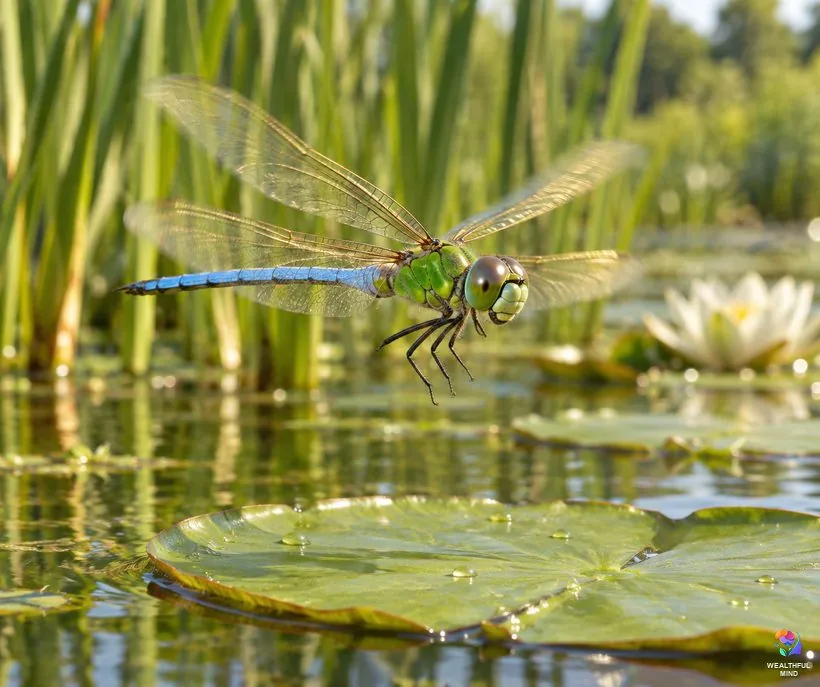
You can read a dragonfly in several ways, and more than one can be true for you.
- Change is coming, or it has already started. Almost everyone agrees on this one.
- Lightness after a heavy stretch. A dragonfly darts and hovers, so you might take it as permission to put something down.
- Seeing clearly. Its huge eyes cover most of its head, so it can be your cue to look past what only seems true.
- Someone you lost, close by. For many grieving people, this is the reading that matters most.
- Luck and courage. In Japan, the dragonfly was a lucky insect of victory (more on that below).
So which one is yours? Think back to the second before you noticed it.
If you were worrying about a move, a new school or a breakup, the change reading probably fits. If you were missing someone, it is likely about them.
And if you were just sitting by a pond on a hot afternoon? Then the dragonfly may simply be telling you to enjoy it.
○ Why the Dragonfly Stands for Change
Most of a dragonfly’s life happens where you never see it. It begins in the water as a nymph, a wingless hunter on the bottom of a pond or stream.
Encyclopaedia Britannica says this underwater stage lasts from three weeks to more than 8 years, depending on the species and the habitat. There is no cocoon. The body turns into an adult’s inside the last nymph skin, and then the insect climbs out of the water to shed that skin one final time.
Picture a nymph climbing a reed at dawn. Its back splits, the adult wriggles out, and it hangs there, soft and pale, while its crumpled wings stretch. Soon after, a creature that has only ever crawled and swum lifts off into the air.
The growing happens slowly and out of sight, and then there is one brave climb into the light. If you are partway through a long change of your own, it is a kind picture to keep.
You may also know the butterfly as a sign of change. It rests inside a chrysalis first, while the dragonfly just keeps growing until it is ready to climb.
What It Means When a Dragonfly Lands on You

A dragonfly on your hand, knee or shoulder can feel like being chosen. You might take it as a blessing, a sign of good news on the way, or a quiet hello from someone you miss.
It can also be a cue to pause, because for a minute or two you have to stay perfectly still.
Here is what is happening on the insect’s side. Dragonflies spend a lot of time perched, watching for small insects to catch. Texas A&M AgriLife’s dragonfly experts say they will perch on just about anything, often on concrete or stone in cool weather to soak up its warmth.
Your arm can work the same way. The flies and mosquitoes buzzing around you bring its food close, too.
Some kinds are bolder than others. Dragonfly watchers on Reddit say the small red meadowhawks seem unusually relaxed around people, and often let you walk right up to them.
You have nothing to fear, either. Many people worry that dragonflies sting, but the University of Florida’s extension service says plainly that they do not sting or bite people.
If one lands on you, here is what to do.
- Stay still and let it rest. It will leave when it is ready.
- Notice what you were thinking about, and take a photo if you like.
- Keep your fingers away from its wings. They are thin and tear easily.
- Let it go on its way. A dragonfly in a jar will not live long.
A praying mantis likes to land on people too, and it has meanings of its own.
A Dragonfly Flying Around You or Following You

A dragonfly that circles you, hovers at eye level or flies just ahead of you on a path can feel very deliberate. You might read it as encouragement, a sign you are on the right track, or a loved one keeping you company.
There is a real reason some dragonflies seem to walk with you. A 2010 study in the journal Odonatologica explains that certain kinds follow large animals, such as cattle, antelope and people, to catch the small insects their feet stir up.
In that Odonatologica study, a person walked through a pasture in southern Spain. Groups of up to 11 dragonflies flew in a half circle just in front of them, following for as far as 111 meters. Yet the scientists saw them catch stirred-up prey in only 1.6 percent of cases, so even they could not say it is always about food.
We like that little mystery, and you can take the company as a gift either way.
If one flies into your car, roll the windows down and give it a minute to find its own way out.
Seeing Dragonflies Everywhere, or a Swarm
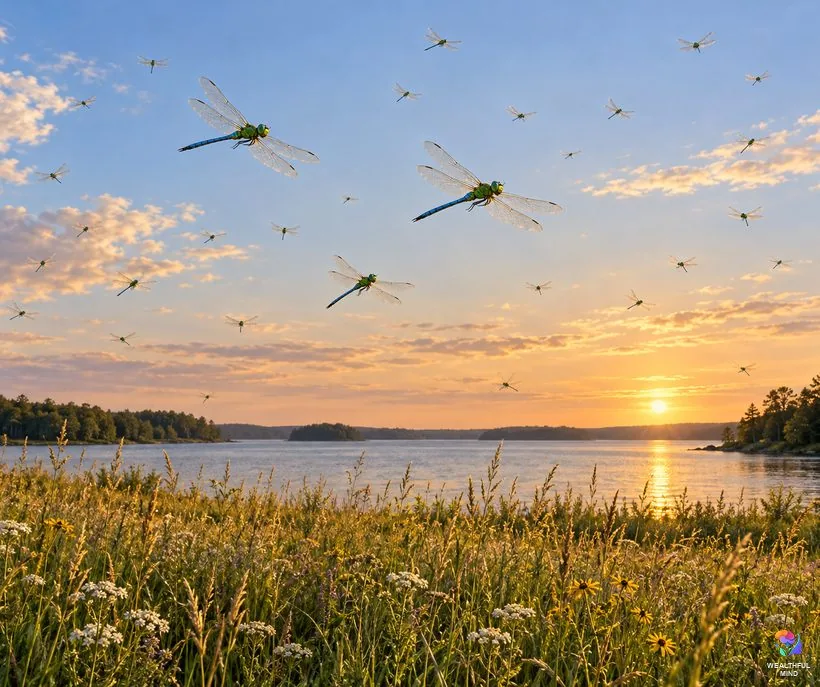
Suddenly you see dragonflies at the park, by the shops and outside work. You might read a run of sightings as a message that keeps knocking until you listen.
Ask yourself what keeps coming back to you, too. It may be a change you keep putting off, or a person you keep thinking of.
The season plays a big part. Dragonflies are out on warm, sunny days from spring to autumn, and you see them most near ponds, lakes, rivers and marshes.
Most of the “dragonflies everywhere” stories people share online fall in late summer. (That is our own count of Reddit posts, not a study.)
Some of them are travelers, too. The Xerces Society, a group that protects insects, explains that the common green darner migrates in a relay of generations. Each generation likely travels around 3,000 km (1,850 miles), about as far as monarch butterflies go in eastern North America, the Xerces Society adds.
And sometimes they come all at once. In July 2024, WFSB reported that thousands of dragonflies surrounded beachgoers at Misquamicut Beach in Rhode Island for about three minutes. Experts told WFSB that dragonflies can come out in large numbers when the weather is warm and there is plenty of prey.
A swarm around you is often taken as a big change arriving all at once, or as a sign of plenty. Stay calm and let it pass.
○ How Rare Is It to See a Dragonfly?
Not rare at all, if you live near water. The Illinois State Museum counts over 360 kinds of dragonfly in the United States, and about 5,000 kinds of dragonflies and damselflies worldwide.
A few kinds really are rare. The US Fish and Wildlife Service listed the Hine’s emerald as endangered in 1995, when it was known from just seven small sites in Illinois and six in Door County, Wisconsin. So enjoy any dragonfly where you find it, and leave it there.
Dragonflies and Loved Ones Who Have Died

A blue dragonfly lands on your father’s grave while you pray. Three dragonflies circle your car the day after the funeral. One appears outside the hospital, somewhere dragonflies never seemed to go.
These are real stories from grief groups on Reddit, and there are many more like them.
○ Is a Dragonfly a Visitor From Heaven?
Many people believe it is. To them, a dragonfly that stays close or turns up on an anniversary is their person saying hello.
If you felt that too, nobody can tell you it was wrong. It cannot be proved either way, but the comfort is real, and you may hold onto it.
And if a dragonfly never comes? That says nothing about your love, or about where your person is now.
Dragonflies keep to water and warm weather. Plenty of people who miss someone deeply live where they are hardly ever seen.
You may also see a dragonfly as just a dragonfly, and that is fine. One grieving person on Reddit, who did not believe in signs, said a dragonfly simply told her the world is still beautiful.
That is a good reading too.
If your grief feels too big for one person, share it with someone you trust, or with a grief counselor.
Other signs carry the same hope for many families, such as a white butterfly in the garden or a cardinal on the fence after a funeral.
○ The Water Bug and the Dragonfly
Much of the link between dragonflies and heaven goes back to one gentle story. A colony of water bugs lives at the bottom of a pond.
Every so often, one of them climbs a lily stem and never comes back. So the others promise that whoever goes next will return and tell them what is up there.
Then it happens to one of them. It climbs into the sunlight and becomes a dragonfly. It can see its friends below, but it can no longer go back into the water to tell them, and they will only understand when their own turn comes.
The story is Water Bugs and Dragonflies by Doris Stickney. The Unitarian Universalist Association, which sells its anniversary edition, says she first published it in a magazine article in 1970. She wrote it after watching adults struggle to talk with children about death, when a child in her neighborhood died.
So this is not an ancient legend. It began as a way to help children with grief, and we think that is exactly why so many grieving families still share it.
(Some memorial shops credit it to a different writer, and we could find no source for that.)
○ Red Dragonflies at Obon
Japan has its own version of this belief. Rev. Anne Spencer of the Idaho-Oregon Buddhist Temple writes that, in Japan, part of the Obon tradition holds that the spirits of the ancestors return “on the backs of dragonflies.” In the year her mother died, a red dragonfly landed at her feet beside a pond on the family farm, and she said, “Oh, hi Ma.”
We love that she is honest about it, too. In the same Idaho-Oregon Buddhist Temple post, she says she does not know if dragonflies really carry spirits. But she likes the tradition, and every dragonfly reminds her of the people who came before.
○ A Dragonfly During Pregnancy or After a Loss
Some of the most tender dragonfly stories come from pregnancy. One woman wrote on Reddit that during her fourth miscarriage, a dragonfly settled on her car at the hospital for several seconds.
She said she was not a big believer, but it made her feel better.
Many people connect dragonflies with pregnancy because the move from water to air feels like new life. For some, it is also a picture of a little one who has gone on ahead.
If a dragonfly came to you at a time like this, you can let it be comfort without deciding exactly what it means. Lean on your doctor and the people who love you for everything else.
Dragonfly Colors and Their Meaning
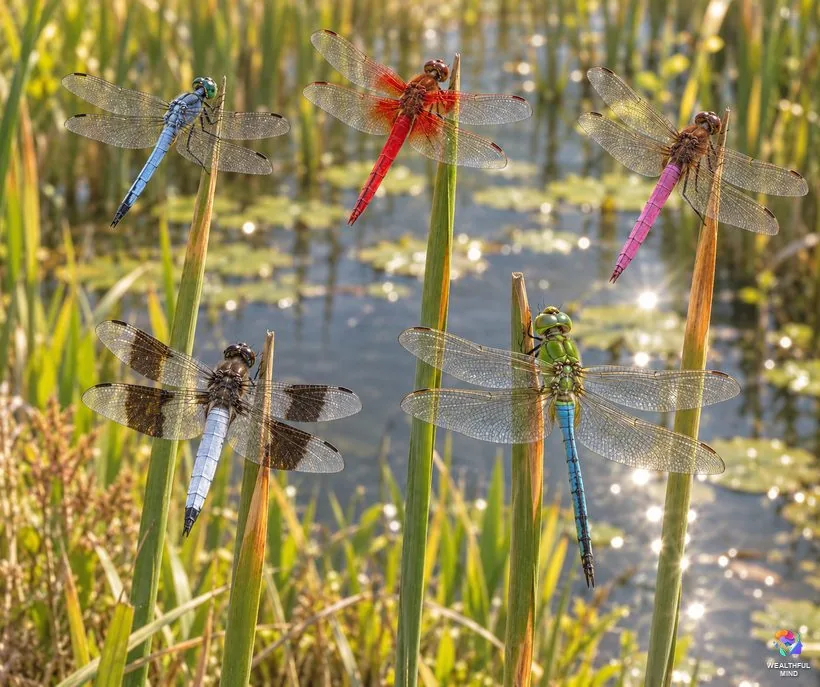
Most color meanings you see online, like red for passion or blue for loyalty, are modern spiritual writing. None of the lists we found has an older tradition behind it, so take the ones below for what they are.
A dragonfly’s color usually tells you its species, its sex and its age. When readers sent their sightings to Texas A&M AgriLife’s dragonfly experts, a pink one was probably a male Roseate Skimmer and bright red ones were probably male Neon Skimmers. One with a white tail turned out to be a male Common Whitetail.
○ Blue Dragonfly
If you saw a powder blue dragonfly, it was probably a grown male. A 2020 review in Frontiers in Ecology and Evolution explains that many kinds grow a whitish or pale bluish wax on the body as they mature. Mature males usually carry much more of it on their backs than females do, the review adds.
As a sign, blue is read as calm, honesty and clear thinking. Many grieving people also take a blue dragonfly as a sign from a mother or father.
One woman on Reddit wrote that blue dragonflies have always been her symbol for her mom.
○ Red Dragonfly
Red dragonflies are often meadowhawks or skimmers. You might read red as energy, passion and courage, or as a push to act on something you care about.
In Japan, red dragonflies are tied to Obon and to a much-loved children’s song. You will find both on this page.
○ Black Dragonfly
A dragonfly that looks black is often a dark one with black patches on its wings. You might read it as a transition, as protection, or as something you are not yet ready to see.
Some people feel uneasy about a black one. But no tradition we found treats it as a bad omen.
○ Green Dragonfly
In North America, a big green dragonfly is often a common green darner, with a bright green front half. People link green with growth, healing and starting over, and some take it as a good sign for money or a new job.
○ White Dragonfly
A white or chalky dragonfly is usually a mature male covered in that same wax. Many people link white with peace and purity, and with a loved one close by, much as they do with a white feather.
○ Yellow or Orange Dragonfly
Yellow and orange are read as joy, hope and confidence. If one turned up on a gray day, you could take it as a small promise that things will brighten.
Two Dragonflies Together
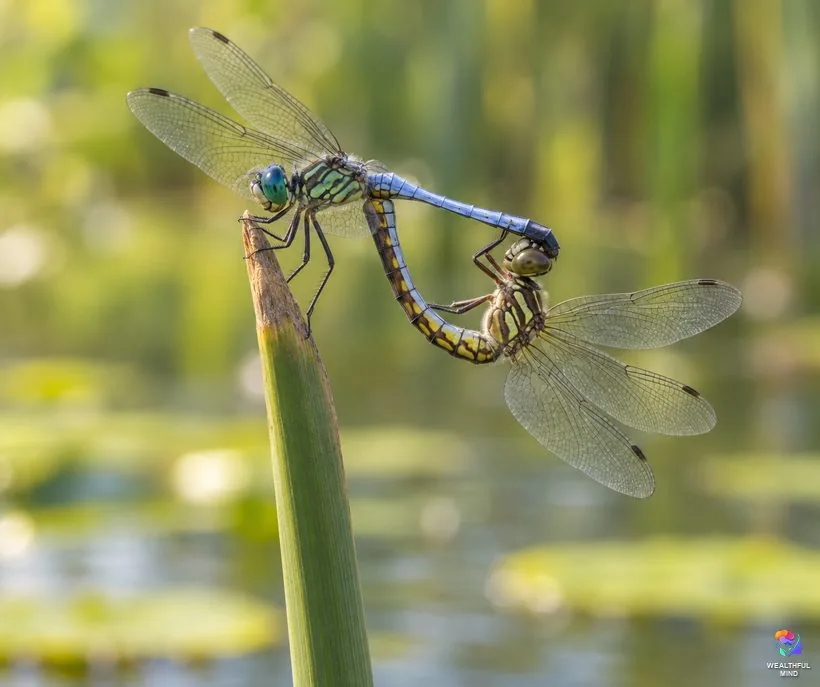
Two dragonflies joined in the air are a mating pair. The male holds the female just behind her head. She curls her body forward to meet him, so together they make a loop that many people see as a heart.
That shape is why two dragonflies are read as love and partnership. You might take it as a hopeful sign for you and your partner, or as a sign that two people you have lost are together again.
Some people see it as a twin flame sign. That is a modern idea with no older tradition behind it, but if it helps you, enjoy it.
A Dragonfly in Your House

You might read a dragonfly indoors as change arriving at home, good news for your family, or a hello from someone who once shared your home.
Some websites say it means an illness will pass. None of them names a single culture that believes it, so we would not lean on that one.
We could not find any study on why dragonflies come indoors, so we will not guess. Here is a calm way to help it back out.
- Switch off any ceiling fan, and close the doors to other rooms.
- Open the nearest window or door wide, and give it a few minutes.
- If it is tired and resting, slide a sheet of paper under its feet and carry it outside to a plant.
- Never pick it up by the wings.
A Dead Dragonfly, or One That Dies Near You
Finding a dead dragonfly can be upsetting, especially if it died on you. One woman on Reddit wrote that a dragonfly tried to get into her house, landed on her back and died, and she worried it meant something bad.
We do not think it does.
An adult dragonfly lives only a few months, after up to five years as a larva, as a Guardian column on dragonflies notes. So if you find one on your windowsill at the end of summer, it has most likely reached the end of its natural life.
Others are caught. The Illinois State Museum names swifts, swallows, purple martins, kingbirds and frogs among the animals that eat dragonflies. It says they are most often caught just after leaving the nymph skin, when they can barely move.
You can read a dead dragonfly as a chapter closing or a cycle finished, not a curse. If you have also found a dead bird lately, our dead bird meanings page talks through that worry.
Dragonfly Spiritual Meaning in Different Cultures

One insect has meant victory in one country and the devil’s work in another. Below, each belief comes with where it was written down.
○ Japan: Dragonfly Island and the Victory Insect
Japan gave us the oldest dragonfly story we found. In the Kojiki, Japan’s ancient book of myths and history, an emperor is out hunting when a horsefly bites his arm. A dragonfly comes and eats the horsefly, and the emperor’s song says the land of Yamato was called “the Island of the Dragon-Fly.”
Web Japan, the culture site of Japan’s Ministry of Foreign Affairs, says a chronicle compiled in 720, the Nihon Shoki, tells the same horsefly story. It says these events gave Japan its old name, Akitsu Shima (the Dragonfly Isles).
According to Web Japan, dragonflies came to be called kachi-mushi, “victor insects” that bring good luck, so samurai helmets, hats and family crests carried them. Japanese children still sing Aka-tombo (Red Dragonflies), a song written in 1921.
You can still see one of those helmets. The Metropolitan Museum of Art in New York holds an 18th-century samurai helmet topped with a large dragonfly. The museum explains that warriors respected the insect because it flies straight at its prey and never wavers.
○ Zuni and Other Southwest Stories
The Zuni (A’shiwi) people of New Mexico have a story that the writer Tony Hillerman retold for children as The Boy Who Made Dragonfly. The University of New Mexico’s Digital Hillerman project says it comes from ethnologist Frank Cushing’s retelling of a Zuni tale. In it, a boy and his sister are left alone through a hard winter, and the story warns against waste and teaches care for your neighbors.
The same Digital Hillerman project describes the Zuni dragonfly character as a link between the people and their spirit ancestors.
Dragonflies also show up on Southwest pottery as a sign of water. The Arizona State Museum lists dragonflies, with waves, tadpoles and frogs, among the water designs that many peoples of the region share. It also shows a Zuni canteen from the late 1800s painted with dragonflies.
That makes sense when you think about it. Where you see dragonflies, there is almost always water nearby.
You may have read broader lines, such as “Native Americans” seeing dragonflies as healers or wish-granters. The pages that repeat them name no nation and no source, and we could not trace them either, so they stay off this page.
○ Europe: the Devil’s Darning Needle
In much of Europe, the dragonfly had a darker name. Encyclopaedia Britannica notes that Europeans often saw dragonflies as threatening, even though they do not hurt people. That is where names like horse stinger, snake doctor and devil’s darning needle come from, Britannica adds.
Etymonline, a dictionary of word origins, records “dragonfly” in English from the 1620s. It lists an even older name, adderbolt, from the late 1400s.
A Guardian column from 2021 mentions a Swedish folk belief that dragonflies are “weighers of souls.” In it, a dragonfly circling your head is judging your life on behalf of the devil. The column points to a personal blog for this, and we found no Swedish folklore collection that records it, so treat it as a story, not a record.
So if a dragonfly makes you a little nervous, you are in line with centuries of Europeans.
○ Is the Dragonfly in the Bible?
No. We searched Bible Gateway for the word “dragonfly” in both the NIV and the King James Version, and neither has a single verse with it.
So the question of why God might send you a dragonfly is answered by personal faith, not scripture. Many Christians take a dragonfly on a hard day as a quiet gift from God, or as word that someone they love is at peace with Him.
That is a personal reading, and it can sit happily beside your faith.
The Dragonfly as a Spirit Animal
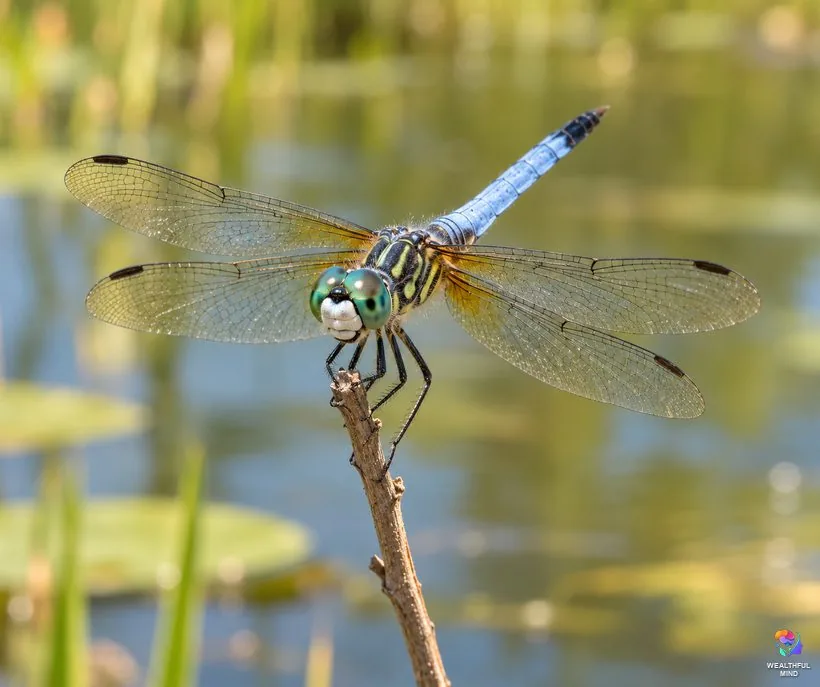
A spirit animal is a modern idea: a creature you feel drawn to, whose way of living you take as a lesson. If the dragonfly keeps finding you, these are the traits people usually take from it.
- Patience. Years of slow growing underwater come before any flying.
- Agility. It hovers, darts backward and turns on the spot.
- Focus. It picks a target and goes straight for it.
- Living now. Its time in the air is short, so it makes every day count.
That focus is real. In lab tests reported in Integrative and Comparative Biology in 2013, dragonflies caught fruit flies in about 90 to 97 percent of their chases. Bigger prey, like mosquitoes, got away more often.
If this is your spirit animal, the lesson might be simple. Be patient with yourself while you grow, and when your moment comes, go for what you want without wavering.
A Dragonfly in a Dream
No old tradition explains dragonfly dreams, so read yours by how it felt and what the dragonfly was doing.
- One landing on you: comfort, or a change you are finally ready for.
- One with a butterfly: two kinds of change happening in your life at once.
- Many dragonflies over water: your feelings are on the move, and that is alright.
- One you could not catch: something you are chasing that needs a lighter touch.
- A dead dragonfly: a chapter you are ready to close.
Before you open a dream dictionary, recall what you were worrying or hoping about as you drifted off. Most dreams start there.
A dragonfly spends years getting ready for a short season in the light. If one spent a minute of that season beside you, that is worth a smile, whatever you believe.
More Questions About Dragonflies
When God sends a dragonfly, what does it mean?
Many Christians take it as a quiet gift from God when life feels heavy, or as reassurance that someone they love is at peace. That comes from personal faith rather than scripture, because no verse in the NIV or the King James Version names a dragonfly (we checked on Bible Gateway). You are still free to receive it as a gift.
Is a dragonfly a visitor from heaven, or a sign of angels?
Many grieving people feel so, and there is no way to prove or disprove it. The idea owes a lot to Doris Stickney’s 1970 children’s story Water Bugs and Dragonflies, and in Japan, Obon tradition holds that ancestors return on the backs of dragonflies. No older tradition we found ties dragonflies to angels. If one brought you comfort, keep it, and if none comes, that says nothing about your love.
How rare is it to see a dragonfly?
Not rare near water in warm weather. The Illinois State Museum counts over 360 kinds of dragonfly in the United States alone. A few kinds really are rare, such as the Hine’s emerald, which the US Fish and Wildlife Service lists as endangered.
Is it good luck if a dragonfly lands on you?
Many people take it as a blessing or a sign of good news, and in Japan dragonflies were lucky “victor insects”. On the insect’s side, it is usually using you as a perch to watch for prey or to warm up. Stay still, enjoy it and let it fly off on its own.
Can a dragonfly sting or bite you?
No. The Illinois State Museum says dragonflies have no means of stinging and are harmless to people, and the University of Florida’s extension service says they do not sting or bite people. Their old name, the devil’s darning needle, made people fear them for nothing.
What is a dragonfly’s biggest enemy?
Birds and frogs. The Illinois State Museum names swifts, swallows, purple martins, kingbirds and frogs, and says dragonflies are most at risk just after they climb out of the nymph skin and can barely move. Underwater, the young nymphs are eaten mainly by fish, according to Encyclopaedia Britannica.