Ask people for the praying mantis spiritual meaning and most of them will tell you the same thing: be still, wait for the right moment and trust what you sense. Many also take a mantis as good luck or as an answer to a prayer. That reading is older than it looks, because the Greek word mantis means “one who divines, a seer, prophet,” according to the word-origin dictionary Etymonline, and in Provence the naturalist J. H. Fabre heard it called “the creature which prays to God.”
The meaning you keep depends on what was happening when the mantis found you. We also think it helps you to know the insect itself, because its real habits explain why a mantis feels so personal, and they make your meaning richer, not smaller.
Quick pick
What Did the Praying Mantis Do?
Pick the moment closest to yours and jump straight to it.
- Landed on you? Many feel it as a gentle blessing, and it cannot sting or bite
- Stared right at you? Its head really does turn toward you, so it was watching
- Sat at your door or window? Often read as protection for your home
- Green or brown? The color mostly shows where it lives, so read the moment instead
- Came after a loss? Many feel it as a quiet hello from the person they miss
- Found it dead? Usually the natural end of its year, read as rest or release
Keep reading below The San story of the Mantis and his son The mantis and the chariot Is it in the Bible? Is it illegal to kill one? Questions

If you want to compare the mantis with bees, moths and ladybugs, our guide to what insects mean spiritually covers them all. And if signs are new to you, our main page on signs from the universe explains how to read one when it arrives.
What Does It Mean When You See a Praying Mantis?

Here are the five readings people give most often. No one can prove any of them, so pick whichever matches your day.
- Stillness. A mantis can hold one pose for a long time, and many people hear it as “slow down, you are rushing.”
- Patience and timing. It waits, and then it moves very fast. You could treat it as a sign to hold off on a decision until the time is right, and then act without second-guessing yourself.
- Intuition. Many people hear it as “listen to your gut.” (Our page on instinct vs intuition explains how the two differ.)
- Prayer and calm. Those folded front legs look like hands at prayer, so people of faith often feel it as a reminder to pray, or a sign that a prayer was heard.
- Good luck. This is the old folk reading, the one you may have heard from a grandparent.
To find yours, go back to the second before you spotted it and remember what was in your head. That thought is usually your answer.
If you were about to send an angry text, it was probably the stillness one. A student waiting for exam results might take it as patience. And if you asked for a sign that morning, you will likely feel it as an answer.
There is a plain reason you are seeing one now, too. Mantises hatch in spring and spend the growing season eating and growing, and the Missouri Department of Conservation says they mate and lay eggs in late summer. That is why you will usually meet a full-grown mantis between late summer and the first cold nights.
○ Seeing Praying Mantises Again and Again
Seeing a mantis every few days, or two in one afternoon, can feel like a message sent twice to make sure you got it. Part of the answer is simply where you live, since the Missouri Department of Conservation calls the Chinese mantis “very commonly encountered.” Mantises are also easy to miss until you notice one. After that, your eyes start finding the others that were there all along.
That does not make it meaningless. If the same message keeps arriving, we think you should take it literally: slow down for a week, put off the big decision and see what becomes clear.
Is a Praying Mantis Good Luck or a Warning?

Most people take a mantis as good luck. It is calm, it rarely rushes away from you, and a visit from something so unhurried can feel like a blessing.
But not everyone feels that way. In one Reddit post, a reader saw two mantises within a day, one sitting on the gum at a gas station and one on the office windowsill. A friend called it a good omen, yet the poster felt uneasy, and the only reply said every mantis they had met had been a warning.
Our view is simple. The insect carries no fixed message, so your own feeling is the guide. If you feel calm, keep the calm reading. If you feel uneasy, use it as a cue to look at whatever is worrying you, not as a curse.
The darker side of the mantis has a history too. Britannica lists folk names such as devil’s horse and mule killer, along with old superstitions that its brown saliva can blind a person and that a horse or mule that eats one will die.
Then there is the famous story that the female always eats the male. The University of Wisconsin Extension says this happens only occasionally in the wild, unlike in captivity, and UC IPM adds that it does not happen during most matings. So if a mantis made you think of a scary partner, you can breathe out, because the legend is much bigger than the truth.
Old Names and Stories Behind the Praying Mantis Spiritual Meaning
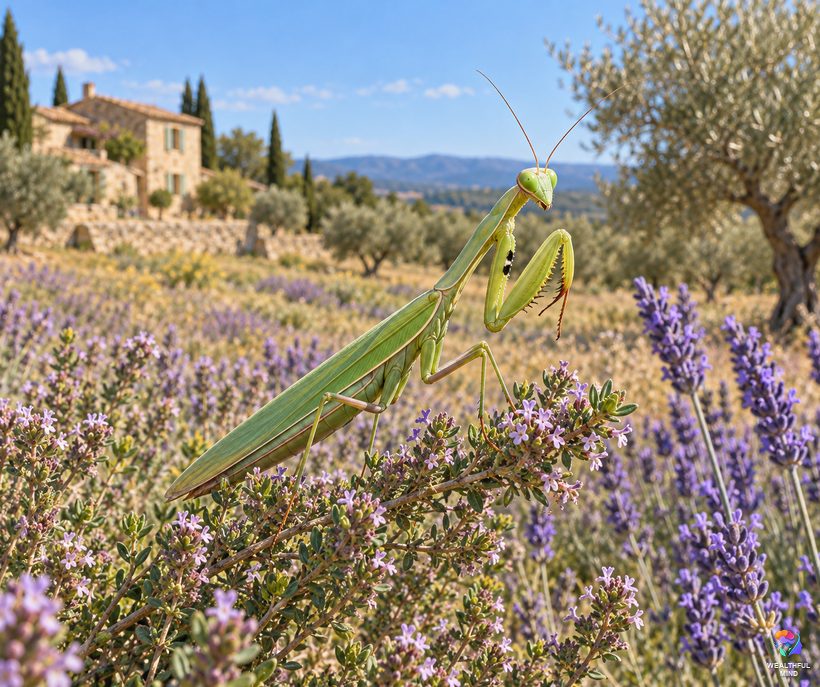
Many of the mantis “legends” you will find online have nothing behind them. The ones below do, and you can read each one for yourself.
○ The Prophet in Its Name
The Greek seer came first. Etymonline says the poet Theocritus already used the word for a long-limbed insect, and that English took it for the insect in the 1650s.
The idea of the mantis as a fortune-teller is written down in the Suda, an old Greek reference book. In the English translation on Suda On Line, it describes a slow, pale green “locust” called a mantis and says people “divine auguries by noting its movements.” In other words, people watched where it walked and read the future from it, the way you might read tea leaves.
The praying side of the name comes from farm country. In Social Life in the Insect World (first published in English in 1911), Fabre wrote that people in Provence called it lou Prègo-Diéu, and that since ancient times popular imagination had filled the bushes with “priestesses emitting oracles and nuns in prayer.”
Other languages agree. Britannica lists prie-Dieu in French, Gottesanbeterin in German and the West Indian “god-horse,” names that all suggest piety. In Portuguese, the Priberam dictionary gives louva-a-deus, which reads as “praise God.”
Some sites say the mantis stands for hope because its Portuguese name is esperança. Priberam gives that insect sense of esperança to the tettigoniids, a family of leaping insects you may know as katydids or bush crickets. So the “hope” story belongs to a grasshopper-like cousin, which you can read about on our grasshopper spiritual meaning page.
The State of Connecticut, which made the European mantis its state insect on October 1, 1977, says the name fits its habit of standing still with its front legs raised “in an attitude of meditation.” We cannot think of a better picture for this insect.
○ The Mantis Who Brought His Son Back: a San Story
The richest mantis stories we found come from the San people of southern Africa. In Specimens of Bushman Folklore, Bleek and Lloyd wrote down tales from |xam storytellers, and the Mantis is a character in them. The Digital Bleek and Lloyd archive at the University of Cape Town gives his name as |kaggen.
He is not a distant god in these records. He is a trickster with very human feelings, who fights, loses and cries, and the Digital Bleek and Lloyd notes describe him slipping into a hungry person’s thoughts while they sleep.
One story from Bleek and Lloyd stays with you. Baboons kill the Mantis’s son, !gaunu-tsaxau, and play ball with the boy’s eye. The Mantis fights them, gets the eye back and puts it into the water.
Later, he creeps back to the water, and the child has grown “like that which it had (formerly) been.” He brings his son home, still weak from the water, but alive, as the Bleek and Lloyd telling puts it.
Some websites tell you the San “worship” the mantis as God. We found nothing in these records to support that. What they do hold is a grieving father who will not give up on his child, and we think that is the better story.
○ The Mantis in China and Japan
The Chinese mantis lessons are warnings. In the Zhuangzi, an ancient Chinese classic, a mantis “stretched out its arms to prevent a chariot from passing, unaware that this was beyond its strength,” in Herbert Giles’s 1889 translation.
Sinica, a podcast and newsletter about China, says the line lives on as the idiom 螳臂当车, “a mantis trying to stop a chariot,” for someone who overestimates their own strength.
The same book has a second mantis. In Herbert Giles’s translation, it seizes a cicada, “forgetting in the act its own body,” and a bird snatches the mantis a moment later. Zhuangzi sighs, “Loss follows the pursuit of gain.”
So if a mantis shows up while you are picking a fight far too big for you, or chasing something so hard you have stopped looking around, these two old stories make a fair reading.
Be brave, but know your size.
Japan sees the mantis more gently, as a sign of the season. The University of Virginia’s Japanese haiku dictionary lists kamakiri, the praying mantis, as a season word for “all autumn.” A poet who mentions one is telling you it is fall, which is exactly when the grown insects turn up.
○ Is the Praying Mantis in the Bible?
No. Type “mantis” into Bible Gateway’s search and it comes back empty, whether you choose the King James Version or the NIV.
The Christian reading comes from the insect’s pose instead. Fabre notes that its scientific name, given by Linnaeus, is Mantis religiosa, and that here “the language of science and the vocabulary of the peasant agree.”
Some Christians also say a mantis in the home means angels are watching over the family. That is folk belief and personal devotion, not church teaching. You are welcome to keep it if it draws you closer to God.
○ What About Egypt, Greece and Native American Lore?
You will read that ancient Egyptians believed a mantis led souls to the afterlife, that ancient Greeks thought it showed lost travelers the way home, that an Assyrian list called it a soothsayer, and that Native Americans believed it came before people. We looked for the text or the people behind each claim and could not find them.
None of the sites we read names a chapter of the Book of the Dead, a Greek writer or a single Native nation. So we will not pass these on to you as fact, and if a real source turns up, we will gladly add it.
A Praying Mantis Landing on You

A mantis on your arm or shoulder is one of the sweetest moments people describe. For you it might be a blessing, a sign that you are safe, or a quiet “pause here.”
You do not need to be afraid. Entomologists at the University of Kentucky write that praying mantids “do not sting or bite,” and the State of Connecticut calls its state mantis “harmless to humans.”
A mantis landing on you is rarer than spotting one. The University of Wisconsin Extension calls mantids clumsy fliers that are rarely seen in flight. In the native Carolina mantis, Clemson explains, the male has long wings and flies, while the heavier female has short wings and cannot.
If you want it off, hold out a leaf or a twig and let it walk on. Then set it on a plant, and do not shake it off or grab its body, since it is fragile.
Why a Praying Mantis Seems to Stare at You
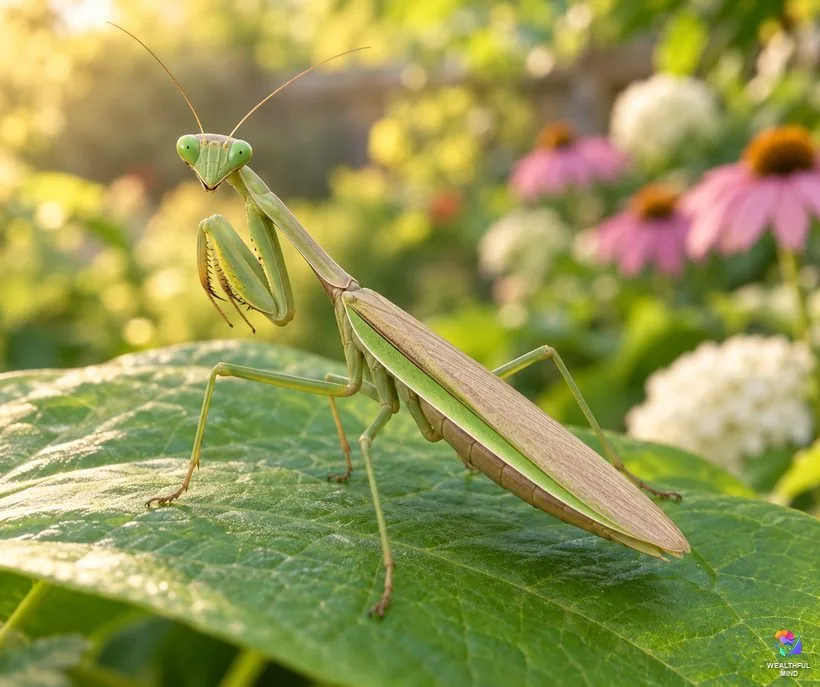
This is the moment that sends most people searching. The mantis turns its head, looks straight at you and holds your gaze, and you feel like it knows something.
There is a real reason it feels that way. UC IPM says a mantis can rotate its triangular head about 180 degrees, and the University of Illinois Extension calls it “the only insect that can look over its shoulder.”
It also sees depth. Researchers at Newcastle University, who fitted mantises with tiny 3D glasses, say it is the only insect known to have stereo vision.
And it listens, though not to you. The National Wildlife Federation reports that most mantis species have a single ear in the middle of the chest, tuned to the high calls of hunting bats.
It will usually let you watch it back, too. The University of Kentucky notes that a mantis you find is unlikely to fly away and “will also usually stand still and allow you to get close for a good photograph.”
So yes, it really was watching you, probably working out whether you were food, a threat or a tree. We still think the moment can mean something. Being seen that clearly by something so small and so still is a good reason for you to stop and check in with yourself.
A Praying Mantis at Your Door, Window or in Your House
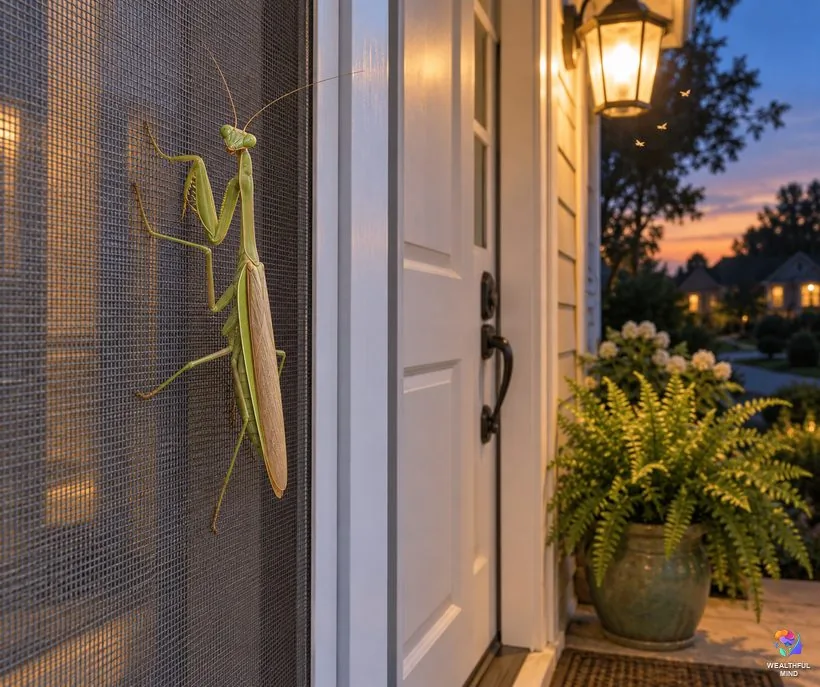
A mantis on your front door, a window screen or the wall by your porch light is, for many people, a guest standing at the threshold. You could see it as a sign of protection for your home, or a reminder to stay calm with the people inside.
We could not find an official source that explains why mantises sit on doors and windows. Here is a likely reason, though. In its advice on raising mantids, Colorado State University Extension notes that midges and other small flies gather around porch lights and make good food for young mantises.
Tiny mantises in your house in winter usually have a plain cause. Clemson says Chinese mantis egg cases are often attached to Christmas tree branches, and the young hatch once the tree comes indoors.
If a mantis is inside, coax it onto a sheet of paper and set it on a plant outdoors. If you spot an egg case on a branch before it comes in, snip off that twig and tuck it into a sheltered spot outside. The University of Illinois Extension warns never to put an egg case on the ground, because ants will eat the eggs.
Other bugs indoors are their own story. Ladybugs in the house have meanings of their own on our ladybug spiritual meaning page, and our page on ants and other bugs in the house explains when a visitor is a sign and when it is simply a pest problem to fix.
Green Praying Mantis vs Brown Praying Mantis
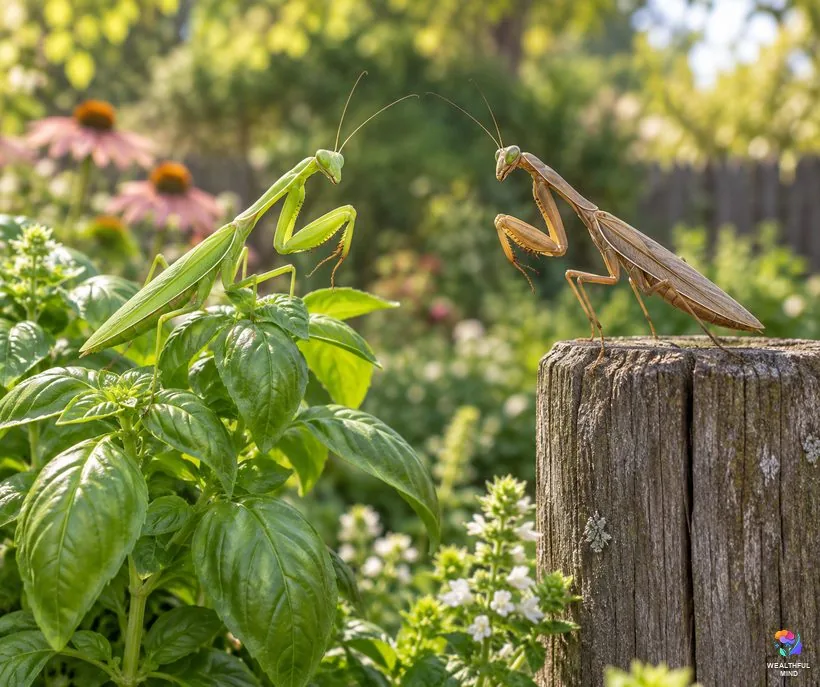
Many people read a green mantis as growth and fresh energy, and a brown one as being grounded and steady through a hard season. These color meanings are modern. We could not trace them, or the longer charts with white, black and yellow, to any tradition, so use them only if they speak to you.
The color of a real mantis says more about where it lives. UC IPM says mantids are usually brown, green or yellowish, and a single species can come in all three. Many can also shift their color somewhat to match their surroundings, according to the University of Wisconsin Extension.
So the green mantis on your basil and the brown one on your fence post are doing the same job, hiding. If you want a reading anyway, look at the spot where you found it as much as at its color.
A Praying Mantis After a Death or When Someone Is Ill

Some of the most tender mantis stories come from people who are grieving. In one grief support thread, someone who had lost their dad saw a baby mantis and felt it was “like a little gift” from him. A parent replied that mantises were what their son used to send.
If a mantis came to you after a loss, you are free to treat it as a visit, a sign that your person is at peace or simply a moment of quiet in a loud week. All of those are yours to keep.
Others see a mantis near someone who is very ill and fear the worst. One reader wrote that a mantis had stayed on their in-laws’ porch for a week while their father-in-law was dying, and their first thought was the angel of death. The replies were gentler, calling it a watcher or a guardian, and one pointed out that a porch can simply be good hunting ground.
No tradition we traced makes the mantis a sign of death. The |xam story of the Mantis and his son is not a promise about the dead either. But a father who refuses to let go of his child is a picture many grieving people will recognize.
No mantis at all? Nothing is wrong with that. Your person is no further away because an insect stayed home, and plenty of people grieve where mantises never live.
Other signs people treasure after a loss include a white butterfly drifting past and a white feather found somewhere it should not be.
○ If a Mantis Met You at Your Lowest Moment
One of the most-read mantis posts on Reddit was written by someone who had come very close to ending their life. They sat down, turned around and saw a mantis resting perfectly still on their bike seat, and that stillness changed something. Years later, they added that the post “stands as a reminder that it is worth it to keep going, even when it feels like it’s not.”
If you are in that dark place right now, please do not wait for a sign. Tell one person near you today, and talk to someone trained to listen.
- In the US, a 988 Lifeline counselor answers calls, texts and chats at 988, day or night, and the 988 Lifeline keeps it free and confidential.
- Across the UK and Ireland, the number for Samaritans is 116 123. Samaritans say the call is free from landlines and mobiles and will not show on your phone bill.
- In India, Tele MANAS counselors answer on the toll-free number 14416.
If you feel you could act on these thoughts soon, call your local emergency number now. You deserve to see a great many more autumns.
A Dead Praying Mantis

Finding a dead mantis can feel like a bad omen, especially if you had been watching it for weeks. You can read it more gently, as a chapter closing, a rest after hard work or a sign to let something go.
The timing is usually nature’s own. The Missouri Department of Conservation says most mantids live only about a year and die when it freezes. Colorado State University Extension adds that in Colorado they usually die by late September or early October.
So a mantis lying still on your step in autumn has most likely finished its year. If it was a female, she may have left an egg case nearby that will hatch in spring.
We think that is the real message of a dead mantis: nothing ends without leaving something behind.
A Praying Mantis in Your Dream
No old tradition fixes a meaning for mantis dreams. The dream lists you find online all disagree, so start from what the mantis was doing.
- If it sat calmly on you or watched you, it often reads as a call to be patient or to trust a quiet feeling.
- If it was hunting or eating, it may point to someone waiting for the right moment, perhaps you.
- If it frightened you, look at what in your waking life feels like a trap.
- If it was in its praying pose, it may simply be your own wish for peace.
Type the dream into your notes app before breakfast. The feeling you woke with is usually a better guide than any list, ours included.
Are Praying Mantises Rare or Protected?
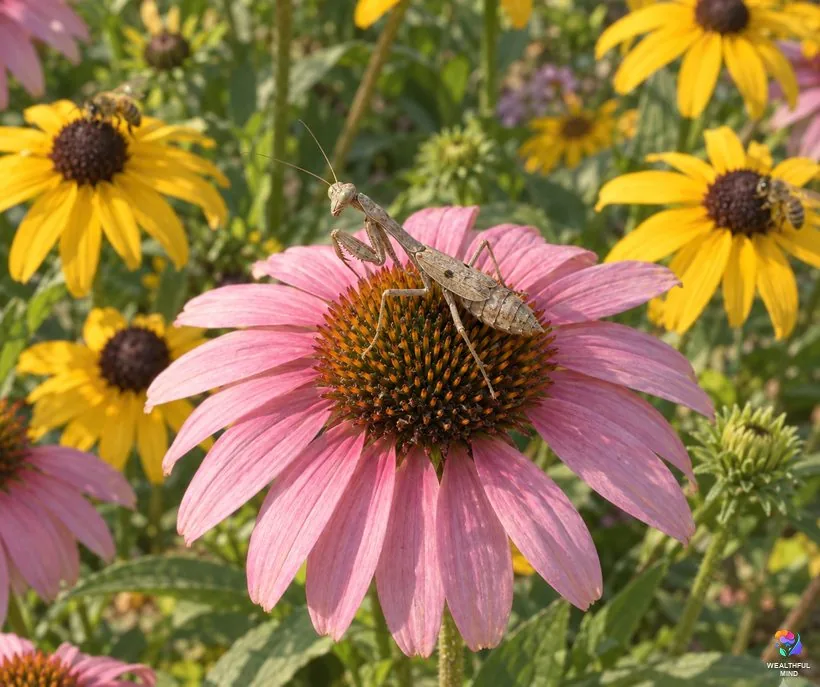
Neither, in most of the US. The University of Kentucky says mantids are common in Kentucky from late spring to early fall, and hard to see only because of their camouflage and their sit-and-wait hunting. So if one felt special, that came from when it found you, since in season they are all around.
You may have heard it is illegal to kill a praying mantis. Snopes says that belief has floated around since the 1950s, often with a $50 fine attached, and that no federal or state law has ever banned it. The University of Kentucky agrees that US mantids are not protected by any specific law, though killing any animal is illegal in some nature preserves and wildlife sanctuaries.
Even so, there is no reason to kill one.
○ Store-Bought Mantis Egg Cases
You may see mantis egg cases sold as natural pest control. Clemson says the ones you buy are usually Chinese mantis egg cases, and Colorado State University Extension calls the Chinese mantid an invasive species whose egg cases often fail at pest control.
UC IPM goes further and says mantids are of no benefit for biological pest control, because they eat any insect they can catch, bees and butterflies included.
The Missouri Department of Conservation says the Chinese mantis may be playing a role, in some regions, in the decline of the native Carolina mantis. If you want to try mantids anyway, it suggests egg cases of the native Carolina mantis.
You do not need to buy mantises to welcome their meaning into your garden. Plant a few native flowers, go easy on sprays and let the mantises that already live near you find you.
○ A Mantis on Your Hummingbird Feeder
This is the mantis’s darkest habit, and you should know about it if you feed hummingbirds. Audubon says it is rare, but a mantis can wait on a hummingbird feeder and grab a hummingbird. The Missouri Department of Conservation also lists hummingbirds among the small animals large females have occasionally been recorded eating.
Audubon’s advice is to hang feeders away from shrubs and trees, where mantises hide, and to gently lift a mantis off a feeder with a stick and move it elsewhere. It adds that insecticides may do more harm than good, hummingbirds included.
To learn what those tiny birds mean when they visit you, see our hummingbird spiritual meaning page.
○ What to Do When You Meet a Praying Mantis
- Stop and watch it for a minute. For many people, that pause is the whole message.
- Leave it where it is, unless it is on a hummingbird feeder or somewhere it could get stepped on.
- Write down the date, the place and what was on your mind, so you can spot a pattern if more come.
By the time most of us meet a mantis, it has only a few weeks of its year left. Let it spend them on your rosebush or your porch rail, and carry the one thing nearly everyone agrees it teaches: be still first, then move.
Your Praying Mantis Questions
Is finding a praying mantis lucky?
Many people think so, and it is one of the oldest folk readings of the insect. A mantis is calm and rarely rushes away, so a visit feels like a blessing. Nobody can prove it brings luck, but if it felt lucky to you, you are free to hold on to that feeling.
What does it mean when a praying mantis visits you?
For most people it is a call to be still, to wait for the right moment and to trust what they sense. People of faith often feel it as a reminder to pray, and grieving people sometimes feel it as a visit from someone they miss. The best guide is what was on your mind just before you saw it.
Are praying mantises protected, or is it illegal to kill one?
No law protects them in the US. Snopes traces the idea that killing one is illegal back to the 1950s and found no federal or state law behind it, and the University of Kentucky says US mantids are not protected by any specific law, though killing any animal is banned in some nature preserves and wildlife sanctuaries. There is still no reason to kill one, since it cannot hurt you.
Do praying mantises bite or sting?
No. Entomologists at the University of Kentucky write that praying mantids do not sting or bite, and the State of Connecticut calls its state mantis harmless to humans. If one lands on you, let it walk onto a leaf or twig and set it on a plant.
What does a brown praying mantis mean?
Many people read a brown mantis as a sign to stay grounded and steady, but that color reading is a modern one, with no tradition we could find behind it. UC IPM says one species can be brown, green or yellowish, so the color mostly shows where the mantis lives and hides.
Is the praying mantis mentioned in the Bible?
No. Bible Gateway’s search returns nothing for the word mantis in either the King James Version or the NIV. The Christian reading comes from the praying pose and the scientific name Mantis religiosa, so seeing a mantis as a reminder to pray is personal devotion rather than scripture.