If a coyote just trotted across your path, the coyote spiritual meaning you will find most often is adaptability and cleverness. Behind it stands the trickster Coyote of particular Native nations, and the Aktá Lakota Museum says the Lakota stories about him “are not meant to praise the coyote but to teach important lessons.” So we read your coyote less as a lucky sign and more as a friendly check on your own shortcuts.
If the coyote is still in sight, look after yourself and your pets first and leave the spiritual meaning for later. A coyote out in daylight is usually behaving normally, and MassWildlife, the Massachusetts wildlife agency, says daytime activity “does not mean the animal is rabid.”
Coyotes are one of many animals in our animal spiritual meaning guide, and signs from the universe gives you a simple way to read any sign. If you are not sure your animal was a coyote at all, start with how to tell a coyote from a dog.
What to Do First When You See a Coyote

Most coyotes would rather stay out of your way. The San Diego Humane Society, an animal welfare group in California, says coyotes “are skittish by nature and do not typically act aggressively towards people.”
- Stay calm and do not run. The San Diego Humane Society puts it in capital letters: “NEVER run away from a coyote!”
- Make yourself big and loud. The same group says to stand tall, wave your arms and yell until the coyote moves off.
- Use what is close by at home. MassWildlife suggests an air horn, a spray from the garden hose or small objects tossed near the coyote. The goal is to scare it away, not to hurt it.
- Walk children away calmly. MassWildlife says children should leave the area without running and find an adult to scare the coyote off.
- Bring your pets in. Humane World for Animals says to keep cats indoors and dogs on short leashes.
- Clear away food. The National Park Service lists pet food, garbage, birdseed and open compost as things to remove from your yard.
- Never feed a coyote, not even once. MassWildlife says most coyote bites on people can be traced to people feeding coyotes on purpose.
- Leave a sick or hurt coyote alone. MassWildlife lists a lack of coordination, circling, heavy drooling and aggression toward objects among the signs of rabies, and says to report a coyote like that to your local Animal Control Officer or police right away. The agency also warns you not to scare off a coyote that seems sick or injured, and never to corner one or chase it toward a road.
The risk to you is small.
MassWildlife calls the chance of being attacked by a coyote “extremely low.” Humane World for Animals says only one person in the United States has ever been recorded as killed by one.
If you only do one thing, take the food away. Since feeding is behind most bites, we think a tidy yard does more to keep coyotes wary of you than any amount of shouting.
○ A Coyote That Follows You
A coyote trailing you on a walk can feel like an escort, and some people read it as a guide showing them the way. In spring there is often a plainer reason, a den nearby.
Humane World for Animals says that if you walk your dog near a den without knowing it, “coyotes might follow to encourage you to move along.”
So take the hint and pick a different route for the rest of the spring. The coyote is being a protective parent, which is a fine lesson about looking after what you love.
○ Was It Really a Coyote?
Coyotes, Canis latrans to scientists, are easy to mistake for neighborhood dogs. The National Park Service says a coyote has a long, narrow snout and dark fur on its lower front legs. It also says a coyote travels with its bushy, black-tipped tail pointed down, while a dog carries its tail out or curled up over its back.
If you think you saw a wolf, our wolf spiritual meaning page has the full check for telling the two apart.
What Does It Mean When You See a Coyote?

People read a coyote sighting in several different ways, and most of the readings grow out of something the real animal does. Keep the one that fits what you are going through.
- Adaptability. Coyotes have moved into towns and cities, and Humane World for Animals says they can even follow traffic signals and cross roads after rush hour. So a coyote in a parking lot can feel like a nudge for you to bend with a change instead of fighting it.
- Cleverness, with a catch. Britannica says the coyote has “a reputation for cunning.” In the traditional stories that cleverness usually lands Coyote in trouble, so the message for you is to use your wits without getting too sure of yourself.
- A look at your own habits. In Lakota stories, Coyote’s mistakes are the lesson, as the Aktá Lakota Museum explains, so you can read a sighting as a nudge to check your own behavior (more on that below).
- A lighter heart. Many modern spiritual writers say a coyote asks you to laugh at yourself a little and stop taking every setback so seriously.
- A time of change. You are in good company if you feel lost right now or are starting something new. Many people who write about coyotes online say one appeared at just that kind of moment.
Which reading is yours usually depends on what was on your mind just before you saw it.
Our worked example near the end shows you how to tell.
○ A Coyote in the Daytime, or a Lone Coyote
Seeing a coyote by day is normal, especially in spring and summer.
MassWildlife says coyotes travel mostly between dusk and dawn but can be active at any hour. The agency adds that you will see them more by day in spring and summer, while they are raising their young.
Humane World for Animals goes further, saying coyotes are naturally active in daylight and only switch to night hours when they live near people.
A coyote on its own is ordinary too. The National Park Service says coyotes in Ohio live as a pair with their young and do not form packs beyond that family. So the one you saw alone may simply be one parent out searching for food.
As a sign, a lone coyote is often read as independence, or as a reminder that you can find your own way through a difficult stretch. Perhaps you saw one resting calmly in an open field on an afternoon when you felt lost. You might take its calm as the message (it was at home in an unexpected spot, and you can be too).
○ A Coyote Crossing Your Path
Coyotes cross roads and trails all the time. Humane World for Animals says that in towns they cross roads after rush hour, once the traffic has thinned. So a coyote stepping across your path at dusk is mostly an animal going about its evening.
You will read on many sites that a coyote crossing your path means you should turn back. They often credit the saying to the Navajo.
We looked for a Navajo source that says this and could not find one we were able to read. So we do not pass it on to you as Navajo teaching.
Someone on Reddit’s r/spirituality described a coyote stopping in front of their car three days in a row. The replies ranged from a call from their true self to plain advice to take a different route, and we would start with the plain advice.
The National Park Service says coyotes are busiest at dusk and dawn. So ease off the speed on that road, especially around those hours.
If you want a spiritual meaning as well, many people take a repeat crossing as a sign to slow down in life, not only on the road.
Coyote in the Stories of the Nations That Tell Them
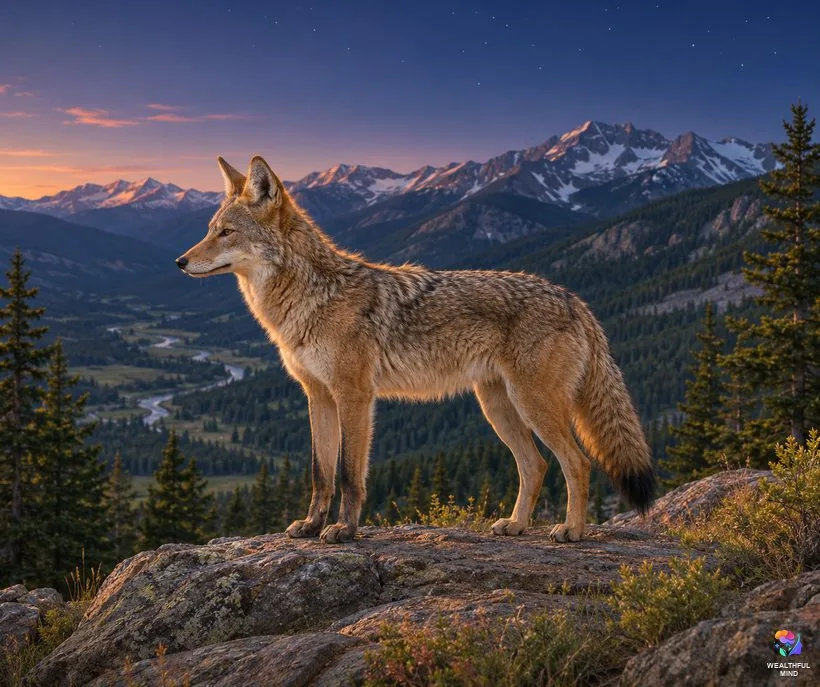
Coyote turns up in the stories of many Native nations, but you will not find a single Coyote. The Oregon Encyclopedia says it would be “a mistake” to assume all Native groups share one idea of him.
The Oregon Encyclopedia tells of a Navajo storyteller who said a Coos story about Coyote stealing salmon was not really a Coyote story at all. In Navajo country, the storyteller pointed out, coyotes do not eat fish.
So each story below carries its nation’s name and the source we read. Where we could not find a nation’s own telling, we left that nation out rather than guess.
○ Lakota: Coyote as a Lesson in What Not to Do
The Lakota name for the coyote is šuŋgmánitu, and the Aktá Lakota Museum calls him “a trickster and culture hero.” In Plains stories, the museum says, Coyote nearly always takes the shape of a man who is clever but reckless. His greed, boasting and lying keep getting him and the people around him into trouble.
You are meant to laugh at Coyote and then not copy him. The Aktá Lakota Museum says plainly that neither children nor adults should behave as Coyote behaves in the stories.
○ Southern Ute and Ute Mountain Ute: The Bag of People
The Southern Ute Indian Tribe shares its creation story on its own website, as told by Alden Naranjo, a Southern Ute Elder of the Mouache and Caputa bands. It begins when only Sinawav, the Creator, and Coyote lived on the earth.
In the Southern Ute telling, Sinawav gives Coyote a bag of sticks to carry over the far hills. He must not open it until he reaches the sacred grounds.
Just over the first hill, Coyote decides a little peek could hurt nothing. People burst out, shouting in many languages, and scatter in every direction. In the Southern Ute story, the few still left in the bag become the Utes.
Sinawav is not fooled. In the Southern Ute telling he calls Coyote “an irresponsible meddler” and dooms him to wander the earth on all fours forever “as a night crawler.”
A 2006 booklet of the same tale, from the Utah State Office of Education and the San Juan School District, sums Coyote up in its cultural note: “He has a bag full of tricks.” The booklet also says the story should only be told at a certain time, so if you want the full telling, go to the tribe’s own pages rather than to us.
It is one nation’s story, not a rule about every coyote. But it is a lovely thing to remember the next time you see one trotting along after dark.
○ Maidu: Coyote Beside Earth-Maker
For the Maidu of California’s Sierra Nevada, Coyote is there almost from the beginning. In the Maidu Texts that the linguist Roland Dixon collected, he is first seen with Earth-Maker, “giving him advice about how to build the world.”
Sacred Texts, the online library that carries the book, adds an important warning for you as a reader. It calls the trickster “an anti-hero, used as a way of defining the limits of the acceptable.”
○ Wasco and Other Oregon Nations: Good Rules and Bad Ones
Along the Columbia River, the Wasco Chinookan stories make Coyote the one who sets how things will be. The Oregon Encyclopedia says he mostly sets good precedents, such as freeing the salmon. He also sets some sad ones, as when he “recklessly loses forever” the chance of bringing loved ones who have died back to life.
The Oregon Encyclopedia article also mentions a Coos salmon story and the Nez Perce story of Coyote and the Shadow People.
Among the Oregon nations it describes, the Oregon Encyclopedia says, Coyote stories were by custom not told casually between spring and early fall. They were kept for formal indoor telling in winter.
That is one more reason for you to treat them as teachings with rules of their own, not as quick fortune readings.
○ What Is Coyote in Cherokee?
In Cherokee stories, the trickster is a different animal. World History Encyclopedia, drawing on the Cherokee tales James Mooney collected, says that in Cherokee lore “the rabbit is a trickster figure living by its wits.”
A Cherokee speaker on Reddit’s r/cherokee made the same point when asking about a coyote that crossed their path after a storm. They also said their searches only turned up pan-Indian answers.
So if a site tells you what a coyote means in Cherokee, be careful with it. We found no Cherokee teaching about coyote sightings that we could check.
○ If Coyote Is Part of Your Own Heritage
Coyote appears in far more nations’ stories than we can tell here. Many sites squeeze a dozen nations into two sentences and never say where any of it came from.
If your own family belongs to one of these nations, your best teachers are close to home, in your elders, your nation’s cultural office or its museum. They can also tell you when a story may be told, which matters in some nations, as the Oregon and Ute sources above show.
Is a Coyote a Good Omen or a Bad One?
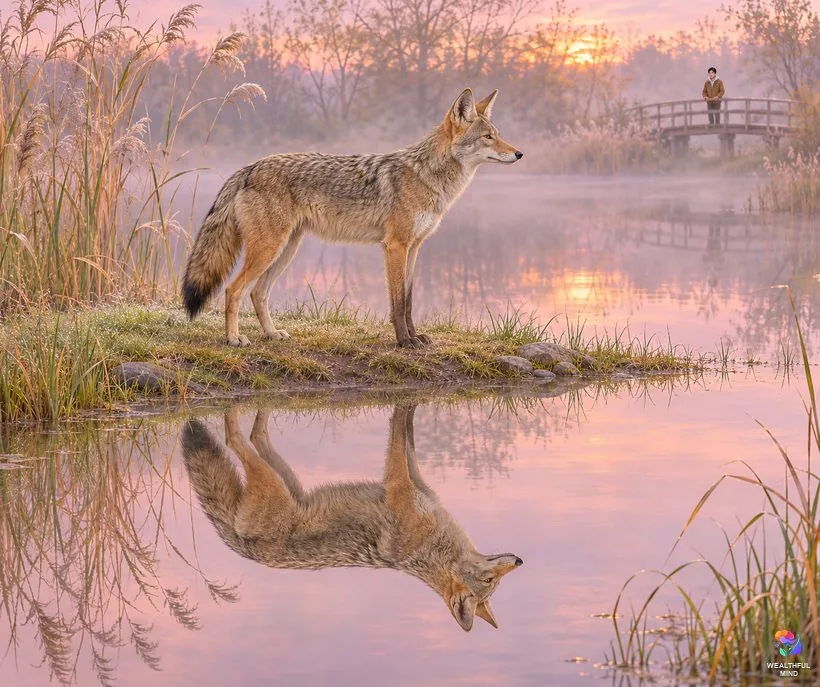
Neither, in our view, and the honest answer depends on whose story you start from. Modern spirit animal sites mostly call a coyote a good sign of adaptability and cleverness.
The Aktá Lakota Museum sees it differently for the Lakota, calling the coyote “a warning and a guide” that “reminds people to act with awareness and integrity.”
So we read a coyote as a small mirror held up to you, not a lucky charm and not a sign of doom. The useful question is whether you are about to be a bit like Coyote yourself, by taking a shortcut, showing off or fibbing your way out of something.
You are free to disagree. If your own family’s tradition says something different, follow that.
Claims that a coyote means something terrible is coming usually name no nation and no source. If someone tells you that, it is fair to ask whose teaching it is.
The fox plays tricks in plenty of stories too, and our fox spiritual meaning page covers the fox’s own folklore.
Coyote Spirit Animal Meaning
When people call the coyote their spirit animal, animal guide or totem, they usually mean they see its traits in themselves or need them right now. Modern writers list quick wits, a sense of humor, an easy way with change and a habit of learning from mistakes.
We think that last one is the trait most worth borrowing, because it sits closest to the old stories.
You do not need a quiz to find out whether the coyote is your animal. Notice whether coyotes keep turning up for you over a few weeks, in real life, in dreams or in conversation.
Write down where, when and what was on your mind each time. While you are at it, learn a little about the real animal too.
Coyotes Howling at Night
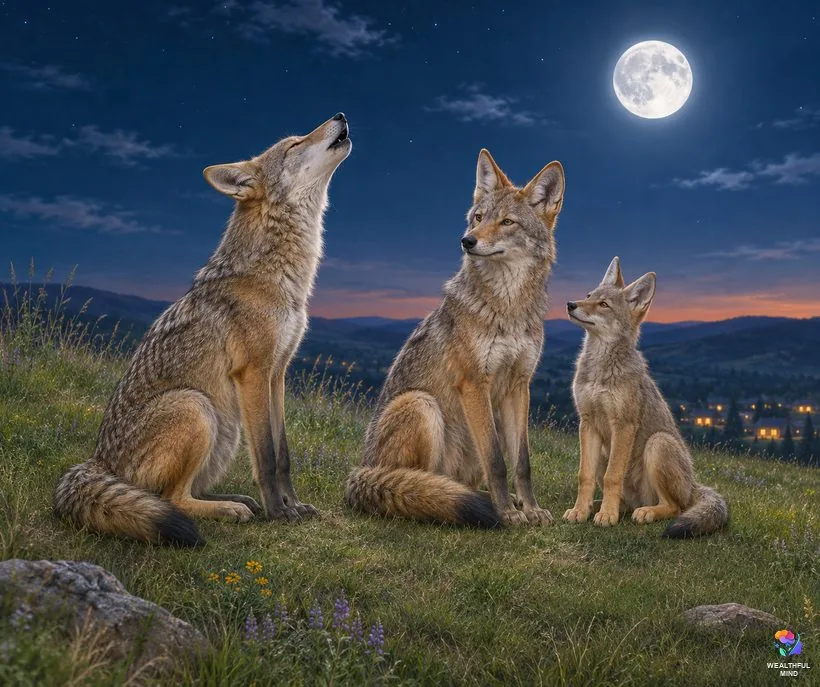
Hearing coyotes howl at night is about as ordinary as coyote moments get. MassWildlife says howling is “the main way coyotes communicate with each other.”
So a chorus outside your window is coyotes talking among themselves, not a warning aimed at you.
If you like to take it as a spiritual sign, many people read a howl as a call to speak up, or to reach out to your own people. And if the Southern Ute story stayed with you, you can picture the howl as Coyote, the night wanderer, still out on his travels.
Colors, Dreams and a Dead Coyote
You may find meanings online for white, black, red or even blue coyotes, for seeing two at once and for finding a dead one. We could not find a tradition behind any of them.
They come from modern spirit animal lists, and the lists rarely match.
A coyote in a dream is easier to read by how the dream felt than by any list. If Coyote tricked you in the dream, look for something in your waking life that feels like a trick. If it walked calmly beside you, you might take it as company through a change.
If you find a dead coyote, keep your distance and leave it alone. The CDC says never to approach an animal that looks injured, sick or dead, and to call animal control for help instead.
Our animal guide says more about what people take from finding a dead animal on the road.
How to Work Out What Your Coyote Meant

- Write down where you were, the time and what the coyote did.
- Think back to what was on your mind just before. That is usually where the meaning sits.
- Ask the trickster question. Is there a shortcut, a boast or a small fib in your week right now?
- Ask the change question. Where are you fighting something you could bend with?
- Look back over your notes if coyotes keep turning up, and see what those moments share.
○ An Example: The Coyote on the Bike Path
Imagine you are walking home along a bike path at dusk, a little pleased with the excuse that got you out of a group project that morning. A coyote trots out of the long grass ahead, stops, looks at you and slips away again. You stand tall the way the steps say, though it is already gone.
At home you write it down, and when you ask what was on your mind, the answer is the excuse and how easily it worked. That is just the kind of trick the Lakota stories warn against, so the lesson is to own up before it grows (and yes, you can also just enjoy that you saw a coyote).
Whatever you take from yours, a coyote is a clever neighbor that has learned to live right beside you. Give it plenty of room, and let it keep you a little more honest.
Frequently Asked Questions About Coyotes
Is a coyote a good omen?
It depends on whose story you follow. Modern spirit animal sites usually call a coyote a good sign of adaptability and cleverness, while the Aktá Lakota Museum describes the coyote as a warning and a guide whose stories teach what not to do. We read a sighting as a gentle check on your own shortcuts rather than a promise of luck or a sign of doom.
What is coyote in Cherokee?
In Cherokee lore the trickster is the rabbit, not the coyote, as World History Encyclopedia explains from the Cherokee tales James Mooney collected. We found no Cherokee teaching about coyote sightings that we could check, so be careful with sites that offer one.
Is it normal to see a single coyote, or one in the daytime?
Yes. MassWildlife says coyotes can be active at any hour and are seen more by day in spring and summer while they raise their young, and that daytime activity does not mean a coyote is rabid. The National Park Service says coyotes in Ohio live as a pair with their young, so one on its own may simply be a parent out looking for food.
What does it mean when coyotes howl at night?
MassWildlife says howling is the main way coyotes communicate with each other, so a chorus at night is coyotes talking among themselves. Spiritually, many people read a howl as a call to speak up or to reach out to the people who matter to you.
What should I do if a coyote follows me or comes close?
Do not run. The San Diego Humane Society says to stand tall, wave your arms and yell until the coyote leaves. In spring a coyote may follow you to move you away from its den, as Humane World for Animals explains, so walk a different way. If it seems sick, stumbling or circling, do not try to scare it off; call your local animal control instead.
Do coyotes mean different things to different Native nations?
Yes. The Oregon Encyclopedia says it would be a mistake to assume all Native groups see Coyote the same way. For the Lakota he is a trickster whose stories show what not to do, in the Southern Ute creation story he is a meddler who lets most of the people escape from a bag, and in the Maidu texts he sits beside Earth-Maker giving advice on building the world.