If a wolf keeps finding you, in a dream, on a friend’s hoodie or at the edge of a field at dusk, the wolf spiritual meaning most people give it is instinct, loyalty and freedom. We think the heart of all three is belonging, because a wild wolf pack is a family.
There is one catch with that field at dusk. In most of the United States, the animal you saw was probably a coyote or a dog, so we will help you check, and tell you what to do if it really was a wolf.
A wolf is one of the rarer animal signs, which is part of why it feels so big. Our animal spiritual meaning guide sets it beside the animals you are far more likely to meet, and signs from the universe shows you how to read any of them.
What Does a Wolf Mean Spiritually?
Most readings of the wolf you will find come back to four ideas.
- Instinct and intuition. A wolf studies the ground, the wind and the herd before it moves. Seeing one is often taken as a nudge to trust your gut. If you are not sure which of the two you are feeling, our post on instinct vs intuition in real-time decisions can help you sort them out.
- Loyalty. A wolf lives and hunts with its family. So a wolf sign is often read as being about the people you would stand up for, and the ones who would stand up for you.
- Freedom with belonging. The wolf travels far, but it comes back to its pack. Many people read this as permission to go your own way without cutting yourself off.
- The shadow side. The wolf is also the hungry one at the door in fairy tales. A wolf that frightened you may point to anger, hunger or fear you have been pushing down, and these shadow work prompts are a kind place to start with that.
Here is a simple rule of thumb. If the wolf felt calm or protective, start with one of the first three readings. If it felt threatening, start with the fourth.
Seeing a Wolf: Was It a Wolf, a Coyote or a Dog?
Before you decide what it means when you see a wolf, it helps to be sure you saw one.
Wolves once roamed from the Arctic tundra to Mexico, but the National Park Service says loss of habitat and extermination programs wiped them out across most of the United States by the early 1900s.
Today, the US Fish and Wildlife Service places the vast majority of wolves in the lower 48 states in two groups. You are in wolf country if you live in Michigan, Wisconsin or Minnesota, or in parts of Montana, Idaho, Wyoming, Oregon, Washington, northern California or northwest Colorado. Alaska has wolves too, and the Fish and Wildlife Service notes they have never been endangered there.
The US Fish and Wildlife Service adds the Mexican wolf, the rarest kind of gray wolf in North America, in Arizona and New Mexico, and the red wolf in eastern North Carolina.
Outside those places, you are very unlikely to meet a wild wolf. New York’s Department of Environmental Conservation (DEC) says there is no evidence of a breeding wolf population in the state, and only 3 wolves have been confirmed there since 2000.
So if you live in Texas, Ohio or Georgia and a “wolf” crossed your path, we would bet on a coyote or a dog first. Once you know what you saw, you can read the right animal.
○ How to Tell a Wolf From a Coyote
If you live in the East, your local coyotes can look surprisingly like wolves, and there is a reason. New York’s DEC says the average northeastern coyote is about 26 percent wolf by ancestry (and about 64 percent western coyote and 10 percent dog).
So look for several of these clues together, because one alone can fool you.
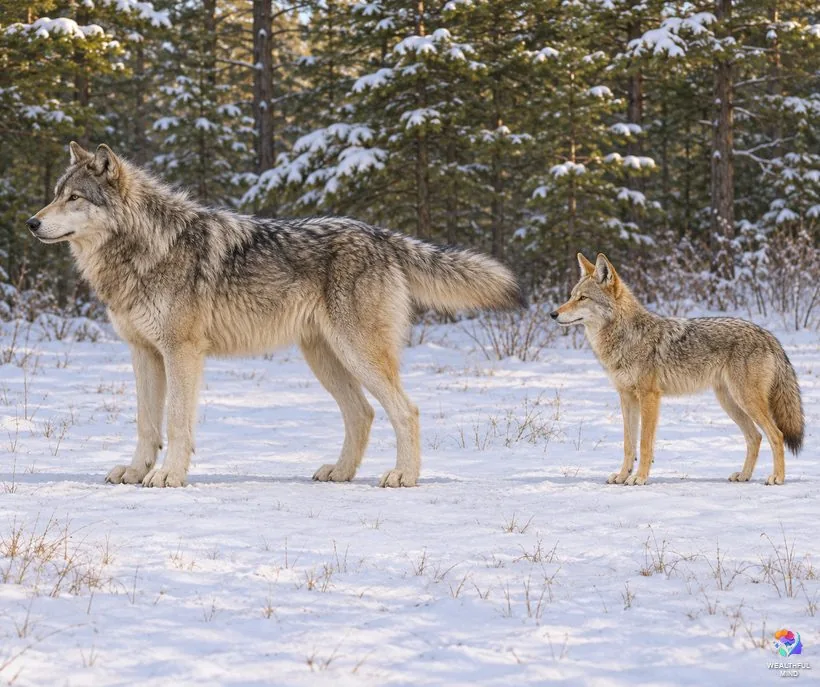
- Size. The Iowa Department of Natural Resources (DNR) puts a wolf at about 50 to 110 pounds and a coyote at 25 to 45. The Iowa DNR adds that a wolf stands about 27 to 33 inches at the shoulder, against 20 to 22 for a coyote.
- Ears. Wolves have small, rounded ears, and a coyote’s ears are pointed, the Iowa DNR says. A 30 pound coyote can even have ears as big as an 80 pound wolf’s, according to the Iowa DNR.
- Face. New York’s DEC describes a wolf’s large head with a short, broad muzzle. A coyote’s snout is pointed, the Iowa DNR says.
- Tail. If you watch it move, a wolf tends to carry its tail out behind it, while a coyote usually lets it point down, according to New York’s DEC.
- Paws. Wolves have much bigger feet, and New York’s DEC says their tracks measure 4 to 5 inches long.
Size is the most reliable clue, New York’s DEC says, but it is also very hard to judge from a quick sighting or a photo. So do not feel bad if you cannot tell. The Iowa DNR agrees the two can be hard to tell apart, especially at a distance.
If your animal was slim, with big pointed ears and a tail held low, you probably met a coyote, and it has meanings of its own. Our page on coyote spiritual meaning covers what a coyote sighting is said to mean and what to do when one comes near your home.
○ How to Tell a Wolf From a Dog
A husky, a malamute or a big shepherd mix can look a lot like a wolf, especially at night. By sight alone, the setting is often your best clue. New York’s DEC points out that dogs turn up where people bring them, like hiking trails, and that off-leash dogs can roam widely.
If you see a collar, a tag or someone calling a name, you have your answer.
If you can see tracks, New York’s DEC gives two more clues. Dog tracks tend to splay out, with big, blunt nail prints, while wolves keep their toes tight and pointing forward. A dog also wanders about, while a wolf tends to travel in a straight line, often setting its back foot into its front foot’s print.
Never walk closer to find out. A loose dog can be frightened too, and you are always better off watching any wild animal from far away.
○ If It Really Was a Wolf
Here is the comforting part first. Wolf attacks are extraordinarily rare, according to the staff of Denali National Park in Alaska. The Denali staff say the wolf to be careful of is one that does not act wary around people.
If you do meet a wolf, the steps from the National Park Service are simple.
- Stay calm, and do not run. Denali’s staff are clear that you should never run from a wolf.
- Keep your distance. The National Park Service asks Yellowstone visitors to stay at least 100 yards from wolves, about the length of a football field.
- Do nothing to invite it closer. Denali’s staff say never throw food, your bag or anything else at a wolf to distract it.
- Look big if it comes toward you. The National Park Service says to stand tall and hold your ground, then wave your arms, yell and flare your jacket. Denali’s staff add that you can make noise and group up with the people around you.
- Report it. If a wolf comes close or seems unafraid, tell the park or your state wildlife agency. New York’s DEC, for one, asks you to send in wolf-like sightings with a photo so its biologists can check them.
In the very unlikely event that a wolf attacks, Denali’s staff say to fight back, and never play dead.
And what does a real wolf sighting mean? For most people it is a once-in-a-lifetime moment, so many take it as a call to trust themselves or a reminder of who their pack is. We would add that a wolf that watched you and walked away chose distance, a good lesson in respect for both of you.
Wolf Spirit Animal: What It Means If the Wolf Is Yours

When you say the wolf is your spirit animal, you usually mean it feels like a guide, an animal whose nature matches something in you or something you need. For many people the phrase belongs to Indigenous teachings. So some prefer to say “animal guide,” and that is the term we reach for when we are unsure.
If you feel close to the wolf, you may recognize yourself here. You are loyal to a small circle rather than friendly with everyone. You watch a room before you speak, you need time alone, and you protect anyone who cannot protect themselves.
You may also wonder about a female wolf spirit animal. The traits are the same, and the real animal backs that up. In L. David Mech’s study of wild wolves, both parents guide the pack, and the mother takes the lead in caring for and defending the pups.
○ How to Know If the Wolf Is Your Spirit Animal
You will find plenty of quizzes for this. We skip them, because a quiz only sorts the answers you give it. The animal that keeps turning up in your life over weeks tells you far more.
- Notice it. Make a note each time a wolf appears, whether in a dream, a song, a show, a post on your feed or a real animal. Write the date and what was going on.
- Give it a month. One wolf on a poster is a coincidence. A wolf every few days for a month is a pattern.
- Watch your dreams. Many people say their animal guide showed up in a dream first.
- Learn the real animal. If the facts move you as much as the symbol, that is a good sign.
- Feel for the fit. Ask yourself whether the wolf’s way of living is something you already are, or something you need right now. Both count.
You do not need to have seen a real wolf, either. Plenty of people who feel close to the wolf never have.
○ Wolf Spirit Animal by Month or Birthday
You will also see wolf spirit animals sorted by birth month or birthday, along with a “wolf number.” We could not trace any of these to an old tradition, so treat them as modern ideas. The same goes for “wolf totem” and “power animal,” which you will see online used to mean much the same thing as spirit animal.
○ What the Lakota Teach About the Wolf
The clearest Indigenous teaching about the wolf that we could read in full comes from one nation, the Lakota, through the Akta Lakota Museum and Cultural Center. In Lakota, the wolf is Šuŋgmánitu Tȟáŋka, and the museum says it stands for loyalty, keen perception and the sacred bond between a person and the community.
The Akta Lakota Museum explains that watching wolf packs taught people about family, working together for the good of the community, sharp observation and avoiding needless fights. The Akta Lakota Museum also says the Wolf Society, an elite warrior society, prized the wolf’s power. Lakota scouts wore wolf hides and checked everything a second time, just like their animal guides.
For you, if you feel guided by the wolf today, the Akta Lakota Museum sums up the Lakota message in a single line. “Watch, listen, protect your people, and never mistake silence for weakness.”
This is one nation’s teaching, in their own museum’s words. Many sites say “Native Americans believe” without naming a people, and we leave those claims out.
The Wolf Pack: What Real Wolves Teach
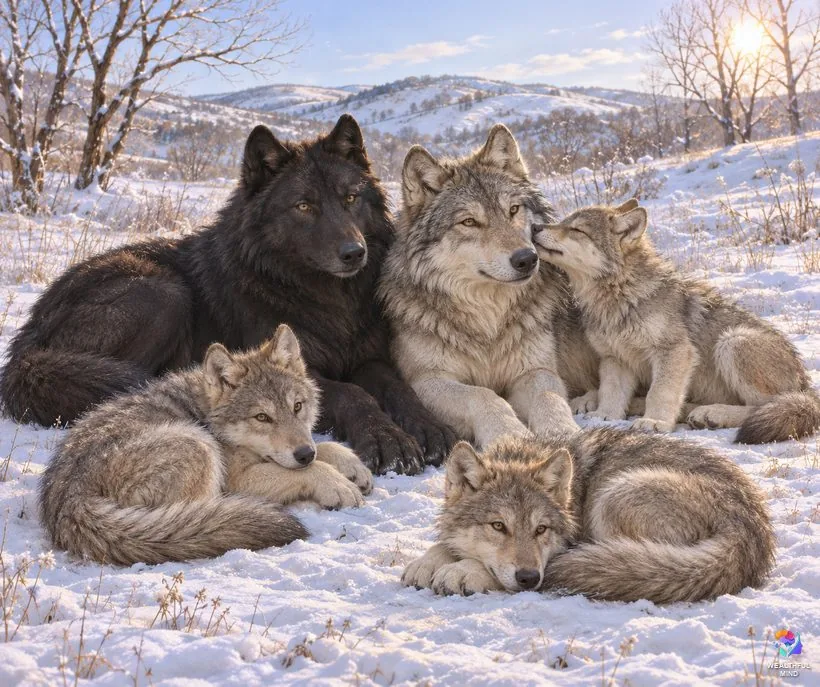
If you take one thing from real wolves, take this. The National Park Service describes a wolf pack as a complex social family, with older members and younger ones, each with its own personality and role.
You have probably heard of the “alpha wolf,” the toughest male who fought his way to the top. The wolf biologist L. David Mech pointed out in 1999 that most research behind that picture came from captive wolves. Those were wolves grouped together by people, not born into the same family.
David Mech’s own evidence came from wild wolves, watched over 13 summers on Ellesmere Island in the Canadian Arctic. His conclusion, published by the US Geological Survey, was that the typical pack is a family, with the adult parents guiding the group.
So the “alphas” are usually just the parents. (You will still see the word on the park service’s own wolf page, used for the older pair.)
That changes what the wolf can mean for you. A wolf does not lead by winning fights. It leads by raising its young and keeping the family fed, and we think that is a far better model for most of us.
Pairs are usually monogamous, the park service’s Yellowstone wolf facts say, though about a quarter of packs have more than one breeding pair. If a wolf came while you were thinking about a partner, you might read it as loyalty and a shared life.
○ The Lone Wolf
Calling yourself a lone wolf sounds strong. But in the wild, lone wolves are a small group. The park service’s Yellowstone wolf facts put them at only 2 to 5 percent of the wolves in Yellowstone, and 10 to 15 percent across North America.
Most of them are young. The same Yellowstone facts say wolves of both sexes leave the family they were born into at about two years old, on average.
We think the real lone wolf is a young wolf between one family and the next. So if you are a lone wolf right now, that can be a fine season, just not the whole story.
White Wolf, Black Wolf and Red Wolf Meaning

The color you saw changes the reading a little. Real wolves come in more colors than you might expect. The US Fish and Wildlife Service says wolf coats vary more than in almost any other species, from white through gray and brown to coal black.
○ White Wolf
A white wolf is usually read as a guide or protector, a sign of clear sight, a fresh start or a message from spirit. If one came to you in a dream, you probably felt it as calm and kind.
In Yellowstone, a white wolf really is unusual. The park service’s Yellowstone wolf facts list the coats there as gray or black in about equal numbers, and white only rarely.
○ Black Wolf
A black wolf is the one you are most likely to worry about. You may hear it read as the unknown, the shadow self, or protection in a dark time. In dreams, it often stands for a part of you that wants to be noticed.
But if you saw one, you did not see a rare omen. About half of Yellowstone’s wolves are black, the National Park Service says, from a gene believed to have come from domestic dogs long ago.
We think that makes the black wolf a better sign of protection than of danger. It is simply a wolf, wearing a coat it borrowed from dogs.
○ Red Wolf
The red wolf is its own species, and the US Fish and Wildlife Service calls it the world’s most endangered wolf. In the wild, the Fish and Wildlife Service says, it is found today in eastern North Carolina, a mostly brown and buff animal with some black along its back.
If you are drawn to the red wolf, you might read it as survival against long odds.
Wolf Howling: What It Means
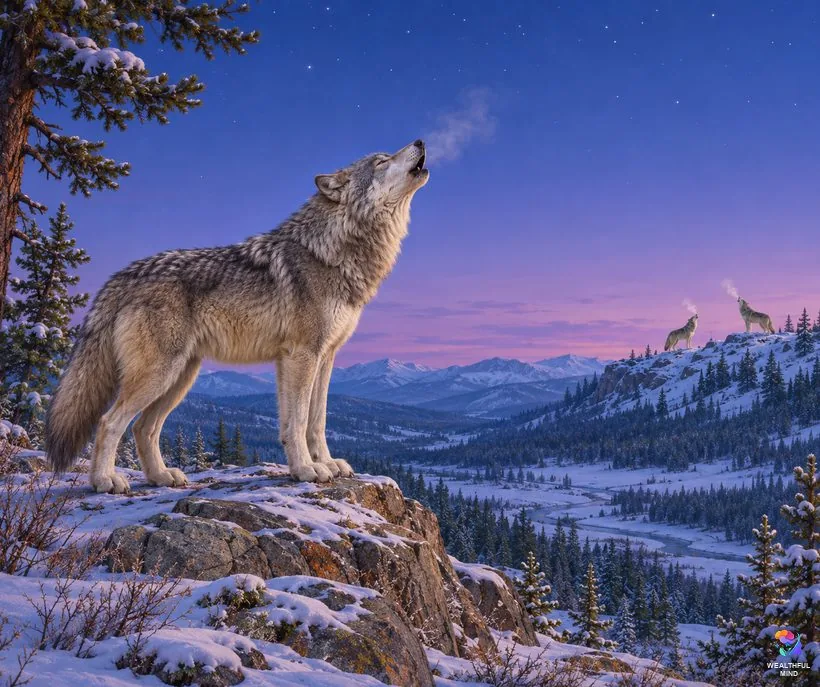
A wolf howl at night is one of the loneliest sounds there is, so you may hear it as a call. It might be someone missing you, a pull to reach out to your people, or a nudge to say something out loud that you have kept quiet.
The real reason wolves howl is far from lonely, though. The National Park Service lists howling’s uses as talking within the pack, advertising territory and coordinating social activities, and says packs howl to their neighbors too. A howl can carry about 6.6 miles through a forest and 9.6 miles over open ground, according to the park service’s Yellowstone wolf facts.
And the full moon? We found no wildlife agency that ties howling to the moon, and the park service’s list of reasons does not mention it. The wolf and the moon make lovely art, but we found no evidence behind the idea.
Unless you live in one of the wolf regions above, a howl near your home was most likely coyotes.
A Wolf in Your Dream
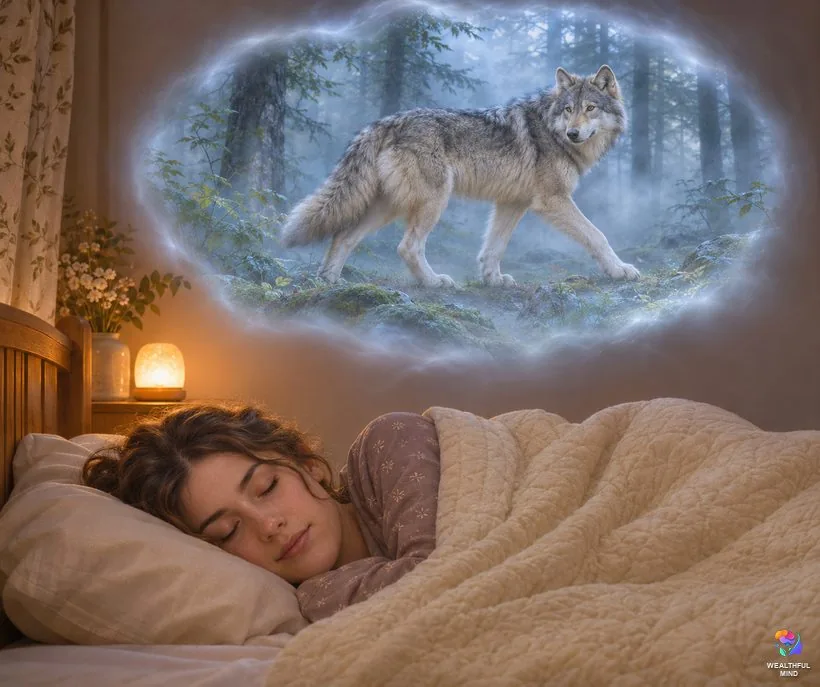
Dream meanings are interpretation, not fact, and no old tradition we could trace gives wolf dreams a fixed meaning. These are the readings you will most often find helpful.
- A calm or friendly wolf. Often read as a guide or protector, or as your own instincts telling you that you are on the right track.
- A wolf chasing you. Many people read this as something you have been avoiding, a feeling, a decision or a talk, catching up with you.
- A wolf attacking or biting you. Usually read as anger, fear or conflict, yours or someone else’s, that has come too close to ignore. It is rarely about a real wolf.
- A pack of wolves. Read as your circle of family or friends, and how safe or crowded you feel among them.
If wolf dreams keep coming back and leave you scared or short on sleep, talk to someone you trust, like a parent, a friend or a counselor. A bad dream that repeats is worth a real conversation, whatever it means.
Wolves in Myth, Faith and Story

These are the wolf stories you are most likely searching for, with what the old texts actually say.
○ The Cherokee Wolf Clan
The Wolf is one of the seven Cherokee clans, alongside Bird, Paint, Deer, Blue, Long Hair and Wild Potato, according to the National Park Service. In each village, a seven-sided council house stood for the seven clans.
Some sites go further and say the Wolf Clan was the largest or supplied the war chiefs. We could not find a Cherokee source that says so, so we stop at the clan itself.
○ Norse Myth: Odin’s Wolves and Fenrir
Norse myth has two very different wolves, and you will often see them mixed up online. Geri and Freki are Odin’s companions. In the Poetic Edda (Bellows’ translation), their names mean “the Ravenous” and “the Greedy.”
They sit by Odin’s side at the feast, and he gives them all the food set before him.
Fenrir is the monster wolf. Encyclopedia.com says it is written that Fenrir will swallow Odin during the final battle, and then be killed by Odin’s son.
So Geri and Freki are not Fenrir’s children, as some wolf pages claim. They are Odin’s own wolves, fed from his table. If you feel drawn to the Norse wolf, it matters which one you mean, a loyal companion or the monster that kills Odin.
○ Greek Myth and the First Werewolf
The werewolf has a Greek ancestor. Encyclopedia.com notes that Ovid wrote of a Greek king named Lycaon, turned into a wolf by Zeus as punishment for serving human flesh to the gods. The word lycanthropy comes from his name, Encyclopedia.com adds.
If you searched for a werewolf spirit animal, here is the honest answer. A werewolf is a creature of stories and films, not an animal guide.
○ Rome and the Celts
In Roman legend, a she-wolf fed the twins Romulus and Remus. You may also read about a Celtic wolf meaning, but we could not find a source we trust for one, so we do not give one here.
○ What Does the Bible Say About Wolves?
The Bible mostly uses the wolf as a warning. In Matthew chapter 7, verse 15 (NIV), Jesus says, “Watch out for false prophets. They come to you in sheep’s clothing, but inwardly they are ferocious wolves.” In John chapter 10, verse 12, a hired hand runs from the wolf, and “the wolf attacks the flock and scatters it.”
But the Bible also gives the wolf a place in one of its best-known pictures of peace. Isaiah chapter 11, verse 6 says, “The wolf will live with the lamb.”
Two claims you will see online are not in the text. John chapter 10 does not compare the wolf to the devil, and we found no demon tied to wolves in the verses we read. In these verses the wolf is a threat to the flock, such as a false prophet, and in Isaiah a sign of a peace so complete that even the wolf takes part.
How to Work With Wolf Energy

Here are two short practices, one on paper and one in your head.
○ Wolf Journal Prompts
- List the people in your pack, the ones you could call at two in the morning.
- Describe one time this week when your gut was right and you talked yourself out of it.
- Finish this sentence: “The person I protect is… and the person who protects me is…”
○ A Five-Minute Wolf Meditation
- Sit somewhere quiet and close your eyes. Breathe slowly until your shoulders drop.
- Picture the edge of a pine forest in the evening, with snow on the ground and the air cold and clean.
- Let a wolf step out of the trees. Notice its color, how far away it stands and how it looks at you.
- Walk with it for a while, at its pace. If it stops, you stop.
- Ask it one question and wait. Whatever comes, a word, a face or a feeling, is your answer for today.
- Thank it, open your eyes and write down what you saw.
If you cannot picture things, play a recording of wolves howling and notice what you feel when the pack answers.
Then send a message to someone you have been missing. That is the wolf’s oldest lesson, and it works whether or not a wolf ever crosses your path.
Frequently Asked Questions About Wolves
What does it mean when you see a wolf?
Most people read a wolf sighting as a call to trust your instincts and a reminder of who your people are, because wild wolves live in family packs. Before you settle on a meaning, check what you saw. The US Fish and Wildlife Service places nearly all wolves in the lower 48 states in two areas: Michigan, Wisconsin and Minnesota, and the northern Rockies and nearby states. Alaska has wolves too, and smaller numbers live in Arizona, New Mexico and eastern North Carolina. Elsewhere, a wolf-like animal is most likely a coyote or a dog.
How do you know if the wolf is your spirit animal?
Watch for a pattern instead of taking a quiz. If wolves keep turning up for you over several weeks, in dreams, songs, shows or real life, and the wolf’s loyal, watchful and independent nature feels like you or like something you need, many people take that as a sign the wolf is their animal guide.
What does a wolf symbolize in the Bible?
Mostly danger. In Matthew chapter 7, verse 15, false prophets are called ferocious wolves in sheep’s clothing, and in John chapter 10, verse 12, the wolf attacks and scatters the flock. But Isaiah chapter 11, verse 6 also says the wolf will live with the lamb, a picture of peace. No verse we read compares wolves to the devil or names a wolf demon.
How can you tell a wolf from a coyote?
Look at several clues together. The Iowa Department of Natural Resources puts wolves at 50 to 110 pounds and coyotes at 25 to 45, and says wolves have rounded ears while coyote ears are pointed. New York’s Department of Environmental Conservation adds that a wolf has a short, broad muzzle, tends to carry its tail out behind it, and leaves tracks 4 to 5 inches long. Size is hard to judge at a glance, so do not rely on it alone.
What does a white wolf mean spiritually?
A white wolf is usually read as a guide or protector, and as a sign of clear sight or a fresh start. It is also an unusual sight in many places. The National Park Service lists Yellowstone’s wolves as gray or black in about equal numbers, and white only rarely.
What does a wolf in a dream mean?
Dream readings are interpretation, not fact. A calm wolf is often read as a guide or your own instincts, a wolf chasing you as something you have been avoiding, and an attacking wolf as anger or fear that has come close. If wolf dreams keep returning and disturb your sleep, talk to someone you trust.