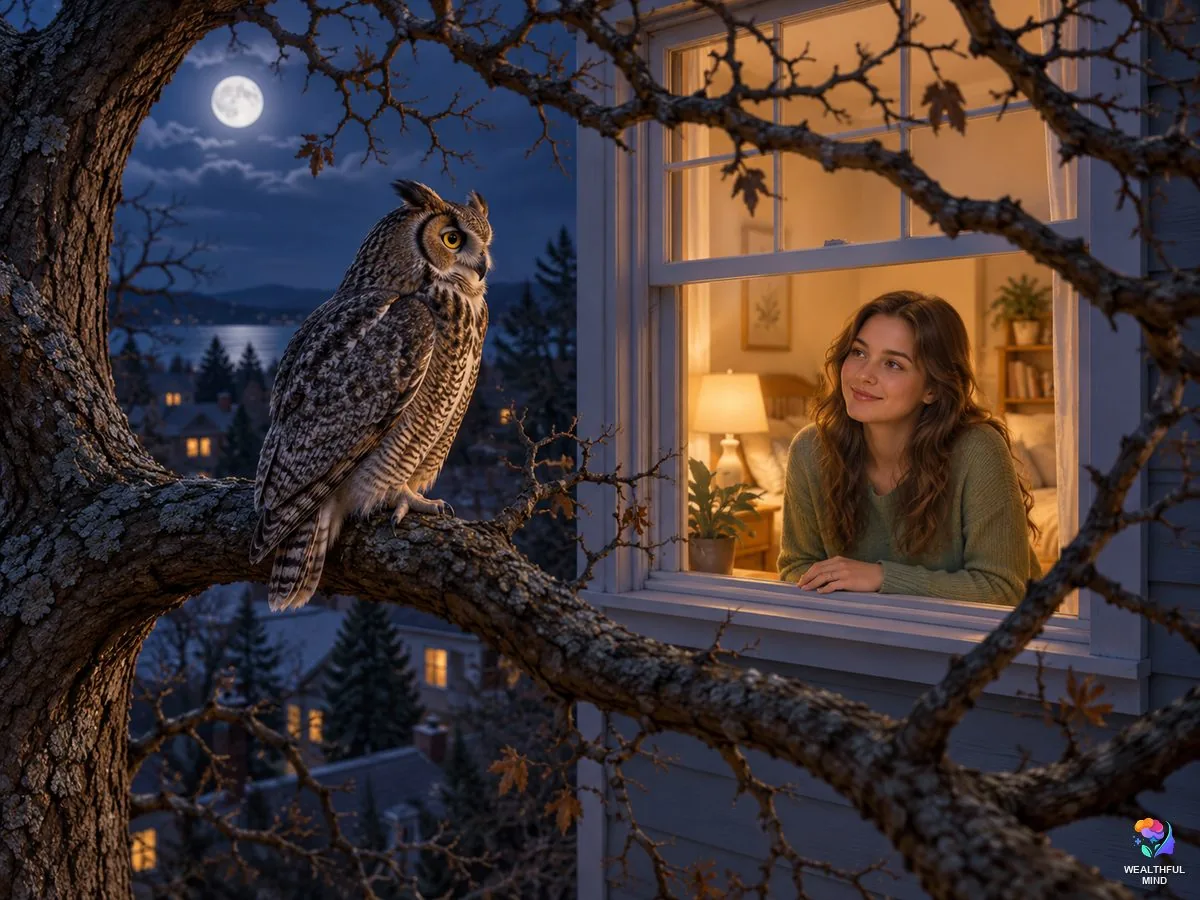
For most people, the moth spiritual meaning is a soul close by, and you can also read a moth as change that happens quietly, in the dark, before anyone else can see it. The soul link is very old, too. If you open the Liddell and Scott Greek dictionary, you will find “butterfly or moth” among the meanings of psyche, the Greek word for soul.
We would not read an ordinary moth at your window as a warning. The death omen you may have heard about belongs mostly to one big, dark moth from Mexico, the black witch (and even that moth is lucky in other places).
Quick pick
What Did the Moth Do?
Find the moment that matches yours, then jump to the full answer.
- Came after someone died? Many take it as their soul nearby, and it is fine if none comes
- Kept circling your lamp? A reflex traps it there, so ask what light you keep chasing
- Landed on you and stayed? Let it rest, and take it as a quiet “you are not alone”
- Huge, dark and on your porch? Probably a black witch moth, feared in Mexico but lucky in the Bahamas
- Pale green, with long tails? A luna moth, a short-lived visitor many read as a new beginning
- Small and hiding in your closet? Likely a clothes moth, so treat it as a pest first
Keep reading below Why moths are tied to the soul White moth meaning Good or bad luck? What the Bible says Questions
Moths share much of their folklore with butterflies and bees, and our guide to the spiritual meaning of insects puts them side by side. If this is the first sign you have ever wondered about, our page on reading signs from the universe gives you a simple way to start.
What Does It Mean When You See a Moth?
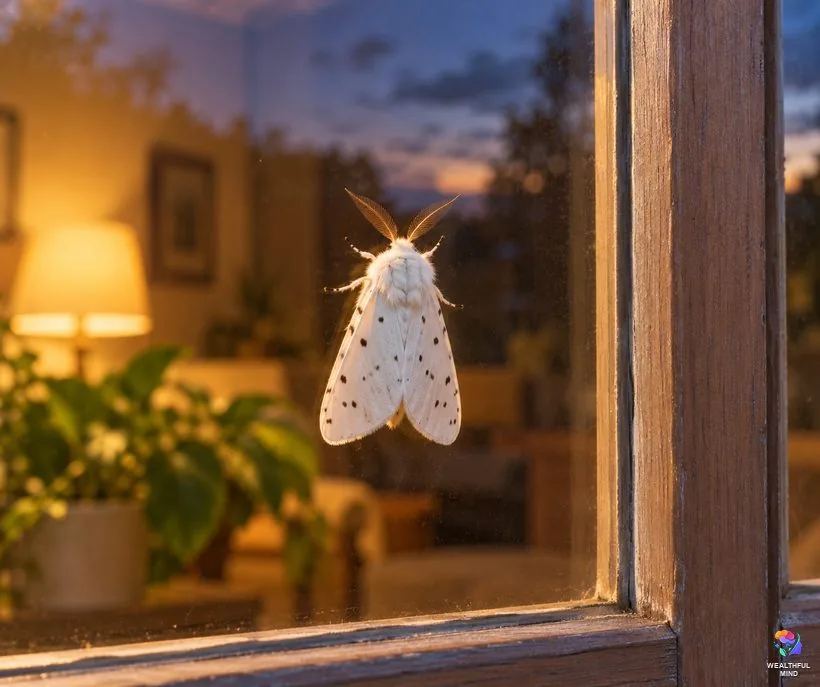
Moths turn up at the edges of your day: at dusk, at a lit window, on the wall beside your bed. These are the readings you will come across most.
- A loved one nearby. This is the big one, and it has its own section below.
- Quiet change. A moth does its changing hidden away in a cocoon, so you might see one as a hint that something in you is shifting before it shows.
- A pull toward the light. It can stand for hope, or for something true that you keep circling.
The right reading for you usually depends on what was in your head a moment before.
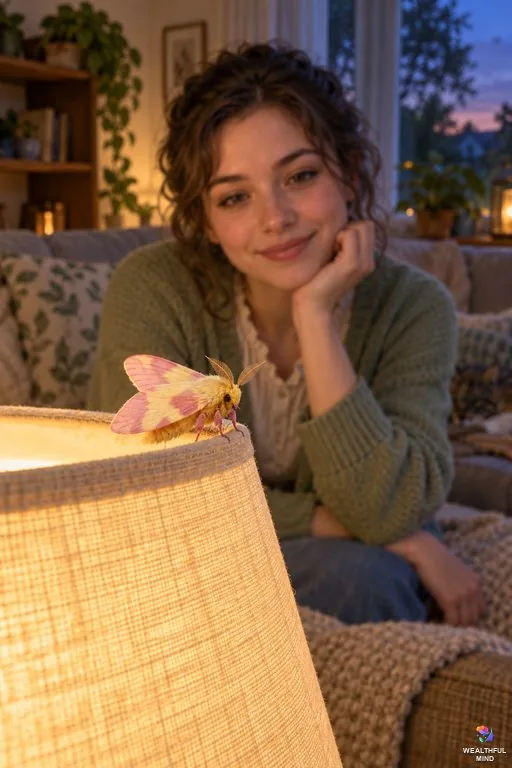
Picture a late night on the couch, your grandmother’s kitchen on your mind, and a pale moth settling on the lampshade beside you. That moth is probably about her. If instead you have been stuck on a decision for weeks and a moth keeps bumping against your window, the light reading may fit you better.
The Smithsonian counts some 160,000 moth species in the world against 17,500 butterflies, with nearly 11,000 kinds of moth in the United States alone. So the moth is no plain cousin of the butterfly.
○ Moths, Love and Big Life Moments
No old tradition ties moths to love. But a moth drawn to a light is an easy picture of you being drawn to a person, so you can read one as a sign of attraction, or of a crush you cannot stop thinking about.
Moths also show up in stories about big days: on the car the week after a breakup, or in a new apartment on moving day. We think the moth works like a bookmark there. It marks a page you will want to come back to.
○ Seeing Moths Everywhere, or the Same One Every Night
Check the plain reasons first. Late summer is busy with moths, your porch light pulls them in, and some kinds travel a long way.
The Smithsonian notes that many moths migrate, including the day-flying Hummingbird Hawkmoth, which moves north across Europe as the weather warms in early summer.
On Reddit, British readers asked about a sudden wave of large moths in August 2026. A commenter said one was a Silver Y and that it had been a strong year for migrant moths, probably from France or Spain.
Try a simple test: turn your outdoor lights off for a few nights. If you still keep meeting moths in odd places (in the car, on your bag, at work), you have a pattern worth thinking about. The person or worry on your mind each time is probably your answer.
Why Moths Fly to Your Light
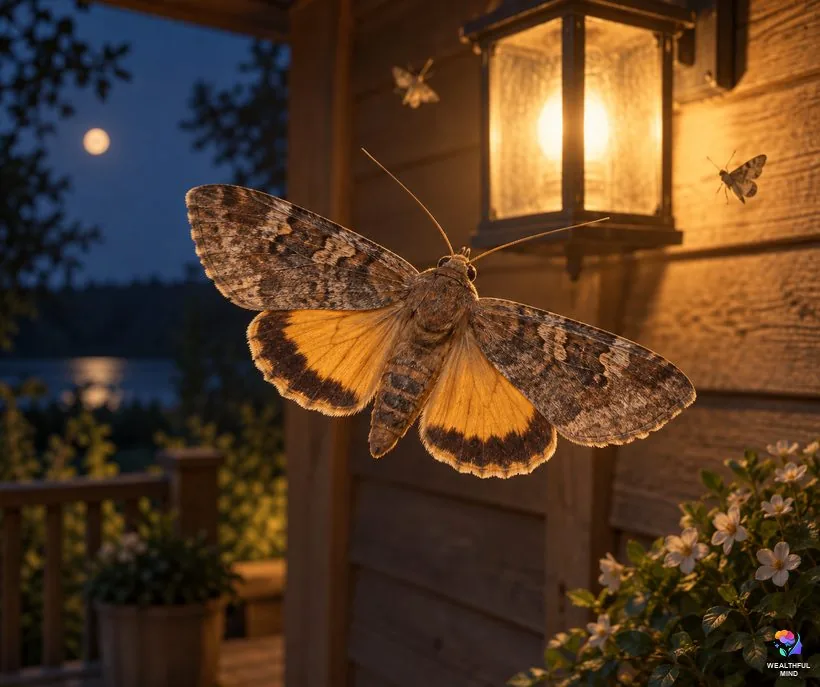
You have probably read that moths steer by the moon and mistake your lamp for it. A study published in Nature Communications in January 2024 found that this old idea does not match how moths really fly.
The Nature Communications team filmed insects around lights with high-speed cameras, outdoors and in a lab. The insects did not fly straight at the bulb. They kept turning their backs toward it. A flying insect normally knows which way is up by keeping its back to the brightest part of its view, the sky. Near your lamp, that same reflex makes it circle, stall or even flip over. A confused moon compass, the authors wrote, “does not match our results.”
If you want to help the moths outside your home, the Nature Communications study suggests cutting back on unshielded lights that shine upward. The University of Florida adds that light pollution may get in the way of mating for luna moths and other silk moths.
- Switch off your porch and garden lights when nobody needs them.
- Point your outdoor lights down, or choose fittings with a shade on top.
- Carry a trapped moth outside under a glass, with a sheet of paper slid underneath.
○ A Moth at Your Window at Night
Moths find their way without daylight, so a moth at your window at night can feel like permission to go forward without seeing every step.
It can also be a plain nudge to rest. Moths are soft, slow night creatures, and you might hear one as “go to bed, you have done enough today.”
“Like a moth to a flame” has two sides when you read it as a sign. A moth at your lamp can stand for the part of you that keeps reaching for something bright and good. It can also be a gentle question for you. Is the light you keep circling really guiding you, or is it only bright?
Moth Spiritual Meaning and the Soul

If a moth came to you after a death, you are standing in the oldest part of moth folklore. Here is where it comes from.
○ The Greek Word for Soul
According to the Liddell, Scott and Jones Greek lexicon, psyche could mean a departed spirit or ghost (in Homer), the immortal soul and also a butterfly or moth, a use it traces to Aristotle.
Ronald Polansky, writing on Aristotle for Cambridge University Press, explains why one word covered both. In Homer the psyche is “a kind of breath-soul escaping at death.” That picture of something light slipping away, he says, “may help explain” why the same word was used for a moth.
○ The Yorkshire “Soul” and the Ghost Moth
British folklore went further. In The Entomologist’s Record, G. F. Le Pard wrote that most butterfly and moth beliefs come from “the curious idea that the human soul takes on the form of a butterfly (or moth) after death.” In Britain, he adds, different kinds were even matched to groups of people, so large grey moths became millers.
In Yorkshire, Le Pard records, the Ghost Swift moth “was called the ‘Soul’ and left strictly alone.” His source is a folklore collection from Notes and Queries, printed in 1859.
Butterfly Conservation, the British wildlife charity, says the Ghost moth’s English name comes from European folklore in which white moths were thought to be the souls of the departed. The males are entirely white and sway slowly over the grass at dusk in a courtship display. The adults have no working mouthparts, so they cannot feed.
Butterfly Conservation also thinks the Ghost moth appears in the last passage of Wuthering Heights, so we read Emily Brontë’s ending ourselves. At three graves on the edge of the moor, the narrator “watched the moths fluttering among the heath and harebells.” He wondered how anyone “could ever imagine unquiet slumbers for the sleepers in that quiet earth.”
Brontë never names the species. So the Ghost moth part is a guess. But her moths at the graves are a picture of peace, not of fear, and you may feel the same way about the moths you meet.
○ A Moth After Someone Dies
One person on Reddit wrote that since their mother died, they had been seeing moths “like crazy,” in the apartment, in the elevator and at work. They had always been scared of moths. Now each one felt like comfort. In the same thread, someone whose father had been a writer said a very large moth landed exactly on their painting of an old typewriter.
Another family in that Reddit thread held a Buddhist funeral and kept noticing a small brown moth. It came near the coffin, during the final prayers and on the seventh day, “when Chinese believed that the deceased will return home.”
If a moth found you like this, there is nothing you need to do about it. You can let it sit, open a window for it later and tell the story to someone else who misses them. Saying hello to them, aloud or silently, is fine too.
If no moth comes, that tells you nothing about where your person is, or how much they loved you. Being afraid of moths is fine, and so is not believing in signs at all. Your grief does not need an insect to be real. If a different sign feels closer to your heart, you might find it in a white feather instead.
A Moth in Your House
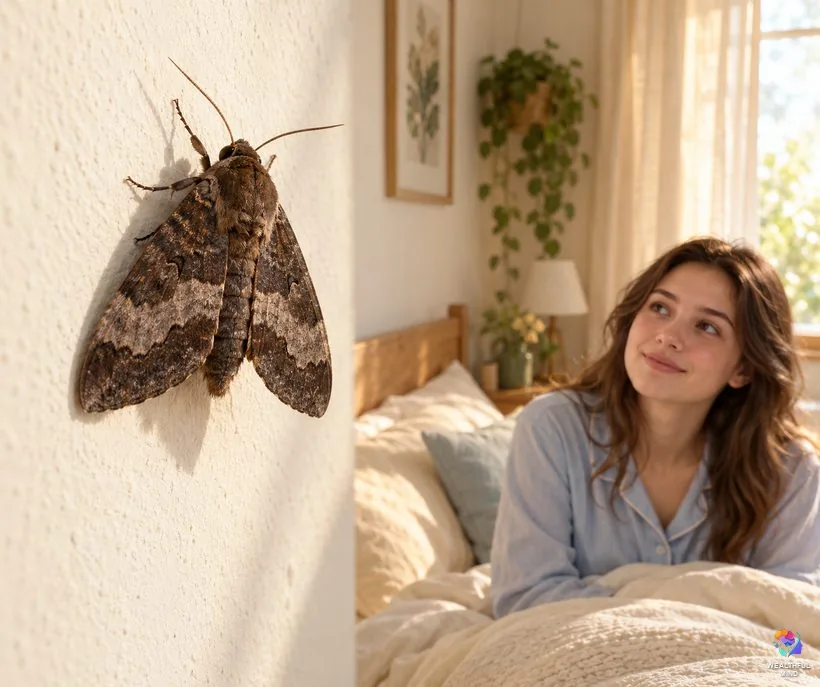
You can read a moth indoors as a visitor in your private space. Some people feel it means that something you have kept at a distance is coming closer: a feeling, a decision or a memory of someone. A moth in your bedroom is often linked to rest and dreams.
The insect side is simple. Butterfly Conservation describes the Old Lady, a large brown moth that sometimes slips into houses for a dark hiding place by day, then comes out at night into someone’s living room.
Plenty of moths do the same, so a big moth on your wall in the morning has usually just been sleeping there.
○ Lamp Moth or Clothes Moth?
This one check tells you whether you are looking at a sign or a pest.
According to the University of California’s pest management program (UC IPM), the webbing clothes moth is small and gold, with wings only about half an inch across. It is a weak flyer and is not attracted to lights, so you usually find it close to the damaged items, in a dark part of the closet. Only the larva eats fabric. Pantry moths, UC IPM adds, are the ones that often fly around the house.
That means a moth fluttering at your lamp is not the one eating your sweaters. Small moths hiding in your closet or kitchen cupboard are a pest problem first, and our guide to moths and other bugs indoors explains what to do about them.
If you buy mothballs, keep them well away from small children and pets, who can mistake them for candy, says the National Pesticide Information Center. In the US, Poison Control is 800-222-1222. UC IPM adds that these products are toxic, and they only work in an airtight container.
A Moth Landing on You
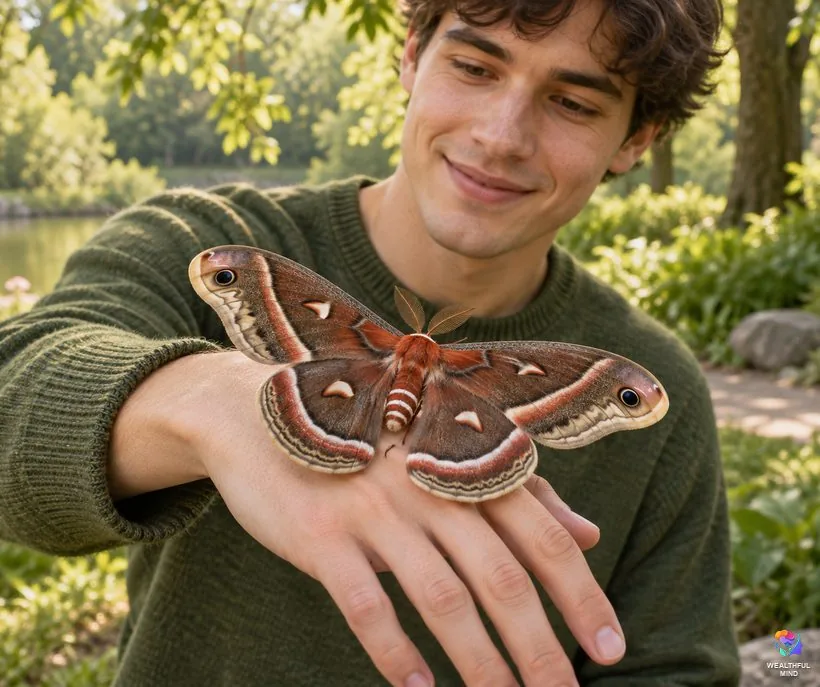
Nobody can tell you why one particular moth chose you. What you feel in that moment is easier to describe: comfort, a sense of being picked out and an urge to stand very still.
One of the most loved posts on Reddit’s moths forum came from a shopper who had a large silk moth ride along for more than a quarter of an hour. Commenters on Reddit said it was a Glover’s silkmoth. They joked that it liked the shopper’s sweater, and one pointed out that these moths do not go looking for salt. (Big silk moths cannot feed as adults, so it was probably just resting.)
You can take a moth on your hand or shoulder as a quiet “you are not alone,” or as a cue to pause before a big step. If it lands on you while you are thinking about someone, you can take it as their hello.
If you need to move on, here is how to do it gently.
- Stay still for a minute and enjoy it.
- Hold a leaf, a card or your other finger in front of its legs and let it step on.
- Set it on a plant or a shady wall outside, away from bright lights.
Moth Colors and What They Mean
Most moth color charts you will find online are recent, and no two of them agree. Only white and black moths have older folklore behind them. Read the rest by how the moth made you feel.
○ White Moth
A white moth is the classic soul moth of European folklore, as you saw above with the Ghost moth. To many people it means a loved one close by, purity or a clean start.
If a white moth made you think of a twin flame, our white butterfly page covers twin flames, and the same ideas apply to pale moths.
○ Black Moth and the Black Witch Moth
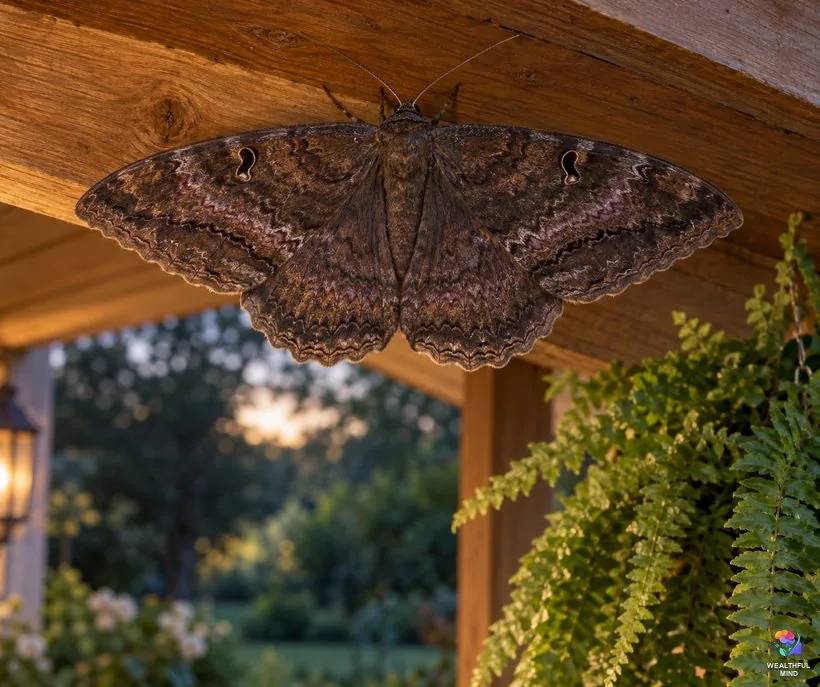
Most small dark moths carry gentle readings for you: rest, endings and the quiet work of letting something go. The big exception is the black witch moth.
Colorado State University calls the black witch the largest moth found in North America, with wings that can be more than 6 inches across. It is mottled brown with a purple and pink sheen, and you might take it for a bat at first as it rests under eaves by day.
It flies north when Mexico’s rainy season begins, from early June through October, Colorado State says. Strong winds have carried it as far as Hawaii and Alaska. In Mexico it is sometimes called “mariposa de la muerte,” the butterfly of death, a legend reportedly dating to the Aztec era.
The entomologist Mike Quinn, on his Texas Entomology site, quotes a 1918 source: when someone in the house is sick and this moth enters, the sick person dies. In the lower Rio Grande Valley, he adds, death comes only if it visits all four corners of the house. One of its Nahuatl names is built on miqui, death.
The same moth is lucky elsewhere. Mike Quinn reports that on Cat Island in the Bahamas it is called a money moth, and money comes to you if it lands on you. In South Texas, one resting above your door for a while is said to bring a lottery win.
You will also read that in Hawaii the black witch is a loved one’s soul coming back to say goodbye. Mike Quinn and the University of Wisconsin-Milwaukee field station both repeat it without naming a Hawaiian source. We could not trace one either, so treat it as a saying, not an old Hawaiian belief.
Our favorite name comes from the Maya. According to the Milwaukee field station, its Maya name means “May I borrow your house?”, because these moths so often shelter on and inside buildings. So if a huge dark moth is resting on your porch in late summer, you are probably watching a traveler that rode the wind north.
A hospice worker who met one wrote on Reddit about finding it “beautiful instead of frightening.” We would read it that way too.
○ Brown Moth
Brown is the most common moth color, so it gets the most homely readings: being grounded, looking after your home and the people in it, and small, steady changes.
You might be searching for a brown moth’s meaning in love. There is no tradition behind it, but a plain brown moth that keeps returning to you is easy to read as loyal, quiet affection.
Indoors, a small brown moth in your pantry or closet is more likely a pest than a message, so do the clothes moth check above first.
○ Green, Yellow and Other Colors
If you saw a big pale green moth with long tails, you met a luna moth, and it has its own section below.
Yellow moths are often read as joy, creativity and warmth, and orange ones as energy, but these readings are new and personal. A bright yellow or orange flier in the daytime may be a butterfly instead.
The quickest way for you to tell, according to the Smithsonian, is the antennae. Moths usually have threadlike or feathery ones, while butterflies have a small club at the tip. Our butterfly meaning guide covers those.
Luna Moth Meaning
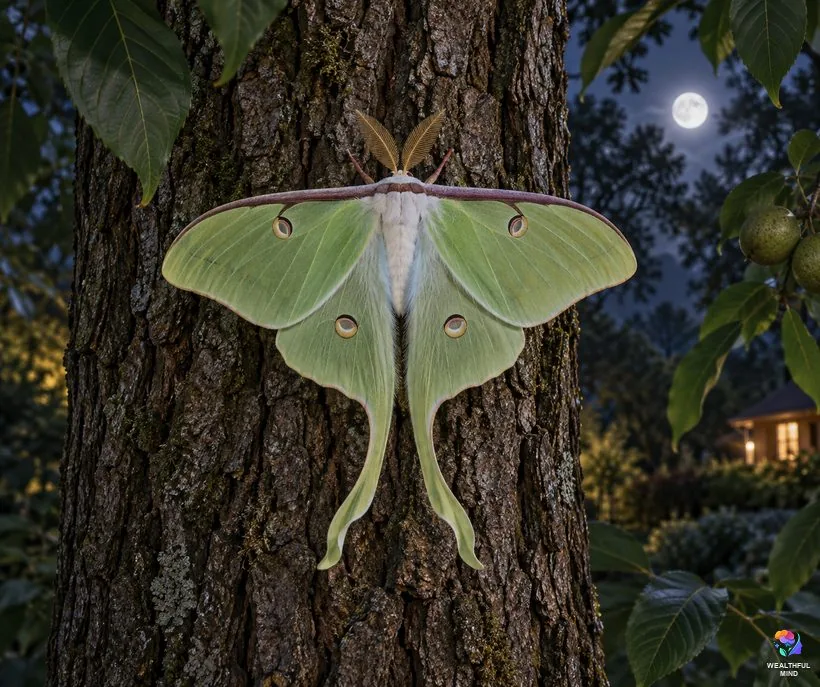
The luna moth is the one you remember for years. Etymonline, a word history dictionary, dates its name to 1841 and says it comes from the crescent-shaped eyespots on its wings.
The University of Florida describes it as a large pale green moth with a long tail on each hind wing and eyespots on all four wings, about 3 to 4 1/8 inches across. The adults have no working mouth and do not feed, so they are short-lived.
Missouri’s Department of Conservation puts an adult’s life at only about a week. The adults fly from early April through August in Missouri and are “common throughout the state.”
So a luna moth is not rare. It is brief, and it flies at night, which is why you so seldom see one.
That is where most luna readings come from. You might treat one as a once-in-a-while gift, a new beginning or a message to use the time you have, and its moon name links it to intuition and cycles.
One Reddit user, new to paganism, found a luna moth inside the house the night before their wife’s first ultrasound. The comments filled with people telling them to name the baby Luna.
There is a love reading too, and this one has a real basis. The University of Florida notes that a female luna releases a scent that can draw males from a distance, and they usually mate in the first hours after midnight. If you saw one while thinking about someone, you could read it as a promise that the right people find each other.
Polyphemus, Hummingbird and Death’s-Head Moths
○ Polyphemus Moth
The polyphemus moth is named after Polyphemus, the one-eyed giant of Greek myth, because of the big eyespots on its hind wings, the University of Florida explains.
The University of Florida calls it the most widely spread large silk moth in the US, found in every lower 48 state except Arizona and Nevada. Its wings are 4 to 6 inches across, and the adult does not feed. When threatened, it flips its front wings forward to flash those eyes, possibly to startle a predator.
From that flash, you can read a polyphemus moth as being seen, as watchfulness, or as a nudge that you are braver than you look.
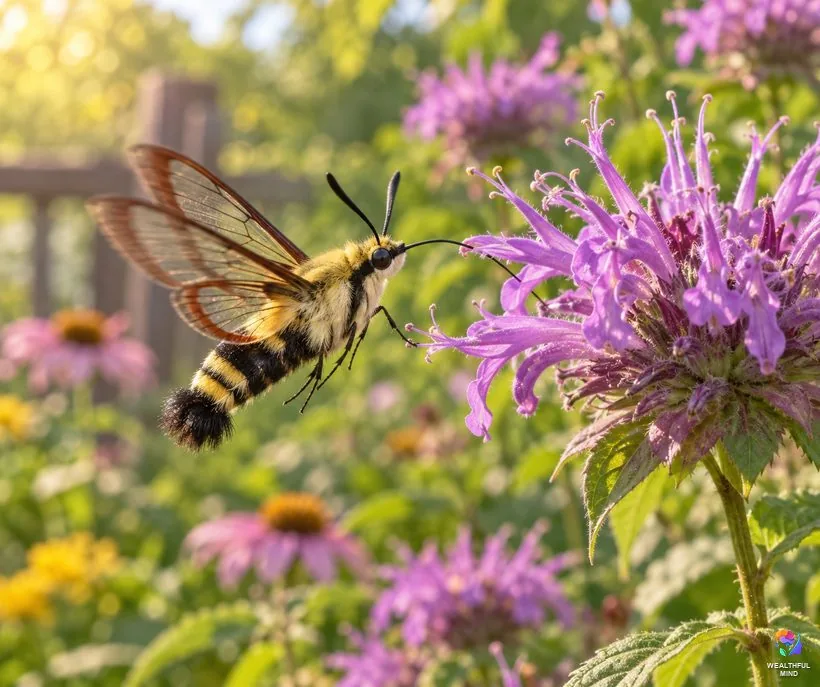
○ Hummingbird Moth
The University of Minnesota Extension describes the hummingbird moth as a furry yellow and black moth with mostly clear wings. It feeds on flower nectar during the day and is active from May to July in Minnesota.
Because it hovers like a tiny bird, you can give it the same readings as a hummingbird: joy, sweetness and enjoying the moment. Our page on what a hummingbird means goes deeper.
○ Death’s-Head Hawkmoth
This is the moth with the skull-like mark on its back. Butterfly Conservation explains that its scientific name points to Acheron, the river of the underworld, and Atropos, the Fate who cut the thread of life.
Its arrival, Butterfly Conservation says, has traditionally been seen as an omen of death. You will find it in Thomas Hardy’s The Return of the Native and in the 1991 film The Silence of the Lambs.
In the novel the film was based on, the moth pupae were black witch moths, and the film swapped in the death’s-head, according to Colorado State University.
The old dread was real. G. F. Le Pard tells of an English village in 1870 where churchgoers backed away from one on the churchyard path until the blacksmith jumped on it. He adds that in France it was an even stronger “harbinger of evil.”
It lives in southern Europe and only occasionally reaches Britain, says Butterfly Conservation. So if you ever see one, you have seen something special.
Is a Moth Good or Bad Luck?
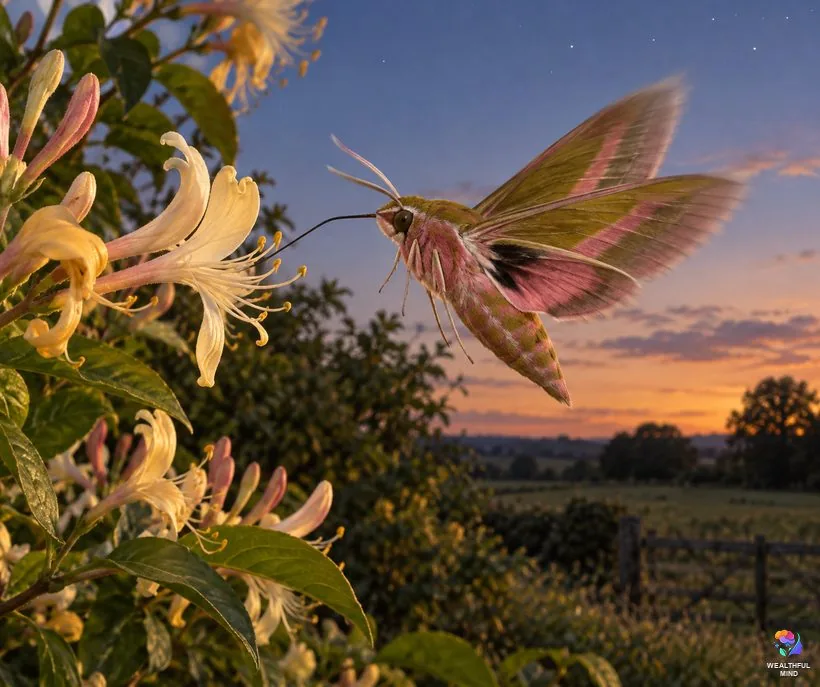
Both stories exist. We think the lucky side wins, because the comfort (moths as souls and loved ones) is far more widespread than the fear.
So do moths symbolize a warning? Not as a rule. The few warning stories we could trace belong to the black witch in Mexico and the death’s-head hawkmoth in Europe.
You will also see websites claim that “Native American,” “Celtic,” “Japanese” or “Hindu” traditions treat moths as messengers or omens, without ever naming the people, the book or the storyteller. We found nothing behind them, so we leave them out.
Moths are quiet helpers, too. Researchers at University College London swabbed 838 moths on Norfolk farmland and found pollen on 381 of them (45.5%), from 47 plant species. That includes at least 7 plants that bees, hoverflies and butterflies rarely visit, University College London adds. A creature that pollinates flowers while you sleep is hard to call bad luck.
○ A Dead Moth
You will often find dead moths, because many adult moths live short lives, as the luna’s single week shows.
You can read a dead moth as a chapter closing, a finished change or the circle of life. Someone who works in victim services tried to save a dying rustic sphinx moth outside work and could not. To them, it said that you cannot save everyone.
If you find one at your door, leave it outside under a plant. If you accidentally killed a moth, please do not carry it as a bad sign. Nothing in the folklore we traced punishes you for an accident.
What Does the Bible Say About Moths?
The Bible mentions moths several times. Every verse we checked in the King James Bible uses the moth as a picture of decay and of riches that do not last.
The best known King James verse is Matthew, chapter 6, verses 19 and 20: “Lay not up for yourselves treasures upon earth, where moth and rust doth corrupt,” but “in heaven, where neither moth nor rust doth corrupt.” There is also Job, chapter 13, verse 28, on “a garment that is moth eaten,” and Psalm 39, verse 11, on beauty that consumes away “like a moth.”
The moth in these verses is the clothes moth. Etymonline notes that until the 1500s the English word “moth” was used mostly for the larva that eats wool, and it points to Matthew.
None of the verses we read mentions light, and none treats a moth as a sign or a messenger. So if you are asking what God says about moths, the King James answer is mostly that earthly things wear out. You can still take a moth as a personal reminder to care about what lasts. That is a lovely way for a Christian to read one.
Moths in Dreams
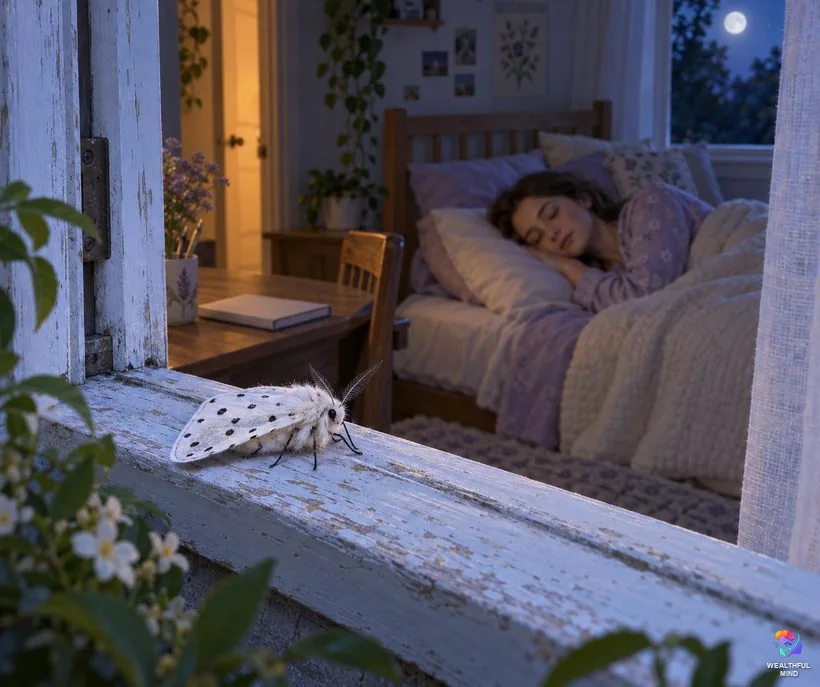
Dream dictionaries give you long lists of moth meanings, but none of them comes from a real tradition. Your own feeling in the dream tells you more.
A calm moth, or one that rests on you, usually reflects comfort or someone you miss. A moth circling a light in your dream can point to a goal or a person you keep coming back to.
A swarm, or a moth you cannot get away from, usually reflects a worry of your own coming out at night. That is especially true if you are scared of moths when you are awake.
People post all kinds of moth dreams online, from a giant white moth to moths flying out of an ear. When you wake from one, think about what was weighing on you the evening before.
Whatever brought you here, a moth at your window is a small, soft visitor that came through the dark to sit near your light. Tonight, open the window, switch off the lamp and let it find its own way home.
Moth Meaning: Your Questions
What does it mean if a moth visits you?
Most people take a visiting moth as someone they have lost coming close, or as a sign that a quiet change is happening in their life. Think about who or what filled your thoughts right before it arrived, because that is usually the part that speaks to you. If it stays at your lamp, it may simply be caught by the light, which research published in Nature Communications in 2024 explains.
Do moths symbolize a warning?
Not as a rule. The warning stories we could trace belong to a few big, dark moths: the black witch moth, called the butterfly of death in Mexico, and the death’s-head hawkmoth in old European folklore. Most moth beliefs are gentle ones about souls and change, and even the black witch is called a money moth in the Bahamas.
Is a moth a sign from a loved one who died?
For many grieving people, yes, and the belief is old. The Greek word psyche meant both soul and moth, and in Yorkshire a white moth was once called a “Soul” and left alone. No one can show it either way, so keep the comfort if it helps you, and know that a quiet year with no moth means nothing about your person.
Why are moths attracted to light?
They are not really steering toward it. Research published in Nature Communications in 2024 found that flying insects keep their backs turned toward the brightest part of what they see, which is normally the sky. Near a lamp that reflex makes them circle, stall or flip over, and the old idea that they mistake lamps for the moon did not match the flights the researchers filmed.
Does a moth in my house mean I have a moth problem?
Usually not, if the moth is flying around your lamp. UC IPM, the University of California’s pest management program, says clothes moths are weak flyers that are not drawn to lights and stay near the damaged wool in dark closets. Small moths in a closet or pantry are worth checking, and our guide to moths and other bugs indoors explains what to do.
What does God say about moths?
In the King James Bible, moths are a picture of decay and of riches that do not last, as in Matthew, chapter 6, verses 19 and 20: lay up treasures in heaven, “where neither moth nor rust doth corrupt.” None of the verses we checked mentions light or treats a moth as a sign. Many Christians still take a moth as a personal reminder to care about what lasts.