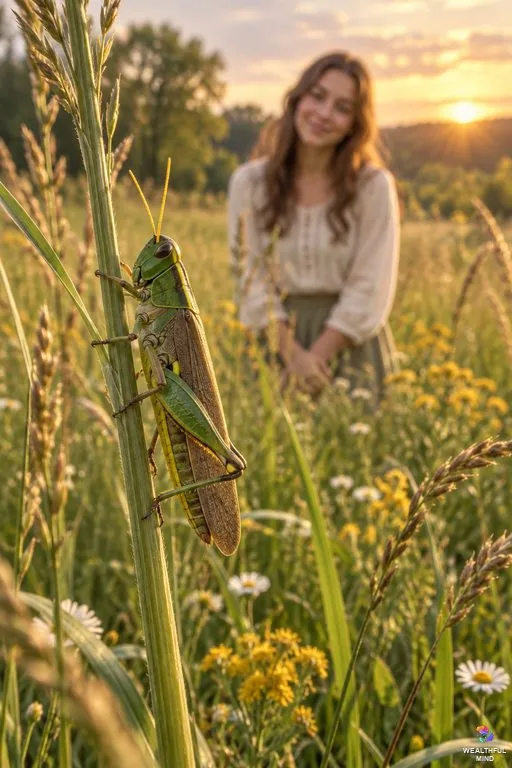
If a grasshopper just jumped onto your sleeve, the grasshopper spiritual meaning you will hear first is a nudge to take the step you keep putting off. Many people add a little luck waiting for you on the other side, and that is the reading we would start with too.
Older traditions are more mixed. Some saw grasshoppers as a blessing of plenty and others as a plague on the crops.
And the popular idea that a grasshopper can only jump forward has nothing behind it that we could find. So enjoy the leap as a picture, not a fact. A grasshopper does not need to be unable to go back for you to choose to go forward.
Quick pick
Where Did You Meet the Grasshopper?
Pick the moment closest to yours and jump straight to its answer.
- Hopped into your house? A stray from outside, often read as a fresh start, so carry it out in a cup
- Landed right on you? Usually an escape jump that came down on you, read as a nudge to act
- Green or brown? Green is read as growth, brown as steady progress
- Seeing them everywhere? Late summer is their peak, and many take it as a push to move
- Hoping it means money? Its money link is a London merchant’s crest, so treat it as a push to act
- Dreamed about one? Read it by how the dream made you feel
Keep reading below Grasshoppers in the Bible The old stories, traced A baby grasshopper Grasshopper or cricket? Questions
For butterflies, bees, moths and the rest, see our guide to what insects mean spiritually. If you would like one simple method for reading any sign, start with signs from the universe and how to read them.
What Does It Mean When You See a Grasshopper?
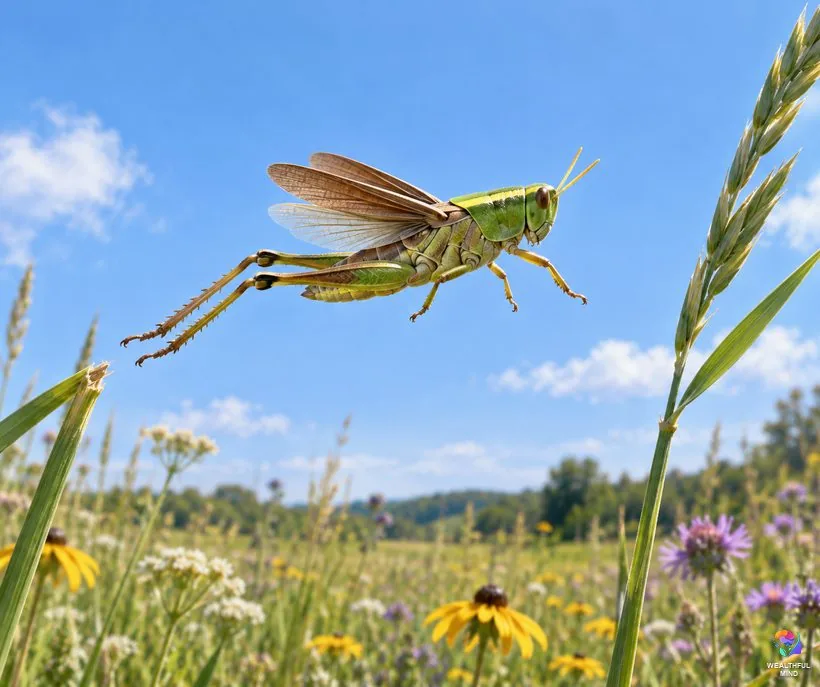
You will meet these readings most often. None of them is proven, so keep the one that fits your life right now.
- A leap forward. This is the heart of it. Many people take a grasshopper as a sign to stop waiting and act.
- Progress after a slow stretch. A grasshopper can sit perfectly still and then, in a blink, it is gone. If you have felt stuck, that can feel like a promise.
- Luck and plenty. This is the favorite modern reading.
- Your own voice. Grasshoppers sing, so some people hear one as a reminder to trust your gut and say what you think.
- Patience while you learn. “Grasshopper” is also a nickname for a beginner, so seeing one can feel like a kind “you are still learning, and that is fine.”
To find yours, go back to the moment just before you saw it. A decision you keep delaying points to the leap. A money worry points to luck, and a new job, class or hobby points to patience.
Some people also feel that someone they have lost is close when a grasshopper stays near them. We found no tradition that says this about grasshoppers, but if it comforts you, it is yours to keep. And if no sign comes at all, that says nothing about how much you were loved.
Why Do Grasshoppers Suddenly Appear?
For most of the year there are simply no grown grasshoppers to see.
UC IPM, the University of California’s pest program, says most kinds have one generation a year. Their eggs wait in the soil through winter and hatch when the ground warms in spring. The adults live two to three months, until cold weather or a lack of food ends them.
Numbers also swing a lot from one year to the next. According to UC IPM, bad outbreaks come only every 8 to 10 years, when warm, moist springs give them plenty of food. When wild weeds dry up in early summer, grasshoppers move into green gardens, and in big migrations adults can fly 15 miles or more in a day.
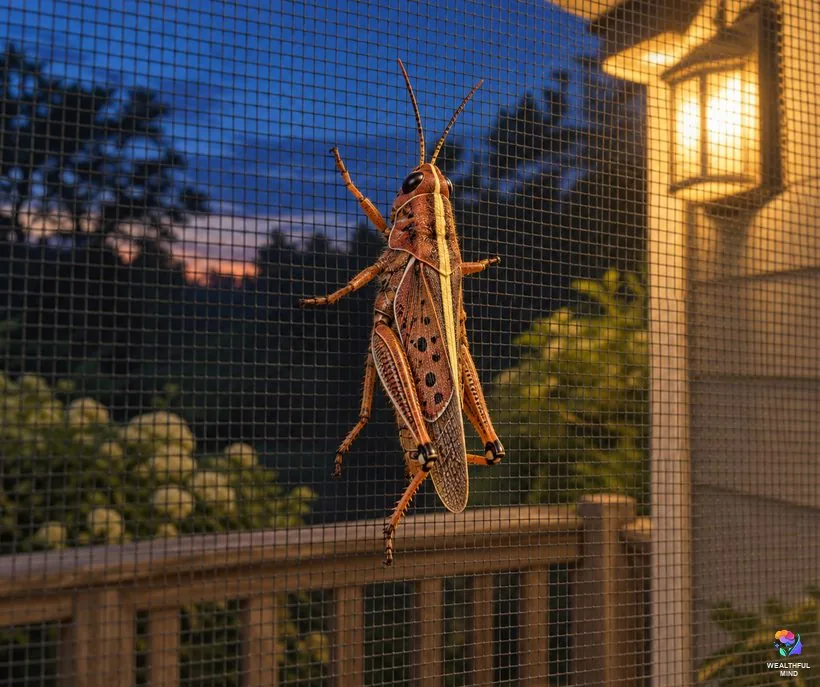
Late summer and fall bring the most. Oklahoma State University’s extension service says the American bird grasshopper starts to show up in late July, peaks from August to October and is often drawn to lights at night. That is why you may suddenly find one on your porch light, your window screen or your car in the evening.
None of this cancels the meaning. You noticed this grasshopper, on this day, with this question on your mind, and that part belongs to you.
A Grasshopper in Your House

A grasshopper on your kitchen wall is one of the moments people search for most. Many take it as luck coming through the door, a fresh start at home or news on its way.
In parts of India, some families say a grasshopper indoors is lucky and others treat it as a warning. We only found this belief in popular videos, not in any written tradition, so hold it lightly.
If you are a Christian wondering about a green grasshopper in the house, no Bible verse talks about one indoors. The grasshoppers of scripture are about smallness and great numbers, which you can read about in the Bible section below.
The plain side is simple. UC IPM says grasshoppers lay their eggs in undisturbed soil outdoors, so the one in your house is a stray that hopped or flew in. It is not going to start a family behind your sofa.
Here is how to help it home.
- Turn off nearby lamps if it is evening, because light may have drawn it in.
- Place a clear cup over it and slide a stiff piece of paper underneath.
- Carry it outside and let it go on grass or a plant, a little away from your door.
- Say goodbye, or say thank you, if that feels right.
Do not worry if it kicks or leaves a brown mark on your hand. Healthline’s medically reviewed guide says grasshoppers rarely bite people, are not poisonous, and that their brown “tobacco juice” can stain your skin for a while but is not dangerous.
If grasshoppers or other bugs keep turning up indoors, treat it as a household problem first. Our page on bugs in the house and their spiritual meaning covers both sides. Please skip the bug spray for a single grasshopper, since UC IPM warns that the sprays used on grasshoppers are very toxic to bees and other helpful insects.
A Grasshopper Landing on You

When a grasshopper lands on you, it can feel as if it picked you. Many people read it as a personal nudge, a sign that the timing is right for the step on their mind, or a small moment of luck.
There is a plain reason too. The University of St Andrews pages on grasshopper jumping say that one of the main reasons a grasshopper jumps is to escape a predator, and that it tumbles in the air after take-off. So the one on your arm most likely jumped away from something (quite possibly your own feet) and came down on the nearest surface, which happened to be you.
If it stays a while, let it. Hold still, take a slow breath and ask yourself what you have been waiting to begin.
○ One Riding on Your Car or Window
Some people watch a big green grasshopper cling to the car window for the whole drive home, looking right at them. It is often read as a companion on the road, or a sign that you are moving in the right direction.
Before you set off, brush it gently onto a plant. If it hitches a ride anyway, keep your eyes on the road and save the meaning for when you park.
○ One in Your Path or Flying Past You
A grasshopper that hops across your path is usually read as a sign that the way ahead is open. One that whizzes past your ear several times in a week is often taken as a “pay attention” moment.
People also ask about a dead grasshopper in their path, and a few websites call it bad luck or worse. We could not find any tradition behind that, so please do not let it frighten you.
Green and Brown Grasshoppers
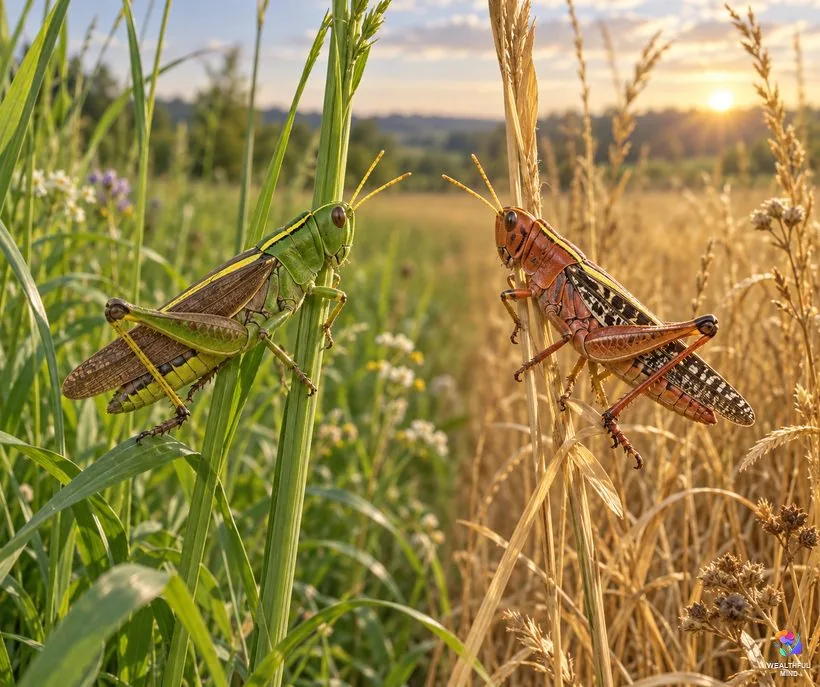
Color meanings for grasshoppers are modern, not from any old tradition. But grasshopper color has a real cause, and it is a nice one.
A 2015 study in BMC Evolutionary Biology sums up earlier research this way. Heat, humidity, moist food and not being crowded all push grasshoppers toward green, while dry conditions favor brown, and many species simply come in one color or the other.
In the alpine grasshopper tested in that BMC study, color was set early in life and never switched to match the background. So your grasshopper’s color tells you something about its season and its kind, and you can read the meaning on top of that.
○ Green Grasshopper Meaning
A green grasshopper is read as growth, healing and a fresh start, and many people see it as a sign that they are on the right path. That suits the insect, since green ones tend to come from lush, damp seasons.
If you saw a green one while starting something new, take it as a yes.
○ Brown Grasshopper Meaning
A brown grasshopper is usually read as grounding and slow, steady progress. Brown suits dry grass and the end of summer, so a brown one often turns up as the year winds down.
You can take it as permission to finish what you started before you leap again.
○ Big, Bright or Black Grasshoppers
If you live in the Southeast and saw a huge, slow, yellow and black grasshopper, it was probably an eastern lubber.
UF/IFAS, the University of Florida’s extension service, describes it as clumsy and slow, with hind wings too short to fly. The adults are often mostly yellow or tawny with black markings. Its young are almost all black with a yellow, orange or red stripe, and people often mistake them for a different insect.
Those bright colors are a warning.
According to UF/IFAS, an alarmed lubber spreads its wings, hisses and gives off a foul froth. Animals that eat one without knowing better often gag, throw up and can even die. So keep your curious dog or cat away from them, and wash your hands if you move one.
For meaning, many people read a big, bold grasshopper as a call to stand out and to protect your energy. That fits a bug that keeps trouble away just by wearing its colors.
What Does a Baby Grasshopper Symbolize?
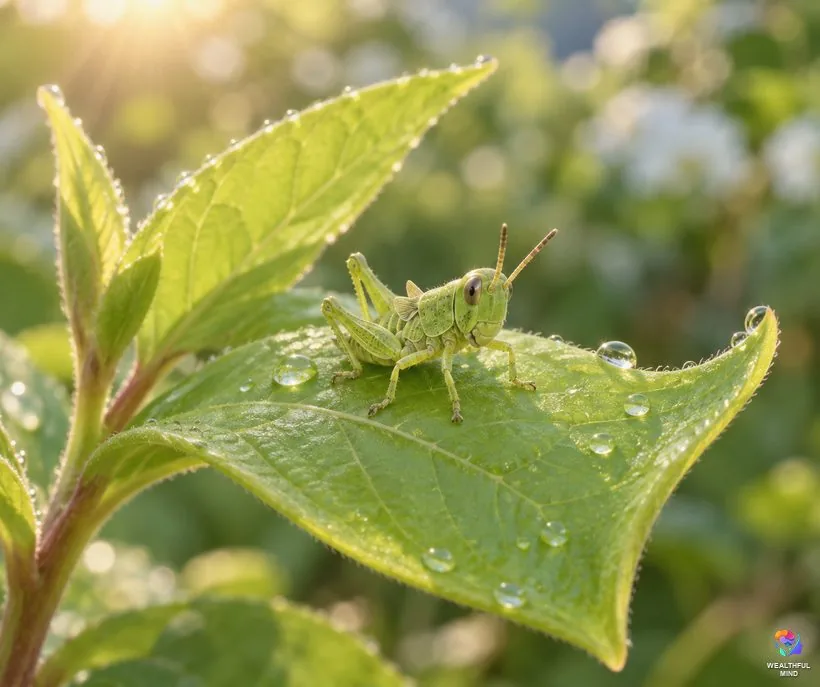
A baby grasshopper is usually read as a small beginning, like a new idea, a new habit or a fresh chapter that is still growing. The real insect makes that reading even sweeter.
According to UC IPM, young grasshoppers (called nymphs) hatch from eggs in the soil when it warms in spring, and most kinds molt five to six times before they are grown. Oklahoma State’s extension service adds that nymphs look like small adults with tiny wing buds.
So a baby grasshopper grows by outgrowing its own skin, again and again. If one showed up while you are learning something, take it as permission to grow in stages and to feel a bit awkward in between.
Do Grasshoppers Bring Good Luck or Money?

Many people today say yes. The real money story behind the grasshopper is about a merchant, though, not magic.
Boston.com explains that the grasshopper is part of the family crest of Sir Thomas Gresham, who founded the Royal Exchange in London in 1571. The building still carries a golden grasshopper on its weathervane. A family legend says a woman heard a grasshopper chirping and found a Gresham ancestor as an abandoned baby in a field, but Boston.com reports that the London Bullion Market Association calls it “probably apocryphal.”
The grasshopper then crossed the ocean. In the same Boston.com story, the merchant Peter Faneuil copies the Royal Exchange and hires coppersmith Shem Drowne to make a grasshopper weathervane for Faneuil Hall in the 1740s. A local tour guide says Faneuil “wanted to announce that we had a marketplace, an exchange of our own.”
So the grasshopper became a sign of trade and money because of one family crest. That is a lovely piece of history, but a grasshopper on your porch will not pay your rent. The old Chinese link is about children, not cash (see the Chinese ode below), and no tradition we found promises money within a set number of days.
If you want to use the luck reading, use it as a push to act. Send the invoice, ask about the raise or open the savings account you keep meaning to open. Our money mindset articles can help with the next step.
Grasshoppers in the Bible
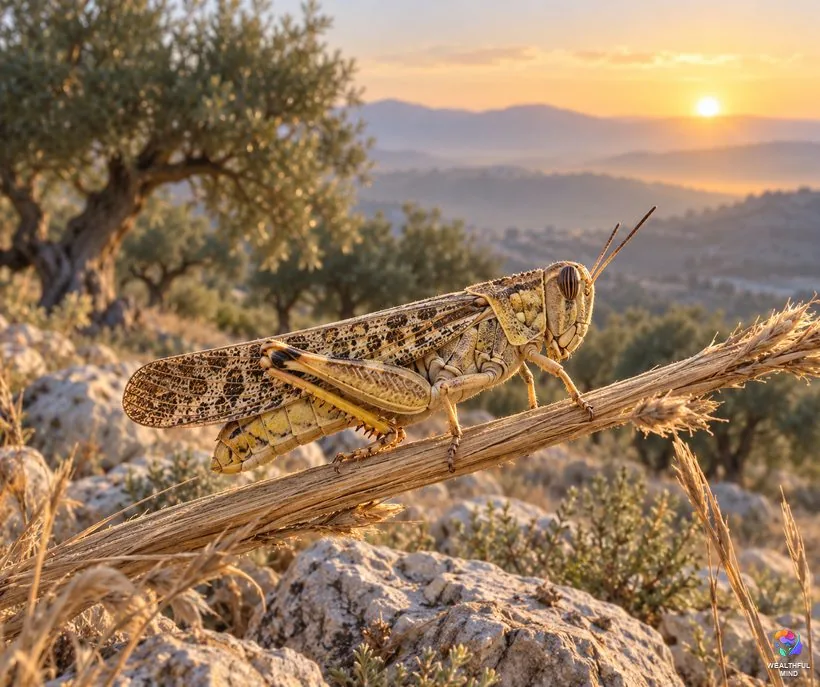
The Bible mentions grasshoppers mostly to say two things, small and many. The verses below are quoted from the King James Version unless we say NIV.
In the Bible, Israelite scouts who met giants in a new land said, “we were in our own sight as grasshoppers, and so we were in their sight” (Numbers, chapter 13, verse 33). Isaiah, chapter 40, verse 22 says that God “sitteth upon the circle of the earth, and the inhabitants thereof are as grasshoppers.”
For many Christians, that is the heart of the grasshopper’s meaning. You may feel small, but you are seen from above, and feeling small does not decide what you can do.
Grasshoppers in the Bible also stand for crowds too big to count. Raiders in Judges “came as grasshoppers for multitude” (chapter 6, verse 5), and the NIV’s Psalm 105, verse 34 speaks of “grasshoppers without number.”
The Bible allows grasshoppers as food as well. In the NIV, Leviticus, chapter 11, verse 22 lists “any kind of locust, katydid, cricket or grasshopper,” and John the Baptist ate “locusts and wild honey” (Matthew, chapter 3, verse 4).
The Bible’s poem about growing old says “the grasshopper shall be a burden” (Ecclesiastes, chapter 12, verse 5), or in the NIV, “the grasshopper drags itself along.” It is a soft picture of a body slowing down.
One line in the Bible even sounds like a real cool morning. Nahum, chapter 3, verse 17 describes great grasshoppers “which camp in the hedges in the cold day, but when the sun ariseth they flee away.”
○ Locusts, Plagues and Revelation
Locusts are the swarming kind of grasshopper, and in the Bible they mostly mean judgment. God warns Pharaoh, “to morrow will I bring the locusts into thy coast” (Exodus, chapter 10, verse 4). In Revelation, chapter 9, verse 3, locusts come “out of the smoke” with power “as the scorpions of the earth have power.”
The Bible’s Proverbs, chapter 30, verse 27 is kinder. “The locusts have no king, yet go they forth all of them by bands,” it says, and many readers take that as a lesson in working together.
Bible Gateway’s topical index adds a useful note. In the King James Version, “grasshopper” is often a loose translation of a word that means locust, as in Judges, chapter 6, verse 5.
People also ask about the spiritual meaning of brown locusts. No verse gives a locust a color, so a brown one has no special Bible meaning. To tell a locust from an ordinary grasshopper, see the locust section below.
Grasshopper Spiritual Meaning in Old Stories
The good luck reading is modern. The older stories are stranger, and a few of them are not about grasshoppers at all.
○ China and the Ode of the Locusts
The idea that grasshoppers mean plenty in China seems to come from one real poem. “Zhong Si” is an ode in the Book of Odes (the Shijing). In James Legge’s 1898 translation, kept online by the University of Virginia, it opens, “Ye locusts, winged tribes, How harmoniously you collect together.”
Each of its three verses then wishes that their descendants be many, “in unbroken strings” and finally “in swarms.” So the blessing in the Book of Odes is a wish for children and a big, busy family.
If a grasshopper shows up while you are hoping for a child or a fuller home, this is the old reading that fits you best.
○ Ancient Greece and Its Golden Cicadas
Thucydides, the Athenian historian, writes about a fashion among the rich old men of Athens. They had only lately given up “fastening a knot of their hair with a tie of golden grasshoppers.” But the insect in his Greek is the tettix, which the Perseus Digital Library’s Greek dictionary defines as “a kind of grasshopper, the cicala, Lat. cicada.”
Plato tells a lovely story about the same singing insect in the Phaedrus. In Harold Fowler’s translation, these singers were once men so delighted by the Muses’ song that they forgot to eat and drink until they died. Now they sing without food and report to the Muses who honors them, telling Terpsichore “of those who have honored her in dances.”
Fowler calls them locusts, but the Perseus dictionary lists the Phaedrus among the texts that use the word tettix. So when you read that the ancient Greeks saw grasshoppers as noble, the honest version is that they prized cicadas, the summer singers.
○ Cherokee, Choctaw and Hopi Stories
Many websites say Native Americans saw grasshoppers as good luck. The stories we could trace are more interesting than that, and each belongs to a particular people.
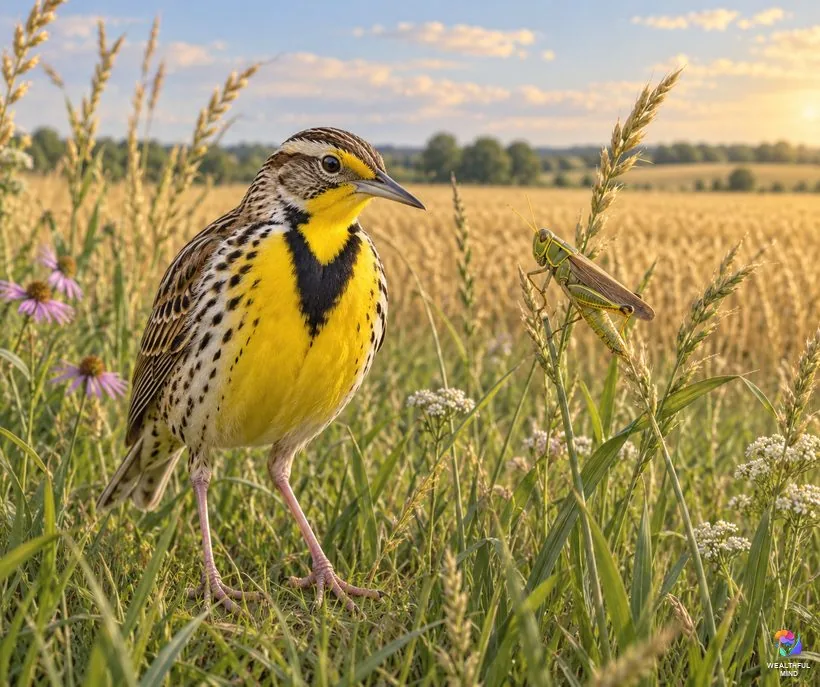
In a Cherokee story retold by Oklahoma State University’s extension service, the other animals tease a bird, likely a meadowlark, about its big feet, and it hides in the tall grass. A grasshopper finds it and says those feet will probably be useful someday. At harvest the grasshopper fetches the bird, which carries a mother bird’s eggs out of a wheat field to safety.
Oklahoma State also retells a Choctaw story from Tom Mould’s book Choctaw Tales (2004). Grasshoppers came up from Nanih Waiya with the first people, but their mother was stepped on along the way. So the Choctaw called them “eske ilay,” which means “mother dead.”
In a Hopi tale that H. R. Voth recorded in The Traditions of the Hopi, a sparrow-hawk kills all ten of a grasshopper mother’s children. When Coyote demands that she sing for him, she slips away and leaves behind a stone shaped like a grasshopper, and Coyote breaks his teeth on it.
Native Languages of the Americas, a nonprofit that works for Native languages, gives a wider picture. It says farming peoples often cast grasshoppers as greedy or careless and linked them with bad luck, and that the Hopi sometimes said grasshoppers bite the noses of children who disobey. Hunter-gatherer peoples were rarely bothered by them, and in some tribes grasshoppers were said to predict or even change the weather.
So in these stories, the grasshopper is an encourager, a survivor and sometimes a pest. Claims that the Hopi saw grasshoppers as “earth-balance messengers,” or that Zulu tradition links them to courage, turn up on many sites, but we found nothing behind either one.
Further south, Mexico’s Ministry of Culture explains that Chapultepec, the great green park in Mexico City, takes its name from Nahuatl words meaning “on the grasshopper’s hill.”
○ Aesop’s Ants and the Grasshopper
Aesop’s fable is the grasshopper’s most famous story, and it is a warning. In the English telling that Wisdom Library keeps with its Aesop’s Fables, a starving grasshopper comes to the ants in winter, begging for a little food.
Some writers say the singer in the Greek original was a cicada, but we could not check the Greek text, so we leave that question open.
If a grasshopper finds you while you are putting something off, this is the other side of the leap. Enjoy the song, and put a little away for winter too.
○ Why People Say “Patience, Grasshopper”
If someone has ever called you “grasshopper” when you were new at something, that comes from television. TV Guide explains that in the ABC series Kung Fu, which ran from 1972 to 1975, the blind Master Po (played by Keye Luke) called his young student Caine “Grasshopper.”
That is why so many people link grasshoppers with being a student and with patience. If you are a beginner at something right now, a grasshopper is a sweet reminder that every teacher once started where you are.
Grasshopper, Locust, Cricket or Katydid?
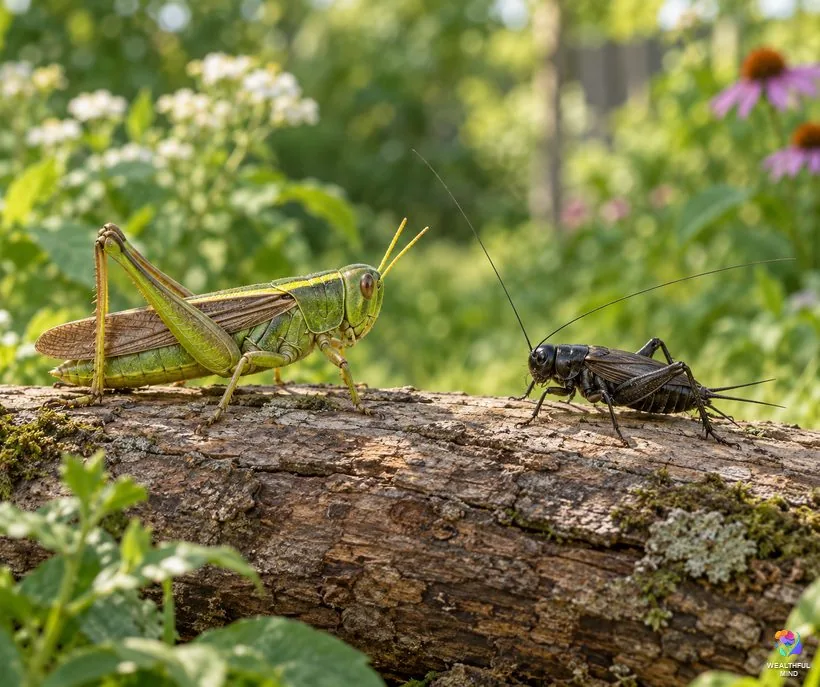
It helps to know what you actually saw, because each insect has its own meaning.
The quickest test is the antennae.
According to the Amateur Entomologists’ Society, grasshoppers have short antennae and sing by rubbing their long back legs against their wings. Crickets have long antennae, sing by rubbing their wings together and mostly come out at dusk. Oklahoma State’s extension service adds that katydids, which look like leafy green grasshoppers, also have thin antennae longer than their bodies.
A locust is a grasshopper that can change.
The Australian Government’s Department of Agriculture explains that locusts can switch from living alone to a swarming state when they get crowded, sometimes changing body shape and color too. Most grasshoppers never do this. So the single grasshopper in your garden is almost certainly not the start of a plague.
If yours had long, thin antennae and chirped after dark, you probably met a cricket, which has its own meanings. And if it was a long green insect holding its front legs up as if in prayer, you will want our page on the praying mantis and what it means.
A Grasshopper in Your Dream
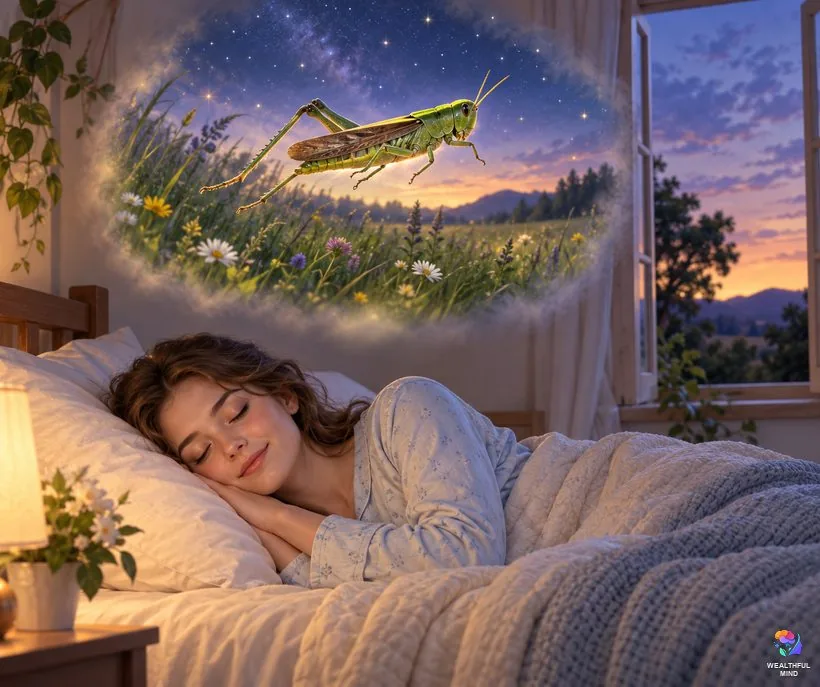
We found no tradition behind grasshopper dream meanings. Some websites promise that a grasshopper biting you in a dream means money is coming, but those lists are made up, and they disagree with each other.
Read your dream by how it felt instead.
- If one grasshopper jumped toward you and you felt light or excited, many dreamers take it as a sign they are ready to make a move.
- If it was stuck, still or dead, it often mirrors a plan you have put on hold.
- If a swarm filled the sky and you felt afraid, it usually points to feeling overwhelmed, not to a real disaster.
- If it was golden, you might connect it with the golden grasshopper of trade above, and with something you hope to build.
Christian dreamers often ask whether a locust dream is good or bad. In scripture, locusts mostly stand for judgment, but a dream speaks in your own pictures. Ask yourself what in your life feels like it is eating away at you, and what you can do to protect it.
When Every Bug Feels Like a Message
Sometimes it is a ladybug, a moth and a grasshopper all in one afternoon, and you start to wonder what the universe wants from you. Late summer is simply busy with insects, so keep that in mind before you build a big meaning on one day.
It is perfectly fine to let a grasshopper just be a grasshopper.
But if reading signs starts to make you anxious or keeps you up at night, take a break from it. The same goes if it gets hard to tell a coincidence from a message. Talk to a parent, a trusted adult or a counselor.
If the ladybug was the one that caught your eye, our page on what a ladybug means is a good next stop.
The grasshopper on your step will be gone by the first frost. The leap it reminded you of does not have to wait that long.
Your Grasshopper Questions, Answered
Do grasshoppers mean good luck?
Many people today take a grasshopper as good luck, especially as a nudge to take a step they have been putting off. The older traditions are more mixed. A Chinese poem in the Book of Odes uses them as a wish for many children, while farming peoples in North America often saw them as pests and bad luck, according to Native Languages of the Americas. So the luck reading is a modern belief, and a kind one to keep if it helps you act.
Does a grasshopper bring money?
Not by itself. The grasshopper’s link with money comes from the family crest of Sir Thomas Gresham, who founded the Royal Exchange in London, which still has a golden grasshopper on its weathervane, as Boston.com explains. Boston’s Faneuil Hall copied that grasshopper as a sign of trade. If you like the money reading, use it as a push to do one practical thing for your finances today.
Why do grasshoppers suddenly appear?
Mostly because of the season. UC IPM, the University of California’s pest program, says most grasshoppers have one generation a year, hatch in spring and live only two to three months as adults, and their numbers jump after warm, moist springs. Oklahoma State University’s extension service adds that some kinds peak from August to October and are drawn to lights at night. You can still treat the timing as meaningful for you.
What is the spiritual meaning of brown locusts?
No Bible verse gives locusts a color. In scripture, locusts mostly stand for judgment and huge numbers, as in Exodus and Revelation, while Proverbs praises them for moving together without a king. A single brown grasshopper in your yard is not a swarm, so many people read it as grounding and steady progress instead.
What do grasshoppers represent in dreams?
There is no old tradition behind grasshopper dream meanings, and the lists online disagree. Read it by how the dream felt. A grasshopper jumping toward you with a light feeling often points to readiness, a still or dead one to a plan on hold, and a frightening swarm to feeling overwhelmed.
Is a grasshopper in the house good luck?
Many people take it as luck coming in or a fresh start at home, and in parts of India some families see it as lucky while others see a warning. It is almost always a stray from outside, since grasshoppers lay their eggs in soil outdoors. Catch it under a cup with a piece of paper and let it go on a plant outside.