Good luck is the ladybug spiritual meaning almost everyone agrees on, and you can also take the little red beetle as a sign of protection, love, a baby on the way or a loved one saying hello. We think it is one of the kindest signs you can get, because the belief behind it is much older than you might expect.
The name itself means Our Lady’s beetle, after the Virgin Mary, as the Online Etymology Dictionary (Etymonline) explains. And the Brown Collection of North Carolina folklore records an old rule you will find across America, Britain and Germany, that it is unlucky to kill one.
Quick pick
What Did the Ladybug Do?
Find the moment that matches yours, then jump to the full answer.
- Landed on you? Most people take it as luck, or a wish being heard
- Inside your house in fall or winter? A guest sheltering for winter, and an old sign of a blessed home
- Came after someone died? Many feel a loved one close by, and it is fine if none comes
- Killed or chased one away? The old rule was about kindness, and one accident is not a curse
- An unusual color? Color shows the kind of beetle, and a pale one may be newly hatched
- Saw one in a dream? Read it by how the dream made you feel
Keep reading below Why it is named after Mary What the spots really mean Love and pregnancy Is it in the Bible? Questions

Ladybugs are one of many small visitors in our guide to what insects mean spiritually. If you would like a simple way to read any sign, you can start with our page on signs from the universe and how to read them.
What Does It Mean When You See a Ladybug?

Most readings of a ladybug are gentle ones. None of them can be proven, so you are free to keep the one that fits your moment.
- Luck and good news. This is the classic reading. You may feel that something you are waiting on is about to go your way.
- Protection. You can take a ladybug as a sign that you, and your home, are being looked after.
- Love, often read as a blessing on a couple.
- A baby or a fresh start.
- A loved one close by, saying a small hello.
- A nudge to slow down. The beetle is tiny and unhurried, so you might read it as a reminder to notice small, good things.
Is a ladybug a good or bad omen? Good, in every tradition we could trace. The only old warning attached to it is about harming one.
Here is how a sighting usually becomes personal. Say you have had three job interviews this month and heard nothing back. You sit on the porch steps after another quiet day, and a ladybug walks up your sleeve.
In that moment, you would probably hear “hold on, it is coming”, and that reading is yours to keep. If you had been thinking about a friend who moved away, it would mean something else. What you were carrying when the ladybug arrived is the best guide you have.
There is a plain side to the luck as well. Penn State Extension notes that ladybug, lady beetle and ladybird are all names for one family of beetles, the Coccinellidae. Most of them hunt aphids, and a single beetle may eat as many as 5,000 aphids in its lifetime, says the University of Illinois Extension.
That is why farmers and gardeners have always been glad to see them, and why you probably are too.
○ Seeing Ladybugs Every Day, or Many at Once
If you keep seeing ladybugs, or a whole cluster at once, the season is usually part of the answer. NABU, Germany’s nature conservation union, says ladybirds gather on railings, house walls and plants in fall while they look for winter shelter. You may then find them wintering in clusters of more than a hundred, in leaf piles, old tree stumps, wall cracks and attics.
In summer, the reason is food. Penn State Extension says that when aphids build up, the lady beetles already living nearby are drawn to them. (One Reddit reply to a “what does this mean” post simply said the ladybugs were doing well that year, which made us smile.)
But a run of ladybugs can still feel like a message to you. You might take it as a sign to keep going, or that good things are piling up.
Sometimes a ladybug arrives with company. If you found ladybugs and a praying mantis in your house on the same day, you can read the two together, the ladybug for luck and the mantis for its own message.
Why Ladybugs Mean Luck: Our Lady’s Beetle

The ladybug’s lucky name has a real paper trail, which is rare for a sign.
○ The Name Comes From the Virgin Mary
The “lady” in ladybug is Our Lady, the Virgin Mary. Etymonline dates the beetle name “ladybird” to the 1670s and “ladybug” to the 1690s. It also lists older country names you may never have heard, such as lady-cow, lady-fly and lady-clock.
Merriam-Webster, drawing on the Oxford English Dictionary, says the seven-spot ladybird of Europe was the first to get the Marian name. Its seven spots were thought to stand for the Seven Sorrows of Mary. Merriam-Webster adds that “lady cow”, from the late 16th century, seems to be the oldest English name of all.
Father Johann Roten, a Marian scholar at the University of Dayton, told Our Sunday Visitor that the German name Marienkäfer, “the bug of Mary”, grew up in the 12th and 13th centuries. He dates the Seven Sorrows link to the 14th and 15th centuries, and calls the whole tradition “essentially German”.
His most interesting line, in the same Our Sunday Visitor interview, is about why it happened. The bug, he said, was linked with Mary “probably in an effort to baptize it and to make it Christian without depriving it of its office as divine messenger.” So if you feel a ladybug is a messenger, you may be holding onto something older than its Christian name.
You may also read that the red shell is Mary’s cloak. The Amateur Entomologists’ Society links the name to old paintings that showed Mary in red, but it gives no source, and we found no older record of the cloak idea.
Take it as a lovely picture rather than history.
The same goes for the story that medieval farmers prayed to Mary during a plague of pests and the ladybugs came. We could not find it in any dated record. What NABU and the Wahrig word dictionary do report is a German folk belief that Mary sent the beetle to save the harvest, and that it guarded against witches and misfortune.
○ “God’s Little Cow” in Other Languages
Wherever you go in Europe, the ladybug’s names keep pointing upward. In Ireland it is Bóín Dé, “God’s little cow”, and the Russian bozhya korovka means the same, according to a column in the Irish newspaper Western People. The same writer gives the Welsh buwch goch gota, a “short red cow”.
If you were in France, you might hear bête à bon Dieu, “the good Lord’s creature”, or the older vache à Dieu, “God’s cow”, as the word blog Word Histories explains. It also gives the German Herrgottskäfer, “the Lord God’s beetle”, the Spanish mariquita and Catalan marieta, both from María, and Romanian names meaning the Lord’s ox, cow and hen.
The German Wahrig dictionary adds the Danish mariehøne, “Mary’s hen”, and the Croatian bubamara, built on the name Maria. (Our favorite is Himmelsziege, “heaven’s goat”, one of the playful German names NABU lists.)
In parts of England it even had a summer name. W. Carew Hazlitt’s Faiths and Folklore says some places called it Barnaby bright, probably because it was seen most around St Barnabas’ Day in June.
So in language after language, the ladybug sits between God, Mary and the family cow. For a farming family, a cow meant milk and safety, and we think that tells you how highly people once thought of this beetle.
○ Why It Was Unlucky to Kill One
The oldest ladybug belief we found in writing is not about luck coming to you. It is a warning against harming one.
Item 7374 in the Brown Collection, the great record of North Carolina folklore, reads simply, “It is unlucky to kill a ladybug.” The editor’s notes list the same belief in Kentucky, New England, Pennsylvania, Illinois, Wisconsin, Britain and Germany.
The folklorist Newbell Niles Puckett recorded it among African American families in the South in 1926. He listed the ladybug beside the dove and the dragonfly as creatures it was bad luck to kill.
In England, the antiquary Francis Grose wrote that it was “extremely portentous” to kill a cricket, a ladybug, a swallow, a robin or a wren. W. Carew Hazlitt quotes him in Faiths and Folklore (1905), along with the reason, which is the part we love. It was perhaps seen as “a breach of hospitality”, because all these creatures take “refuge in houses”.
So the old rule was about manners. A ladybug in your house was your guest.
And you do not hurt a guest.
○ What If You Killed One or Chased It Away?
If you squashed a ladybug by accident, or shooed one out because bugs frighten you, please do not panic. You are not the first. Plenty of people post about it online afterwards, worried they have chased their luck away.
We do not believe one accident brings lasting bad luck, and none of the sources we read says it does. That part is our view, not a rule from a book. The old belief was about respect for a helpful creature, and you can show that respect from today.
If it still sits heavy with you, here are three small things you can do.
- Say sorry, out loud or in your head.
- Carry the next ladybug you find outside on a leaf or a piece of paper.
- Leave a corner of your garden or balcony a little wild, with a few flowers, so ladybugs have somewhere to live.
And chasing one out of your room is not killing it. You simply moved a guest to the porch. (Honestly, the ladybug probably did not mind.)
What Does It Mean When a Ladybug Lands on You?

A ladybug landing on your hand, your hair or your shoulder is the moment you are most likely to treasure. You can take it as a wish being heard, luck arriving or a sign that a worry will turn out fine.
If you look online, you will find these moments everywhere. One person waiting on a job kept finding a ladybug in their room, then came back to post that they got the job. Another watched a ladybug crawl onto her finger just as the engagement ring went on.
There is a real old custom behind this. In the Brown Collection’s notes, a child in Ontario places a ladybird on the hand or arm and says “Ladybug, ladybug, fly away home”, and the beetle flies off. A note from Nebraska adds that if the bug flies off, you will have good luck.
So if one lands on you, you can do just what those children did. Let it walk to your fingertip, say the rhyme or make a wish, and let it leave when it is ready.
You may read that the rhyme comes from English farmers burning their hop vines with the ladybugs still on them. Merriam-Webster gives that explanation, but we found no older source for it, so treat it as one popular theory.
Is it rare for a ladybug to land on you? Not at all, especially in fall. The University of Kentucky’s entomologists say that when lots of lady beetles are flying in fall, they often land on clothing.
No source we read explains why a ladybug picks you over the person next to you. So the choosing part is yours to read however feels right.
You can read a ladybug riding on your car the same way, often with an extra wish for safe travels. In fall, the University of Kentucky says, these beetles gather where the afternoon sun hits. A car parked in that sun is an easy place to land.
A ladybug is not the only small visitor you can read this way. A butterfly landing on you carries its own set of meanings.
○ Should You Let a Ladybug Crawl on You?
Yes, for most people. Ladybugs do not sting, and the Asian lady beetle only sometimes gives you a small “pinch”, which the University of Kentucky says feels like a pinprick and is seldom serious.
Penn State Extension adds that a bite can range from slightly annoying to painful. So if you would rather not risk it, it is fine to let the ladybug walk onto a leaf instead.
Expect a little smell too. When you disturb a ladybug, it can push a smelly, bad-tasting liquid out of its leg joints, the University of Illinois Extension explains. That is why your hand may smell afterwards, so wash it before you touch your eyes, as the Kentucky fact sheet advises.
A Ladybug in Your House: Spiritual Meaning
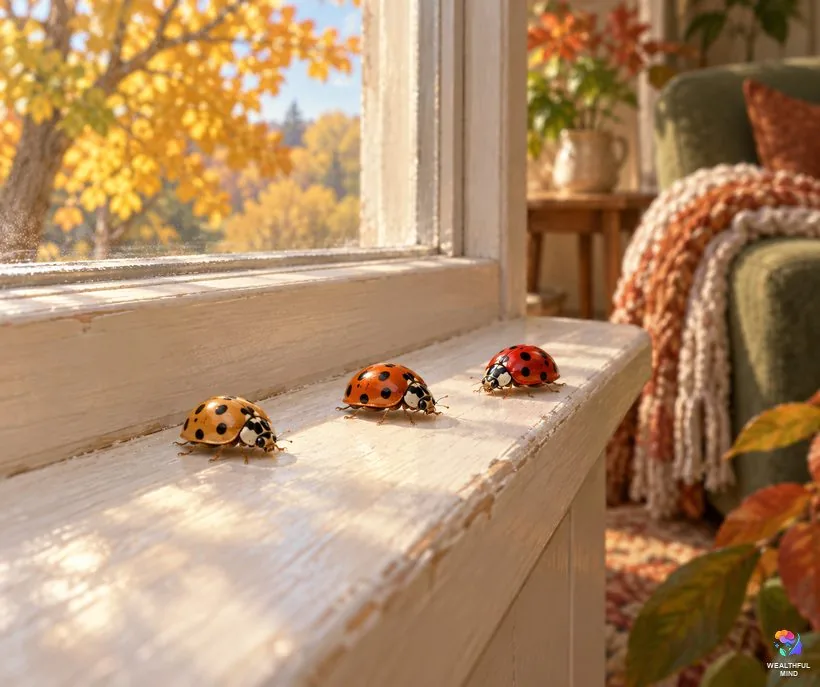
If you find a ladybug inside, on a window, a lamp or your bedroom ceiling, you can read it as a blessing on your home. You might take it as protection, good news on its way to your household, or a visit from someone who used to live with you.
This is where the old English idea of a guest sheltering under your roof fits best.
Now the plain reason, because the timing matters. If your house fills with ladybugs in fall, they are most likely multicolored Asian lady beetles looking for a place to spend the winter. The University of Kentucky says they fly to buildings from September to November and gather on the sunnier southwest walls.
They tuck into wall gaps and attics. Penn State Extension explains that warmth seeping into the walls in winter wakes some of them, and they wander out into your rooms. That is why you can find one on your window in the middle of winter with every window shut.
According to the University of Kentucky, they do not breed indoors and do not eat your wood, food or clothing. The ones you see in spring are the same beetles that came in during fall. If you look closely, most have a small dark mark shaped like an M or a W on the white patch behind the head.
Penn State Extension says this beetle first became established in North America in 1988, in Louisiana, probably arriving by accident with shipping cargo.
Does knowing all this cancel the meaning? We do not think so. A beetle that picked your warm walls for the winter still picked your home.
○ Why Are There So Many All of a Sudden?
A sudden crowd usually means a sunny fall afternoon after a cold spell, the weather the University of Kentucky links to the biggest flights. Its fact sheet adds that if you live near woods or fields, you tend to get the most.
You can still read a crowd as abundance, or as your household being blessed. If you would rather they lived outside, skip bug bombs, which the University of Kentucky says are generally not recommended indoors. Our guide to bugs in the house covers gentle ways to move them out.
○ Is It Safe to Sleep in a Room With a Ladybug?
Yes, for most people. The University of Kentucky says these beetles generally do not injure people and do not spread disease, so one ladybug on your ceiling will not hurt you.
Large indoor swarms can be different for some people. Penn State Extension says infestations in homes have been linked to eye and nose allergies, asthma and even swelling of the face. If your eyes, nose or breathing get worse when the beetles are around, please see a doctor about it.
Ladybugs and Loved Ones Who Have Passed

If you have lost someone, a ladybug may feel like a visit.
One young woman was crying alone in her room after a fight when she looked up and saw a ladybug. Her family has always called her “the bug”, and her late grandma had planned to sew a ladybug square into a quilt for her. To her, it felt like her grandma saying it was okay.
A nurse wrote in a grief group that after her brother died, her home was full of ladybugs for months. A mother shared that a ladybug was in the room the day her daughter was born, the daughter she later lost. Later, one flew onto her car while she was talking to her daughter in her head.
If your story sounds like these, you are far from alone, and nobody can tell you what it meant to you.
Ladybugs do shelter in houses through the winter, so you may well see one near a winter anniversary. We do not think that makes your moment smaller. Something can be ordinary and still arrive at exactly the right minute.
And if no ladybug comes to you, that is completely fine. Many people never get a sign at all, and their grief and their love are just as real. Your bond with someone does not depend on any insect showing up.
If grief is making it hard to sleep, eat or get through your day, tell someone you trust, or speak to a counselor. Asking for help is part of carrying a loss well.
You might find comfort in other signs too, like a white butterfly drifting past, a white feather on your path or a red cardinal at the window.
Ladybug Spiritual Meaning for Love, Pregnancy and New Beginnings

Love comes first for many people. If a ladybug lands on you during a date, a proposal or a wedding, you can take it as a blessing on the two of you.
Wondering about an ex? Many people read a ladybug as a sign of healing rather than a sign to go back, and that part is your call, not the beetle’s.
If you follow twin flame ideas, you may read a ladybug as proof that a connection is real. We would gently say, look at your actual relationship first and the beetle second.
Pregnancy is the other big one. A woman who had been trying for two years shared that a ladybug landed on her on the summer solstice, and a week later she found out she was pregnant. If you are hoping for a baby, you will hear stories like hers often.
We love these stories, but a ladybug is not a pregnancy test. Treat your sighting as encouragement, and leave the answers to the test and your doctor.
New beginnings fit the ladybug well too. A new home, a new school, your first job. Ladybugs vanish into hiding for the winter and come back out with the spring, so you can see one as a small picture of starting fresh.
Ladybug Colors and What They Mean

A ladybug’s color mostly tells you which kind you met. We found no old folklore about the colors, so the meanings below are modern readings.
○ Red Ladybug
The classic red ladybug with black spots is often the seven-spot or a red Asian lady beetle. Red is a warning color, and the Amateur Entomologists’ Society says bright colors tell predators the beetle tastes bad. In meaning, red gives you the full ladybug blessing of luck, love and protection.
○ Orange Ladybug
You will see orange ones very often. UC IPM, the University of California’s pest program, describes the convergent lady beetle as orange, usually with 13 black spots. It also says deep orange with spots is the most common form of the Asian lady beetle in California.
You can read orange as warmth, creativity and energy. You may see claims that orange ladybugs are “more aggressive”, but we found no insect expert who says so.
○ Yellow Ladybug
In Europe, the 22-spot ladybird is lemon yellow with black spots and the 14-spot is black and yellow, NABU notes. A pale yellow ladybug can also be a brand-new one (see white, below). Yellow is usually read as joy, hope and a lighter mood on the way.
○ White or Pale Ladybug
Here is a lovely fact for you. NABU says a ladybug that has just come out of its pupa is completely yellow at first, and its final color appears only after its wing covers harden, a few hours later. So the pale, washed-out ladybug you saw may simply be a few hours old.
That fits the meanings people give a white ladybug almost perfectly: purity, a fresh start and a clean slate.
○ Black Ladybug
Black ladybugs with red spots are real. UC IPM lists Axion plagiatum, which is shiny black with two red spots, and a black form of the ashy gray lady beetle, also with two red spots. The same UC IPM page says the two-spotted lady beetle can be black with four reddish spots.
You can read black as protection, or as luck that arrives quietly.
○ Pink Ladybug
The pink spotted lady beetle is pink to red with six spots on each wing cover, and up to half of its diet can be pollen, says the University of Illinois Extension. Penn State Extension links the spread of the Asian lady beetle to its decline, so you have made a nice find. Pink is read as tenderness, friendship and gentle love.
What the Spots Mean, and What They Do Not
Seven is the only number with a real story, the Seven Sorrows of Mary from the name’s history, and NABU calls the seven-spot the classic lucky charm.
After that, the spot meanings you see online get shaky. You may read about one year of luck per spot, the number of children you will have, or a good harvest if there are seven spots or fewer.
The Forest Preserve District of Will County in Illinois calls these myths. It says a ladybug’s spots cannot tell you its age or anything about the future. What the spots can sometimes tell you is the species, and some ladybugs have no spots at all.
The Asian lady beetle alone comes in more than 100 forms with different spots and colors, according to UC IPM. So a ladybug with many spots is not luckier for you, and one with none is not unlucky.
We could not find an old record of counting spots for luck. The closest thing is a German children’s charm, recorded by W. Carew Hazlitt, in which children asked the cockchafer or ladybird “How many years my life is to be?” and counted aloud. It may be where spot counting began, but that is our guess, not a fact.
If you ever find a ladybug with nine spots in New York, though, you have seen something special. PBS NewsHour reported in 2011 that the nine-spotted ladybug, New York’s state insect, had gone missing in the state for nearly three decades. Then a volunteer with Cornell University’s Lost Ladybug Project found one on a Long Island farm, PBS NewsHour said.
Are Ladybugs Sent by God or Angels?

If you are a Christian, you may feel that a ladybug at the right moment is a small kindness from God, or a sign that an angel is near. We found no church teaching about ladybugs, so this is personal faith rather than doctrine. It can still be a deeply comforting one.
Ladybugs are not in the Bible. A Bible Gateway search for “ladybug” in the King James Version, and for “ladybird” in the NIV, returns no verses at all. The Christian link comes through the name, Our Lady, rather than through scripture.
So if you found one while praying, as one Catholic reader did while walking the backyard with a rosary, you are free to let it remind you of Mary.
As for angels, no old tradition we traced ties ladybugs to them. The angel reading is a modern and heartfelt one, and if it brings you peace, you do not need a verse to keep it.
A Ladybug in Your Dream
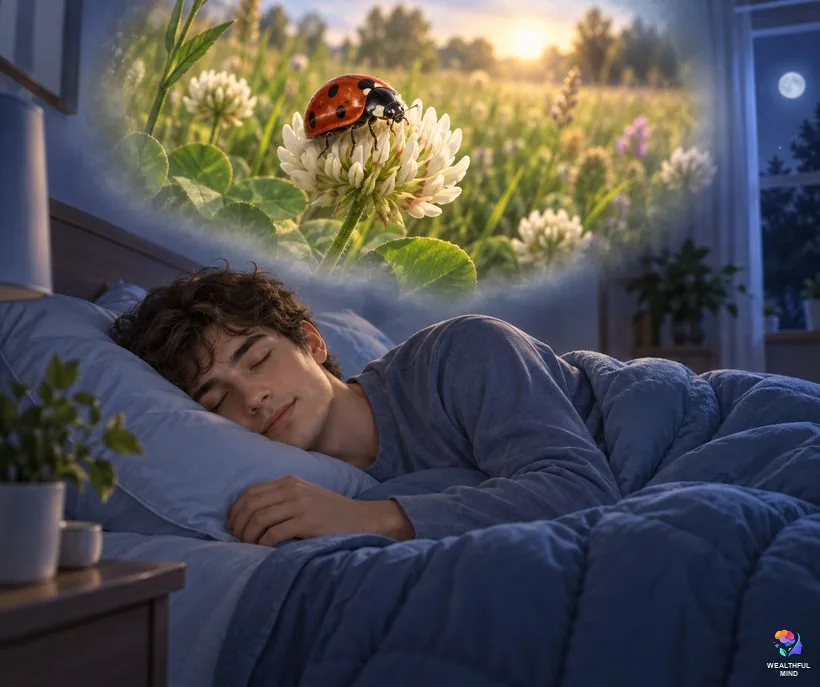
No old tradition gives meanings for ladybug dreams. Dream websites each write their own lists, and those lists contradict each other, so read your dream by how it made you feel.
- A single calm ladybug usually leaves you comforted, so you can take it as reassurance.
- A ladybug landing on you in a dream can be read the same way as in waking life, as luck or a wish heard.
- A swarm can feel frightening, and that is a normal reaction. You might read it as small worries piling up rather than anything bad on the way.
- A ladybug in a dream about someone you have lost often feels like a visit.
If the same frightening ladybug dream keeps coming back, the ladybugs are rarely the point. One person on Reddit had the same nightmare since childhood, and the kindest replies suggested the beetles stood in for an older fear. Talking it through with someone you trust will help you more than any dream dictionary.
How to Welcome Ladybugs to Your Garden

If you would like more ladybug visits, give them food and leave the sprays on the shelf. NABU says chemical sprays often harm the gardener’s natural helpers, and that a few aphids are actually needed for ladybugs to survive.
- Let some aphids be. A plant with a few of them is a ladybug’s dinner table.
- Plant early flowers rich in pollen, such as dandelions, which the University of Illinois Extension says can draw the pink spotted lady beetle in.
- Leave a pile of leaves or a quiet corner for winter shelter.
Skip the bags of ladybugs from the garden store. UC IPM says most bought convergent lady beetles fly away within a day or two of release, even when aphids are plentiful. (So if your ladybug did not stay, it was not personal.)
Then the next time one lands on your sleeve, make your wish and watch it fly home.
Ladybug Questions, Answered
What does it mean when God sends you a ladybug?
For many Christians it is a small kindness from God on a hard day, or a gentle reminder of Mary, since the “lady” in ladybug is Our Lady. That is personal faith rather than church teaching, because ladybugs are not in the Bible and we found no church document about them. If the thought brings you closer to God, you are free to keep it.
Is a ladybug a good or bad omen?
A good one, in every tradition we could trace. Ladybugs are linked with luck, protection, love and the Virgin Mary. The only old warning is about harming one: folklore collections from North Carolina, England and Germany all record that it is unlucky to kill a ladybug.
Is it rare for a ladybug to land on you?
No. In fall, when lady beetles fly to buildings to find winter shelter, the University of Kentucky’s entomologists say they often land on clothing. So a ladybug on your sleeve is common, and the timing is what makes it feel meant for you.
Is it bad luck to kill a ladybug?
Old folklore says so. The Brown Collection of North Carolina folklore records “It is unlucky to kill a ladybug”, and an 18th-century English writer quoted by W. Carew Hazlitt explained it as breaking hospitality, since ladybugs shelter in houses. We found nothing saying one accident brings lasting bad luck. Say sorry, and carry the next one you meet gently outside.
Why are there so many ladybugs in my house all of a sudden?
They are most likely multicolored Asian lady beetles looking for a warm place to spend the winter. The University of Kentucky says they fly to sunny walls from September to November, slip into wall gaps and attics, and wander indoors on warm days. They do not breed inside or eat food, wood or clothes. Our guide to bugs in the house covers gentle ways to move them out.
Do a ladybug’s spots tell its age?
No. The Forest Preserve District of Will County in Illinois calls that a myth, and says the spots cannot tell a ladybug’s age or anything about the future. The spots mostly help tell one species from another, and some ladybugs have none at all.