
Mirror method shifting is a reality shifting method where you meet your desired reality (DR) self in a mirror. Shifters say you cross into their life when your hands meet on the glass. You can do it with your eyes closed, at a mirror you imagine, or at a real mirror in soft light.
Quick pick
Where Should You Start With the Mirror Method?
Tap the line that sounds most like you to jump to your match.
- Trying it for the first time? Pick your version first
- Find it hard to picture things? Use a real mirror
- Thinking of lighting a candle? A battery candle works just as well
- Did your face start to look strange? Read why it happens
- Tried it and nothing happened? See what to change
- Came for mirror manifesting? Read the difference
Keep reading below What it is Eyes closed steps Real mirror steps What you might see Stay safe Questions

Neither version needs a script, a candle or a special hour of the night.
If shifting is new to you, our explainer on what reality shifting is covers the words used here. To compare the mirror method with other shifting methods, see our beginner list. And before you try any of them, read how safe reality shifting is.
What Is the Mirror Method in Shifting?
Mirrors have always made people wonder what is on the other side. In the mirror method, the person looking back at you is your DR self, already living the life you want. Shifters believe that touching the glass and stepping through (or trading places) is how your awareness moves into that reality.
So how does it work? Shifters say the reflection gives your DR a face, which makes that reality feel close.
The touch on the glass then gives your mind one clear moment to let go of your current reality (CR).
Will a mirror really carry you somewhere else? Wikipedia sums up the science plainly: moving your consciousness into another reality is not possible, so shifting is seen as a personal experience.
We think that is worth knowing, and it takes nothing away from the method as a calm, vivid way to spend time with your DR.
Wikipedia dates shifting as a social media trend to mid-2020, and the mirror method belongs to that first wave. By January 2021, a Reddit post in r/shiftingrealities was already talking about “the Mirror Method” as something readers knew.
Using a mirror as a doorway is far older than shifting. A 1989 paper in the journal Zygon describes “portalling”, the feeling of moving from one reality to another through a tunnel or door. It names the mirror as one of the objects used to bring that feeling on in shamanic and meditative practice.
The paper explains an experience people have, though, not proof that mirrors are portals (a point some mirror method guides skip).
These days the named method is quieter than it was. Shifters who talk about mirrors now mostly use them to prepare. They say affirmations to their reflection, or look into their own eyes and talk to the version of themselves they want to be.
○ Eyes Closed or a Real Mirror? Pick Your Version
Both versions share one idea, but they ask different things of you.
- Eyes closed. The room, the mirror and the reflection all happen in your imagination. It suits you if scenes come easily when you shut your eyes, and you can do it lying in bed.
- A real mirror. You sit in front of an actual mirror and look at your reflection. Nothing has to be built from scratch, so it suits people who see little or nothing in their mind’s eye (this is called aphantasia).
Our pick for a first try is the eyes-closed version, if you can picture a room at all. It happens entirely in your head, so a shadow in the corner or a flicker of light cannot startle you.
If pictures do not come, the real mirror gives your eyes something to rest on. You can find more methods built for you in our roundup of shifting methods without visualization.
How to Do the Mirror Method With Your Eyes Closed

Sit or lie down somewhere quiet, where nobody will walk in on you. Reading your script first is optional.
- Close your eyes and let your body go loose. Start with your jaw and shoulders, and breathe slowly until the room around you fades.
- Picture a quiet room with a soft light falling on you. The rest of the room can stay dim. A tall mirror stands a little way ahead.
- Walk toward the mirror slowly. Feel each step, whether the floor is cool wood or a soft rug, and watch the mirror grow as you come closer.
- Stop in front of it and look at your reflection. The person looking back is your DR self. Notice what they are wearing, how they stand and what you can see behind them.
- Look into their eyes. They look calm and happy, as if they have been expecting you.
- Place your hand on the glass. Your DR self presses their hand to yours from the other side. Notice how it feels, cool or warm, hard or soft.
- Step through, or let the two of you become one. Shifters describe both endings. Repeat a line like I am in my DR, stay with the feeling as long as you like, and open your eyes when you are ready.
Here is how it might go if your DR has you playing guitar in a band on tour in Japan. Your reflection wears a faded band jacket, with a guitar strap over one shoulder and a lanyard full of backstage passes. Behind them, you can see a narrow street glowing with neon signs and a tour van with its back doors open.
When your hands meet, the glass is warm, and you can almost hear a sound check thumping in a club down the road. You step through, and the van door slides shut behind you.
Some shifters like a slower ending. After stepping through, they walk down a long hallway to a door, repeating their DR name as they go, then open the door into bright light.
The more detailed the script, the easier the process. Check out our Shifting Script Template (Free Printable PDF)
How to Do the Mirror Method With a Real Mirror

This version swaps the imagined mirror for a real one. It is quicker to start, but it needs a little more care. A real reflection in low light can play tricks on your eyes (more on that below).
- Choose a mirror that shows your face and shoulders. A full-length mirror is lovely if you have one, but a dresser or bathroom mirror works too.
- Pick a calm time of day. Any time works, so there is no need to stay up late.
- Keep a soft light on. A small lamp behind you or to one side is enough, and a battery candle works too. You want your face clear, not lost in shadow, so skip the pitch-dark room.
- Sit down, relax and look into your own eyes. Blink normally and keep your gaze soft rather than fixed.
- See your reflection as your DR self. Talk to them in the present tense, as if they already live your DR, and let them answer in your head.
- Put your hands on the glass and imagine trading places. Some shifters count slowly or repeat an affirmation here. Then step back and notice how you feel.
- Keep it short. A few minutes is plenty. If your face starts to change in a way that frightens you, look away, turn the light up and stop for today.
○ Do You Need a Candle?
No. Some guides put a candle between you and the mirror, but a lamp or a battery candle does the same job without a flame. The US Fire Administration suggests the same swap, since battery-operated flameless candles can look and feel like real ones.
If you still want a real candle, keep it out of bedrooms and bathrooms, since the US Fire Administration advises against lit candles in bedrooms, bathrooms and sleeping areas. Set it in a stable holder at least 12 inches from anything that can burn, and blow it out when you leave the room or go to bed.
Put the candle off to one side, not between you and the glass, so you never reach over a flame to touch the mirror, and tie back long hair and loose sleeves. Never leave a flame burning while you step away, even for a moment, and never let yourself doze off beside one.
The candle is not a spell, either. You do not need a special color, a circle of salt or any ritual to keep you safe. The mirror method, as shifters teach it, is a visualization practice.
○ Affirmations to Say to Your Reflection
Affirmations feel different when you say them to your own eyes. Plenty of shifters use a mirror this way even if they never try the full method, as a short practice before bed.
- I am [your DR name], and I live in my DR.
- You are me, and I am you.
- I can see my DR in your eyes.
- Every time I look at you, I am closer to home.
- I am safe here, and I am safe there.
- When I step back from this mirror, I am you.
Say them out loud or in your head, whichever feels less awkward (the first time can feel a little silly, and that is fine). For more lines to borrow, see our list of powerful shifting affirmations.
What You Might See or Feel

Shifters who try the mirror method describe a lightness in their body, tingling in their hands or a sense that someone is with them. Others feel nothing special and simply enjoy the calm. Our guide to reality shifting symptoms explains what shifters make of each feeling.
Some people later catch what they believe is a glimpse of their DR in a mirror, or of someone from it. One shifter on a forum asked whether seeing their DR partner in the mirror meant they had shifted. The top reply said it was either a split second shift or their mind playing a trick.
Shifters call a brief visit like that a mini shift.
Dizziness is a different matter. A few guides call lightheadedness a sign that you have shifted, but it is only a sign that you need a break. Stop, breathe normally and sit or lie down until it passes, and if it keeps coming back, see a doctor.
○ Why Your Face Looks Strange in a Dim Mirror
If your face starts to stretch, melt or look like a stranger’s while you stare at it, you have not opened a portal. Scientists call this the strange-face-in-the-mirror illusion, and it happens to many people who stare into their own eyes in low light.
In a study published in Schizophrenia Bulletin, 110 teenagers aged 12 to 19 stared into their own eyes in a mirror in a darkened room for 10 minutes. About 79% reported clear changes in their own face, and 24.5% said they saw an unknown person.
A review of 44 mirror and eye-gazing studies by Caputo, Lynn and Houran found that these effects come with longer gazing, more than one minute on average. The authors also say more work is needed to understand why they happen.
In a 2026 study in PLOS One, students sat alone in a dimly lit room and gazed into a mirror for 7 minutes. The gazing brought on dissociation, a feeling of being detached from yourself or your surroundings. The researchers had cut the task down from 10 minutes after some of their own lab members felt uncomfortable sitting in front of the mirror that long.
So here is our view. A face changing in a dim mirror is your eyes and brain at work, and it happens to shifters and non-shifters alike. It is not an entity, a shadow self or proof of a gateway, which is why we suggest short sessions with a lamp on.
○ Is It Scary? The “Don’t Look at Mirrors” Myth
You may have seen warnings on ShiftTok never to look in mirrors while shifting. When a shifter asked about this on Reddit, most replies said they had never heard it in shifting at all. It comes from lucid dreaming, where people expect something scary in a dream mirror and then see it.
Expectation matters here. If you sit down expecting something frightening, a shadow will look like one, so go in expecting your DR self. You are in charge the whole time, and you can close your eyes, turn on the light or walk away whenever you want.
When the Mirror Method Doesn’t Work

Most sessions end with you sitting in your own room, and that is normal. It does not mean you did it wrong or that shifting is not for you.
Start by switching versions. If the imagined mirror kept fading, a real one gives your eyes something to hold on to. If the real reflection felt awkward or eerie, closing your eyes lets you build a softer scene.
Then change one small thing at a time, such as a calmer time of day, a shorter session or a simpler DR self to meet. Pushing harder rarely helps, because a mind straining to make something happen stays on alert.
It is also fine to move on. The mirror method had its moment in the early days of shifting. Many shifters now use other routines, like the ones in our guide to awake shifting methods.
If no method seems to work for you, read why some people struggle to shift.
Mirror Method for Shifting vs Mirror Work for Manifesting

If you searched for “mirror method” and expected the law of attraction, you were probably looking for mirror work. It comes from the author Louise Hay, and her publisher, Penguin Random House, calls mirror work her favorite method for building a deeper relationship with yourself.
Mirror work stays in this life. You look at yourself each day and speak kind, encouraging words, to change how you feel about yourself and, believers say, what you attract. The shifting mirror method aims somewhere else entirely, at a DR with its own people and places.
You can practice both, on different days. If manifesting is what brought you here, our guide to manifestation methods will suit you better.
Is the Mirror Method Safe?
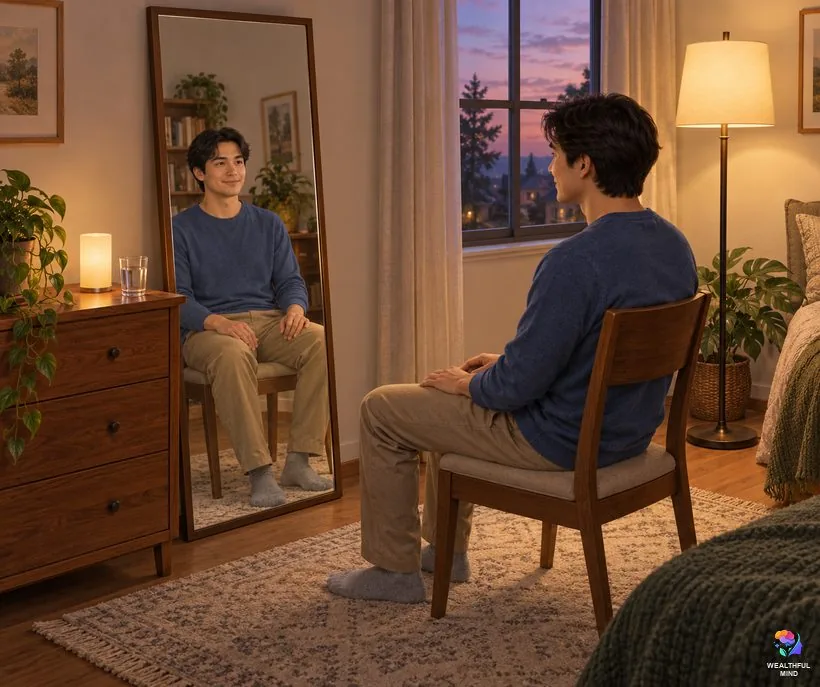
The mirror itself is harmless. What needs care is the flame, the hour and how you feel about what you see.
Start with fire. The NFPA, the US fire safety association, reports that over one-third of home candle fires (36%) start in the bedroom. So if your mirror is in your bedroom or bathroom, keep to a lamp or a battery candle, and stay with any real flame until you blow it out.
Some guides tell you to do the mirror method in the middle of the night. But the American Academy of Sleep Medicine says teenagers aged 13 to 18 need 8 to 10 hours of sleep in every 24. A late session eats into that, so choose an evening or a quiet afternoon instead.
A floaty, faraway feeling after gazing is the dissociation measured in the PLOS One study above, and the students in it said it faded within about 10 minutes. If it comes, look away, switch on a brighter light and press your feet into the floor until the room feels solid again.
If the feeling does not lift after a rest, keeps returning when you are not practicing, or you start to mix up what happened in your head with what really happened, take a break from the method. Talk to a parent, a teacher or another adult you are close to, and know that there is nothing embarrassing about it.
The NHS calls the feeling of watching yourself from outside depersonalization, and says a GP (a family doctor) can check whether something else is causing it.
Then there is what you see. The mirror method asks you to meet an ideal self in the glass, and for some people that is not easy.
The NHS says body dysmorphic disorder, constant worry about flaws in your looks, is most common in teenagers and young adults. Looking in mirrors a lot, or avoiding them, can be a sign, and the NHS advises seeing a GP if you think you have it.
So picture your DR self’s life and happiness, not a new face or body. If mirrors already upset you, choose a method without one, since nothing about shifting needs a mirror.
Last, plan your way back before you begin. A 2021 study of shifting communities by Somer, Cardeña, Catelan and Soffer-Dudek found that scripts often include a safe word to bring the person quickly back to their CR.
Our guide on how to come back from shifting helps you choose one. For the signs that mean it is time for a break, see our shifting safety guide.
Then sit down in front of the glass, say hello to your DR self and let them smile back.
Frequently Asked Questions About the Mirror Method
How does the mirror method work?
Shifters believe the reflection in the mirror is your DR self, and that touching the glass and stepping through, or trading places, carries your awareness into their reality. In practice, it is a visualization method that makes your DR feel close by giving it a face. Science has found no way to move into another reality, so treat it as a calm, vivid practice rather than a promise.
Do you need a real mirror for the mirror method?
No. The classic version happens with your eyes closed, and the mirror is one you imagine. A real mirror is an option for people who find it hard to picture things, since it gives your eyes something real to look at. If you use one, keep a soft light on and keep the session short.
Is the mirror method good for beginners or if I can’t visualize?
Yes to both, if you choose the right version. Beginners who can picture a room usually find the eyes-closed version easiest, because nothing in the real room can distract or startle them. If you see little or nothing in your mind’s eye, try the real mirror version, or a method built around words and feelings instead of pictures.
Should the room be dark or light for the mirror method?
For the eyes-closed version, picture a dim room with a soft light on you, so your attention stays on you and the mirror. For a real mirror, keep a lamp on behind you or to one side rather than sitting in the dark. In low light, faces quickly start to look strange, and a soft light keeps the session calm.
Do I have to follow the steps exactly?
No. The steps give you a shape to follow, and you can change the room, the light, the ending or the words to suit you. Some shifters step through the glass, some merge with their reflection and some walk down a hallway to a door. Keep whatever helps you feel calm and close to your DR, and drop the rest.
Is the mirror method the same as mirror manifestation?
No. Mirror manifestation, often called mirror work, means looking at yourself and saying kind affirmations to change how you feel and what you attract in this life. The mirror method for shifting aims at a different reality altogether, your DR. You can try both, but keep them to separate sessions so each has one clear focus.







I might try it tonight, and i saw it was a top 10 of the best methods, and it’s my first ,time, tysm.