Most people take the spider spiritual meaning as patience and creativity, because a spider spins its whole home from its own body and builds it again when it breaks. Others see the web as a trap or a warning. So your spider’s meaning depends on where it was, what it was doing and how you felt.
We take the hopeful reading for most sightings. A spider also has a plain reason for being where it is, and you will find that reason beside each meaning below.
Quick pick
What Was the Spider Doing?
Choose the moment closest to yours and go straight to its meaning.
- Dropped down in front of you? Many read it as news or a friend on the way
- Crossed your path? A choice in front of you, and folklore says let it pass
- Turned up indoors in late summer? Most likely a male looking for a mate, read as patience at home
- Landed on you or in your hair? Old folk belief says money is coming
- Appeared after a loss? Many feel it as a hello, and it is fine if no sign comes
- Scared you in a dream? Read it by what the spider did and how you felt
Keep reading below Are spiders monitoring spirits? Spider stories from real traditions Killed one by accident? The few spiders to be careful with Questions
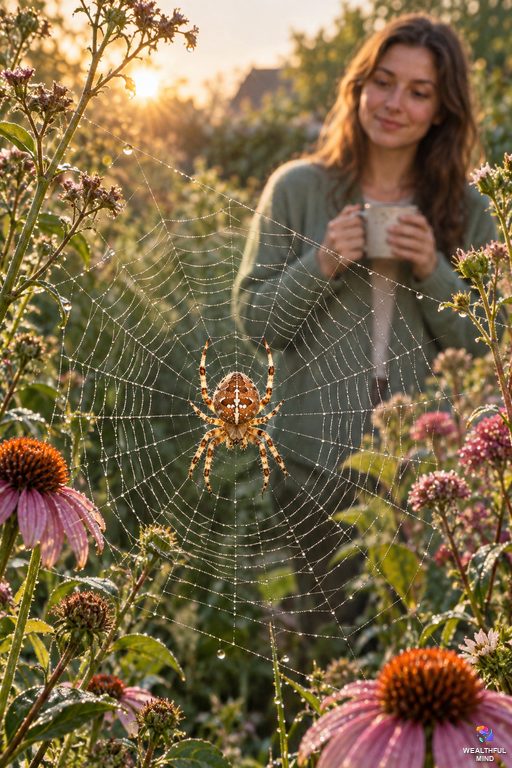
Strictly speaking, spiders are not insects. UC IPM, a pest management program run by the University of California, explains that they are arachnids, with 8 legs, 2 body parts and no wings or antennae. Most of us still file them with the bugs, so you can meet the rest of that crowd in our guide to what bugs and insects mean spiritually. The same steps for reading signs from the universe work for a spider too.
What Does It Mean When You See a Spider?
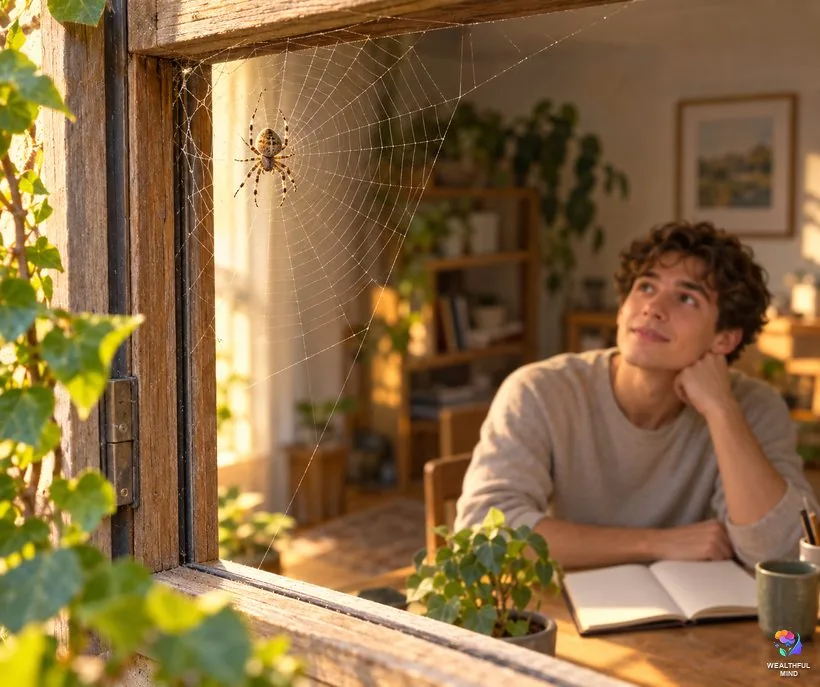
A spider can carry several meanings, and none of them is proven. Here are the ones people mention most.
- Patience. A spider can wait on its web for hours. Let it slow you down on something that needs time.
- Creativity. Many people read a spider as an invitation to make something. Write, draw, sew, cook or build with what you have.
- Weaving your own life. The web is a picture of the life you are making, one thread and one choice at a time.
- Connection. Touch one strand and the whole web feels it, the way your people and plans are linked.
- Facing a fear. If spiders scare you, staying calm near one can be the whole message.
There is another side. In some older lore, and in some churches today, a web stands for a trap, a lie or a tangle.
If your spider left you uneasy, that reading may fit you better. It usually points to a situation in your life, not to danger.
To find your own meaning, go back to the moment. Ask yourself where you were, what the spider was doing and who filled your thoughts.
A spider spinning in your window while you were stuck on an essay says one thing. A spider on your pillow the night after a fight says another.
○ Are Spiders a Good Omen?
Mostly, yes, in folk belief. Old English and American lore, reprinted in a Natural History magazine piece on spider folklore, says a spider found on your clothes means money is coming. In Maryland, killing one that lands on your clothes was said to destroy the presents it was weaving for you. A Dutch belief in the same piece makes a morning spider good luck and an afternoon one bad.
Japan has a similar saying. Sotheby’s, the auction house, notes that a morning spider there is a good omen and a night spider brings bad luck. Ancient China called spiders ximu, or “happy insects”, it adds, though Japanese folklore also has a monster spider, the tsuchigumo.
So spiders are lucky for most people and a warning for a few. We think the better question is what this spider, today, made you feel.
○ Seeing Spiders Everywhere, or in Hard Times
If spiders seem to follow you around, check the calendar first. Late summer and early fall are spider season in many places (the house section below explains why).
Five spiders in one September day is normal.
Many people still read a run of spiders as a message. A Reddit user described how, whenever life fell apart, spiders turned up everywhere, like their spirit guides saying they were not alone. Later they saw one on the ceiling during a therapy session, and felt stronger there than ever before.
Let the comfort walk you toward real people, the way it did for them.
If a hard time has brought thoughts of ending your life, tell someone today. In the US, a call or text to 988 reaches the 988 Lifeline, free, at any hour of the day.
From anywhere in the UK or Ireland, Samaritans can be rung on 116 123 at no charge. Tele MANAS, India’s helpline, is reachable on 14416.
When you feel unsafe this minute, ring your local emergency number.
○ The Spider as a Spirit Animal
If you call the spider your spirit animal, you probably feel drawn to it, or you keep meeting it at turning points. People name patience, craft, a love of stories and quiet strength as its traits, borrowed from older stories like Ananse’s.
The personal spirit animal itself is not in those old sources, so treat it as a modern way to reflect.
If spiders frighten you but keep finding you anyway, many people say that is the point. Your spider guide may be asking you to sit with something you would rather run from.
A Spider in Your House
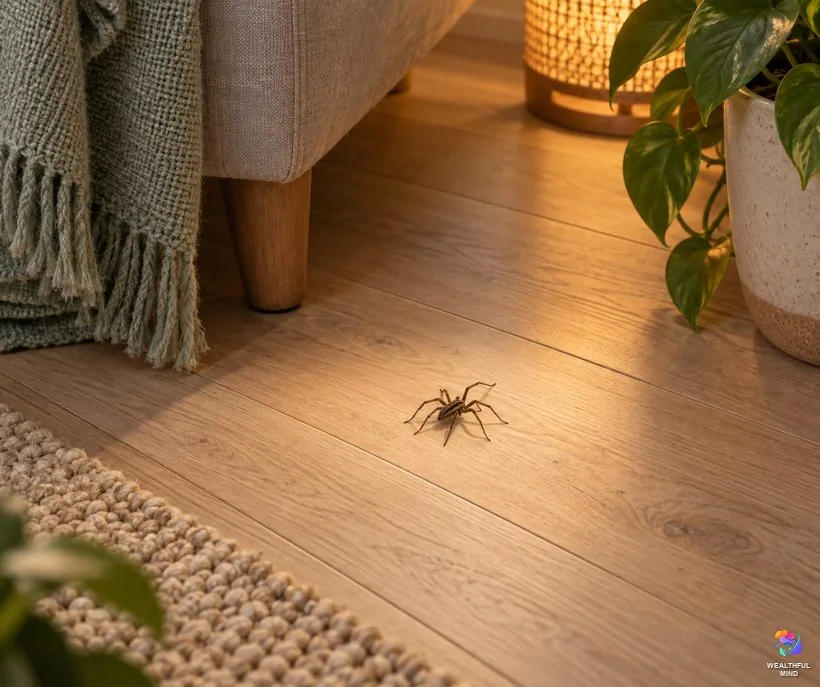
Most people welcome a house spider as a good sign. In the old lore Natural History magazine reprinted, if you felt you must kill a spider living in your house, you had to carry it outside first, or you would be “pulling down your house”. The spider was part of the household.
Today many people read a house spider as protection, patience with a slow project or a creative season starting at home. It is doing you a favor too. UC IPM says spiders are mostly beneficial, because they eat pest insects.
○ Why Big Spiders Show Up in Late Summer and Fall
The Burke Museum in Seattle explains that the spiders in your house are mostly house spiders, a few kinds that spend their whole lives indoors, and few of them are suited to life outdoors in North America. Fewer than 5 percent of the spiders you see indoors have ever been outside. When big numbers appear, usually in August and September, you are seeing grown males wandering in search of a mate.
So if a large spider strolled across your living room one September evening, he was most likely on a search of his own. You can still take him as a sign (a lovesick one, perhaps).
○ A Spider in Your Bedroom or Bed
A spider above your bed or on your pillow comes up again and again in stories people share. Many take it as a note about rest, dreams or something private you are quietly building.
The plain reason is less personal. Rod Crawford, the Burke Museum’s spider curator, told UW News that a spider has no way of telling you are a living creature. To a spider, you are just “the ground”.
Your bed is simply more floor.
If that thought keeps you awake, shake out your blankets before bed and keep them off the floor. That is practical care, and it does not cancel the sign.
○ Should You Put It Outside?
The experts do not agree. Stuart Hine of the Natural History Museum in London says the kindest choice is to let spiders outside. The Seattle museum’s point above pulls the other way.
Our view sits in the middle. A garden spider that wandered in can go back out. A house spider in a quiet corner is already at home.
To move one, cup it under a glass, slide a stiff card beneath and carry it outdoors. If it feels like far too many spiders, our page on bugs that come indoors helps you decide whether it is a sign or a pest problem.
What Does It Mean When a Spider Crosses Your Path?
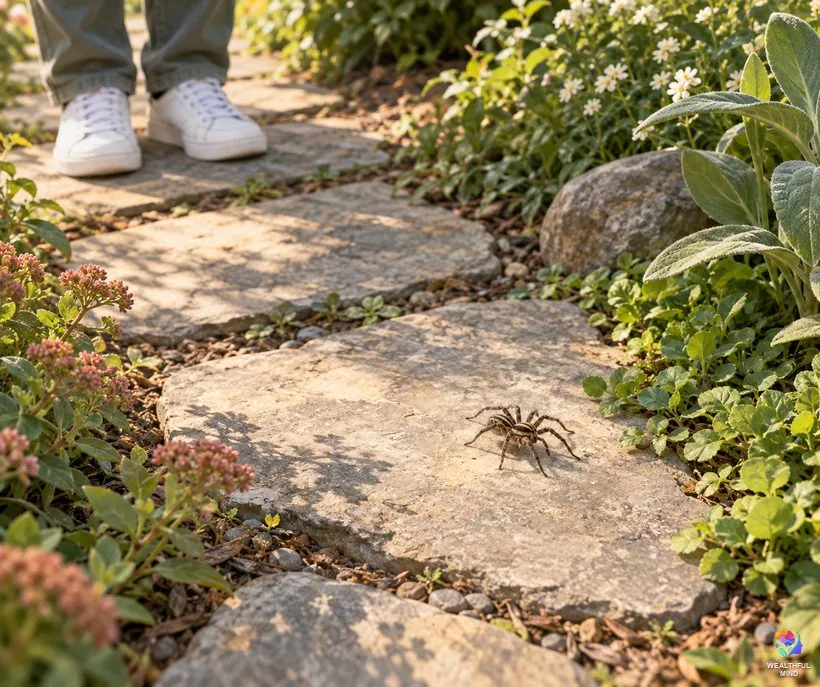
Many people read a spider crossing your path as a choice or a project right in front of you. It can mean “keep going, you are building something”, or “slow down and watch your step”.
Folklore is firm about one thing. In the old beliefs Natural History magazine reprinted, killing a spider that crosses your path brings bad luck.
So let it pass.
A spider out walking is often a hunter. Only about half of all spider species catch their food in webs, the Burke Museum says, while wolf spiders, jumping spiders and others hunt on foot or sit and wait. Every spider, hunter or weaver, also trails a single thread as it walks, which the museum calls the dragline.
○ A Spider Dropping Down in Front of You
A spider sliding down a thread right in front of your nose is hard to ignore. Many people take it as news on the way, a chance dropping into view or a sign to pay attention now.
Old lore even has a color code. In the folk beliefs Natural History magazine reprinted, a white spider dropping in front of you means you will soon see a dear friend, and a black one means you will meet an enemy. We read the black one more kindly, as a hint to keep your eyes open around someone.
The thread is that same dragline. A dropping spider is simply riding it down.
A Spider Crawling on You, in Your Hair or on Your Face

A spider on your arm, in your hair or, worst of all, on your face can feel like a message that came a little too close. Folk belief is kind about it. Remember the old saying from above: a spider on your clothes means money is coming.
Modern readers add their own meanings. A spider in your hair might be a busy mind, and one on your hand a project that wants your attention. These are new ideas, not old lore, so take the one that fits your life, or none at all.
As for why it happened, a spider cannot tell you are alive. It crosses your arm the way it would cross a log.
Some people describe feeling a spider on their face while lying half awake and unable to move. That may have been sleep paralysis, which the NHS describes as being awake yet stuck, unable to move or talk, while drifting off or coming round. It can be scary, but the NHS says it is harmless.
If it comes back often and you start to dread bedtime, the NHS suggests seeing a doctor.
○ Tiny Money Spiders
Tiny spiders that land on your sleeve or in your hair are often called money spiders, a name that fits the old belief about spiders on your clothes.
If one hitches a ride, let it walk off in its own time. Do not brush it away.
Seeing lots of them in one week is usually read as small blessings adding up. That is a nice way to look at your day, whatever your bank balance says.
Walking Into Spider Webs, or a Web Across Your Door
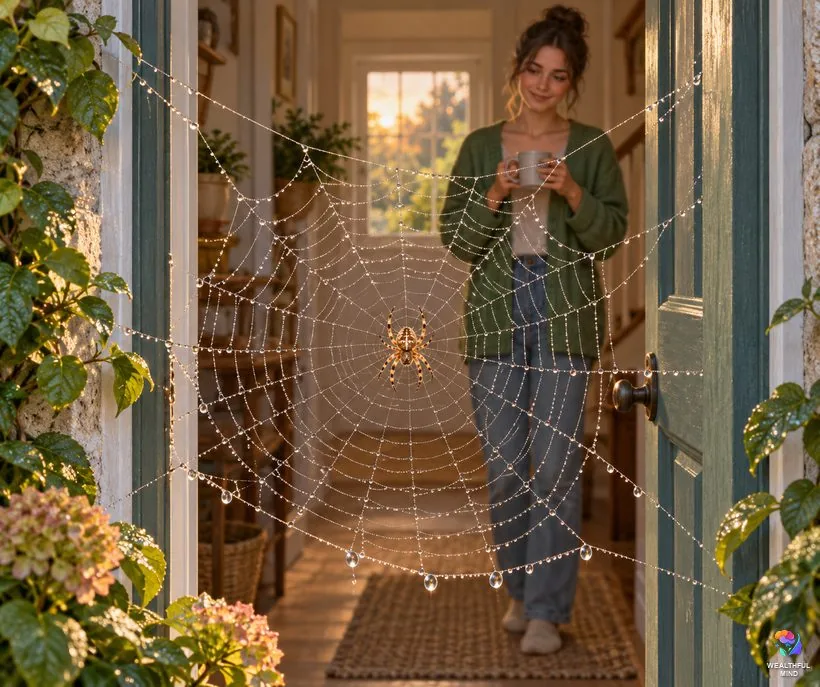
Walking face first into a web is frightening. Walking into one across your front door, the morning after asking for a sign, can feel like an answer.
That is what one person described on Reddit. They asked the universe out loud to show them magic, and the next morning nearly walked into a huge web across the doorway, with a white spider crawling over it. They knew there was a natural explanation and still felt they had crossed a threshold. We think both can be true.
The plain explanation is lovely in its own way. The University of Wisconsin-Milwaukee Field Station explains that many night-active orb weavers eat their old web in the morning and spin a new one each night, a job of about an hour. So the web across your door is a fresh one, built overnight by a spider that will not give up on a good spot.
You can read it two ways. The spider rebuilding every night is a picture of persistence, of keeping at something you love.
Walking into the same web again and again can also be a hint. Stop rebuilding the same thing, and try a new design.
A Spider After Someone Dies
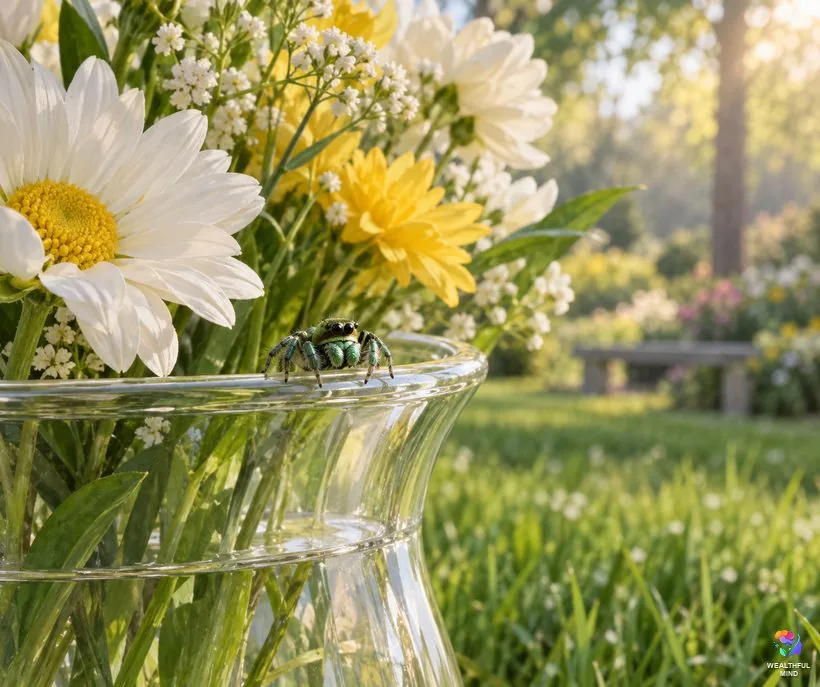
Spiders turn up in grief stories more often than you might expect. On a grief forum, someone described finding a tiny, shiny green jumping spider on the vase at their mother’s new headstone. They wondered if it was their mom saying hi.
A moment later the spider was crushed by accident, and the grief came back as hard as on the first day.
If you had a moment like that, the comfort you felt was real, and so is the hurt that came after. Many who replied said the same thing: the moment of connection still counts.
Others in that thread said they felt no sign at all while someone they loved was dying. That is completely alright. Grief does not need a spider, a butterfly or any other sign to be real, and a missing sign is no measure of your love.
If a spider does show up at a grave or in your loved one’s room, let it be. Watch it for a minute and say what you want to say. You may find your comfort in a white butterfly on the breeze or a white feather on the path instead.
Is It Bad Luck to Kill a Spider?
In English and American folklore, it is. As you read above, killing one on your path brings bad luck, and killing one on your clothes destroys its gifts.
If you killed one by accident or out of fear, be kind to yourself. Arachnophobia is real, and people who have it often feel awful afterwards.
One person on Reddit could not eat for two days because a huge spider was sitting in the kitchen, then felt terrible the moment it was dead.
We think intent matters, and a frightened mistake is not cruelty. If it still bothers you, do one kind thing for the next spider you meet. Leave it alone, or ask someone else to carry it out.
○ What a Dead Spider Means
A dead spider, or a few in a corner, is often read as the end of a chapter: a worry that has run its course, or something you can finally let go. It is not a curse.
Spider lives are short. University of Florida extension agents say orb weavers typically live about a year. So if you find one curled up in late fall, it has usually reached the natural end of its season.
Spider Spiritual Meaning in Stories From Around the World

A lot of spider writing online says “Native Americans believed” or “ancient cultures taught” without naming anyone. Each story below comes from a people we can name or a text you can read yourself, and a few differ from the version that usually gets passed around.
○ Ananse, the Spider Who Won the Stories
Ananse (also spelled Anansi) belongs to the Akan culture of West Africa. Britannica describes him as a trickster whose normal form is a spider. In one well-known tale, he wins the rights to all stories from Nyame, the Sky God, by capturing the Jaguar, the Hornets and the Invisible Fairy.
His tales spread through African communities across the Americas, Britannica adds, and still sit at the heart of many moral tales told to children in Suriname.
If a spider shows up while you are writing, studying or telling a story, think of Ananse.
○ The Water Spider Who Brought Fire
In the Cherokee story “The First Fire”, recorded by James Mooney in Myths of the Cherokee, the world is cold and the only fire burns in a hollow sycamore tree on an island. The raven tries first and comes back with his feathers scorched black. At last the little Water Spider spins a thread from her body, weaves it into a bowl on her back and brings home one small coal.
You may see a version online in which “Grandmother Spider” steals a piece of the sun in a clay pot. We could not trace that one to any source, so we tell Mooney’s instead.
It is a good story to carry: the smallest creature, with a tool she made herself, did what the big ones could not.
○ Spider Woman of the Diné and the Hopi
For the Diné (Navajo), Spider Woman is the one who taught weaving. The Museum of Indian Arts and Culture in Santa Fe explains that, by Diné oral history, she lives on Spider Rock, an 800-foot sandstone spire in Canyon de Chelly, Arizona, and that designs called Spider Woman crosses appear in Diné weaving.
The Hopi picture is more mixed than most websites say. In one origin story recorded by H. R. Voth in The Traditions of the Hopi, Spider Woman makes people from clay, and her people quarrel again and again. In the end, the deity Hurúing Wuhti tells the peoples to stop fighting and learn from one another.
Sotheby’s retells a gentler Hopi telling, in which Spider Grandmother made the earth with Tawa, the sun god, shaping animals and people from clay. Both are real tellings, and neither belongs under a vague “Native Americans believe”.
○ Arachne and the Flawless Weaving
You have probably heard that Arachne was punished for pride. In Ovid’s Metamorphoses, she is a girl known only for her skill, who will not give the goddess Minerva credit for it, and the two hold a weaving contest. Ovid’s own line is the surprise: “Neither Pallas nor Envy itself could fault that work”. The goddess tears the cloth anyway and strikes her, and Arachne ends up as a spider that still spins her thread.
So this is really a story about talent that power could not bear to see. If you make things, that may be your spider meaning.
○ Robert the Bruce and the Spider
In the famous Scottish version, as Sir Walter Scott told it and Discover Ulster-Scots quotes it, Robert the Bruce watches a spider fail six times to swing its thread across, then succeed on the next try. He decides to fight on. Scott wrote that he had met people named Bruce who would not kill a spider on any account.
The history is less tidy. Discover Ulster-Scots says the first mention of the spider is believed to be Scott’s book of 1827, over 500 years after Bruce. The tale was probably first written about Bruce’s ally James Douglas, in a book published in 1643.
Whoever it belonged to, the lesson is the same. Try again.
○ The Christmas Spider of Ukraine
In a legend ZME Science places in Western Ukraine, a poor family cannot afford a single ornament for their tree. The house spiders spin webs over its branches in the night, and the gray silk turns to gold and silver.
Visit a traditional Ukrainian home over the holidays, ZME Science adds, and you might find pavuchky, or “little spiders”: straw mobiles hung from the ceiling, whose webs were believed to catch bad energy.
In at least one corner of the world, then, a web at Christmas means blessing, not dust.
○ Spiders in the Bible and the Quran
Search for “spider” on Bible Gateway and you will find three verses in the King James Version, but only two in the NIV. In Job 8:14, misplaced trust “shall be a spider’s web”, and in Isaiah 59:5 the wicked “weave the spider’s web”. The third verse is kinder. In the King James Version, Proverbs 30:28 says the spider “taketh hold with her hands, and is in kings’ palaces”, but the NIV makes that creature a lizard.
None of these verses calls a spider a spirit, a demon or a sign. The web is a picture of weak shelter and false trust.
Aleteia, a Catholic news site, notes that medieval monks later used spiders to stand for evil. It also retells the legend of St Felix of Nola, the patron saint of spiders, who hid in a gap in a ruined wall while spiders spun a web across it, so his pursuers walked on.
The Quran has a whole chapter called “The Spider”, chapter 29, as Quran.com shows. Its verse 41 says “the flimsiest of all shelters is certainly that of a spider”.
Muslim tradition also has a protecting spider. Brewer’s Dictionary of Phrase and Fable tells how the Prophet hid in a cave while fleeing Mecca, and a spider wove its web across the entrance, so his pursuers decided nobody could have gone in.
So in both faiths, a web is a poor house to trust. In their legends, it is also a shield.
Are Spiders Monitoring Spirits?
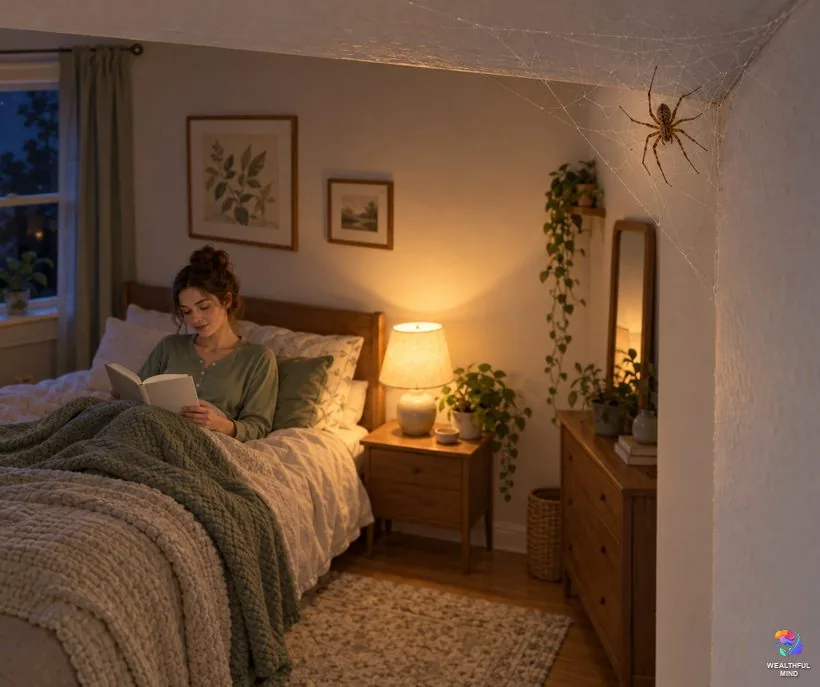
No verse in the Bible or the Quran says so.
The idea that spiders, insects or cobwebs are “monitoring spirits”, sent to watch, block or curse a person, is taught in some deliverance prayer ministries. You will find many videos about it, but we found no scholarly or scriptural source for the phrase itself.
If you grew up with this teaching, or someone sent you one of those videos, it makes sense to feel scared when a spider keeps appearing in your room. You deserve a calm answer.
The scripture verses above are about fragile webs, not about watching anyone. And as you read in the bedroom section, a spider cannot even tell that you are a living creature. It has no way to watch you the way that teaching describes.
A spider that keeps showing up has everyday explanations. It may be a house spider that lives in your room, a male wandering in late summer or a spider that likes one corner.
If prayer brings you peace, pray. You do not need to fear the spider itself.
If the worry of being watched or cursed keeps you from sleeping, eating or being alone in your room, that worry needs care of its own. Talk to a parent, a teacher, a pastor you trust or a counselor.
Spider Colors and Kinds
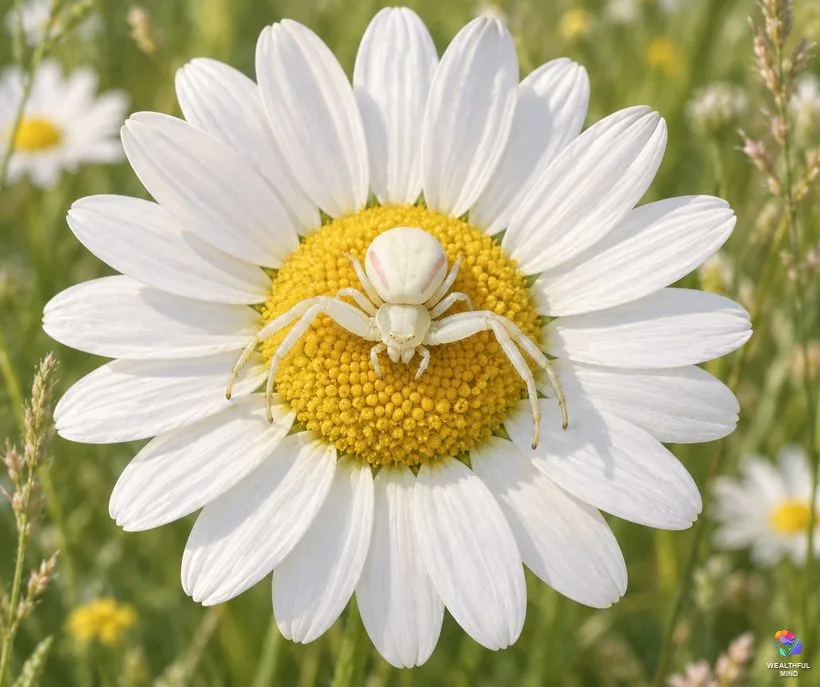
Color meanings for spiders come mostly from modern writers, with a few old folk beliefs mixed in. Here is how people read each one, with the plain facts beside it.
○ Black Spider
A black spider is often read as protection, mystery or a shadow side you are ready to face. In the old lore, a black one dropping in front of you meant meeting an enemy.
Most black spiders are harmless. The one to know about is the black widow, a little further down.
○ White Spider
White spiders are uncommon enough to feel special, and folk belief is kind to them: a white spider dropping in front of you meant a dear friend was on the way. Read white as a fresh start, a clear mind or a message from someone you miss.
○ Brown Spiders and Wolf Spiders
Brown spiders are usually read as grounding, home and steady work.
A large, hairy brown spider running across your floor is often a wolf spider. UC IPM describes wolf spiders as ground hunters with long hairy legs, usually brown to tan, whose eyes reflect green in a flashlight beam at night.
That detail turns a scary shape into something rather beautiful. Next time, try the flashlight before the shoe.
○ Jumping Spider
Jumping spiders are the small, curious-looking ones that seem to turn and look at you. UC IPM says they hunt by day, make no web and pounce on prey from many times their body length, and some have a shiny, metallic-colored abdomen.
Many people read them as boldness and good timing. The green one on that mother’s grave shows how tender a meeting with one can feel.
○ Daddy Longlegs
If you keep seeing a “daddy longlegs”, it may not be a spider at all. The Burke Museum explains that most Americans use the name for harvestmen, arachnids with one body section, two eyes, no silk and no venom. In Britain it usually means a crane fly, which is an insect, and only one daddy longlegs, a long-legged house spider, is a true spider.
People often read these leggy visitors as balance and a light touch.
○ Black Widow, Brown Recluse and Tarantula
A black widow can feel like a warning because of its name alone, and many people read one as a reminder to guard your limits.
A tarantula, big and slow, is usually read as patience and quiet strength.
The CDC’s workplace safety institute (NIOSH) names two venomous spiders to know about in the US: the black widow, with a red marking on the underside of its body, and the brown recluse, brown with a dark violin shape and six eyes instead of the usual eight.
The CDC says spiders are usually not aggressive, and most bites happen when a spider is trapped or touched.
UC IPM notes that the brown recluse does not live in California, and that a bite from most other spiders is usually no worse than itching or a bee sting. California’s tarantulas are not likely to give a serious bite either, it says.
If you are bitten, follow NIOSH’s advice. Stay calm, wash the bite with soap and water, put a cold, damp cloth or ice on it and get medical attention. Get help quickly if you have trouble breathing, pain that spreads, muscle cramps, sweating, fever or vomiting, which the CDC lists among possible symptoms.
Any sore that spreads or will not heal needs a doctor, whatever caused it. Most things people think are spider bites are not caused by spiders at all, Rod Crawford told UW News.
Spiders in Your Dreams
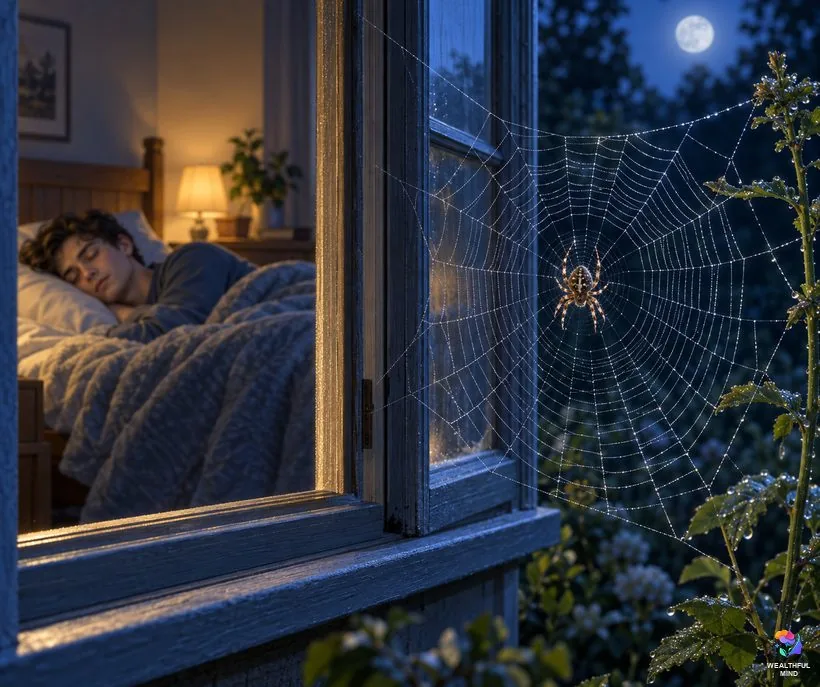
No old tradition we found fixes a meaning for spider dreams, and no two dream dictionaries online agree. So read yours by what the spider did and how you felt on waking.
- A big spider. Something feels larger than you can handle, or a powerful person is on your mind.
- Many spiders. Lots of small worries or responsibilities at once.
- A spider chasing or biting you. A fear you have been avoiding. It is your mind talking, not a curse.
- A spider spinning a web. A plan taking shape, and a hint to be patient with it.
- Being caught in a web. Feeling trapped in a habit, a job or a relationship.
- Killing a spider. Overcoming a fear or closing a problem.
- A black or white spider. Use the color readings above, and notice who else was in the dream.
One dreamer on Reddit found a tarantula in a bedroom of their parents’ house, on a night they had been talking about buying a home. Someone replied that spiders always have a home.
Look for that kind of link: something in the dream that matches something in your week.
Some people dream of spiders and moths together, and the moth has dream meanings of its own.
If spider dreams keep waking you up scared, write them down. Then talk them through with someone you trust.
The next time a spider stops on your wall, give it a minute before you decide what to do. It is probably just living its small, patient life, and you are welcome to borrow a little of that patience.
Common Questions About Spiders
Are spiders a good omen?
For most people, yes. Old English and American folklore, reprinted by Natural History magazine, says a spider on your clothes means money is coming, and a well-known Japanese saying calls a morning spider a good omen. Some traditions read the web as a trap or a warning instead, so let your own feeling in the moment guide you.
What does it mean if a spider crosses your path?
Many people read it as a choice or a project right in front of you, a nudge to keep building or to slow down and watch your step. Old folklore adds one firm rule: killing a spider that crosses your path brings bad luck, so let it pass. In plain terms, a spider out walking is usually a hunting spider on its rounds.
What are spiders trying to tell me?
The messages people take most often are patience, creativity, weaving your own life and facing a fear. Go back to where you saw the spider, what it was doing and who was on your mind. The meaning tied to that moment is usually the one that fits.
Are spiders monitoring spirits?
No verse in the Bible or the Quran says so. The idea is taught in some deliverance prayer ministries, but we found no scriptural or scholarly source for it, and the Bible’s spider verses are about fragile webs, not watching. The Burke Museum’s spider curator says a spider cannot even tell that you are a living creature. If a feeling of being watched is affecting your sleep or meals, talk to someone you trust.
Is it bad luck to kill a spider?
In English and American folklore, yes: killing a spider that crosses your path is said to bring bad luck. If you killed one by accident or out of fear, be kind to yourself. A frightened mistake is not cruelty, and you can let the next spider you meet go free.
Why am I suddenly seeing so many spiders in my house?
Usually because it is late summer or early fall. The Burke Museum in Seattle explains that most spiders in your house are indoor kinds, and the crowds people notice in August and September are mostly grown males wandering in search of a mate. Many people still read the extra visitors as a sign of patience or a creative season at home.