The most common hawk spiritual meaning is a call to rise above a problem, see the bigger picture and then act with focus, and many people also take a hawk as a sign that they are being watched over. Hawks are not rare, and Cornell’s All About Birds guide calls the red-tailed hawk probably the most common hawk in North America. So we think the real message lies in what was happening in your life when one appeared.
Quick pick
What Did the Hawk Do?
Find your moment, then read the meaning and the real bird reason side by side.
- Did a hawk cross your path or the road? A nudge to check the direction you are heading
- Did it circle over you or your car? Being watched over, and a call to rise above the worry
- Does a hawk seem to follow you? Support during a big decision: keep going
- Is one visiting your yard or feeder? Protect your space, and it is probably a Cooper’s hawk
- Did you find a hawk feather? A sign of insight, but in the US leave it where it is
- Did you see it after a loss? A personal, modern sign, and it is fine if none comes
Keep reading below Core meanings Red-tailed hawk Bible, myth and tradition Questions
This page is part of our guide to the spiritual meaning of birds, and it reads hawks the same way our page on signs from the universe reads every sign. For each situation below, you will find the meaning people give it and the plain bird reason right beside it. You can hold both.
What Does It Mean When You See a Hawk?
A hawk spends its day up high or perched somewhere tall, watching. So it is no surprise that people read it as a message about seeing clearly.
These are the meanings you will come across most often.
- See the bigger picture. Step back from the small worries and look at your whole situation, the way a hawk looks down on an entire field.
- Focus. Pick the one thing that matters most right now and go after it.
- Trust your gut. A hawk does not hesitate once it has spotted what it wants. Many people take that as a push to trust your instincts on a decision you keep putting off.
- You are protected. Plenty of people feel a hawk as protection from God, the universe, their angels or someone they have lost.
- Pay attention. Sometimes the message is only to notice. Something in your everyday life deserves a closer look.
The bird’s real eyesight fits the first meaning beautifully. A red-tailed hawk sees about eight times better than you do, and in flight it can spot a mouse on the ground from 100 feet up.
So what is a hawk trying to tell you? Most likely the thing you already half know. If one meaning above made you stop for a second, start there.
What Your Hawk Encounter Means
What the hawk was doing changes the reading. Find your moment below.
○ A Hawk Crossing Your Path or the Road
When a hawk flies across your path, on foot or in front of your car, many people take it as a cue to slow down and check which way your life is heading.
Some people take it as a green light for a plan. Others take it as a gentle stop sign. Your first feeling in that moment is usually the better guide.
There is a plain reason it happens so often on roads. Red-tailed hawks often hunt along highways, circling overhead or hovering in place as they scan the ground for prey. Roadsides, fields and pastures are among their favorite open spaces, and voles, mice and rabbits are among their usual meals.
Once you know this, you will start noticing them on every long drive. That does not take the meaning away from you. The moment you happened to look up is still yours.
○ A Hawk Flying Over You or Your Car
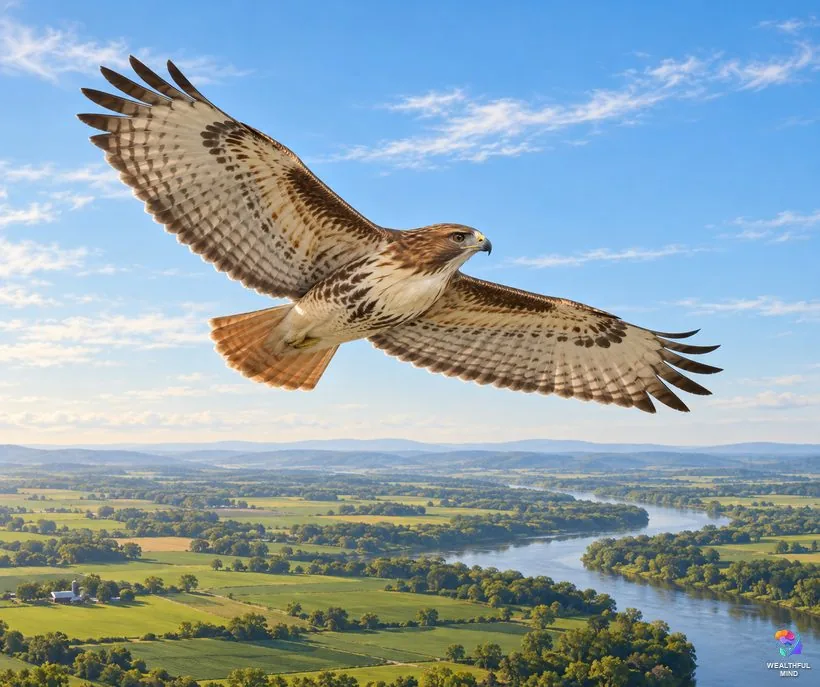
A hawk circling above you is one of the best-loved hawk signs. Many people read it as being watched over, and as a reminder to rise above whatever is weighing on you.
If a hawk circles over your car on a hard day and you suddenly feel a little less alone, plenty of people have felt exactly that.
The circling has a real cause too. Cornell’s guide describes red-tails soaring above open fields, slowly turning circles on broad, rounded wings, and climbing on thermals, which are rising currents of warm air. So the hawk above your car is usually riding the air and hunting at the same time. (It is not especially interested in your car.)
○ A Hawk That Seems to Follow You
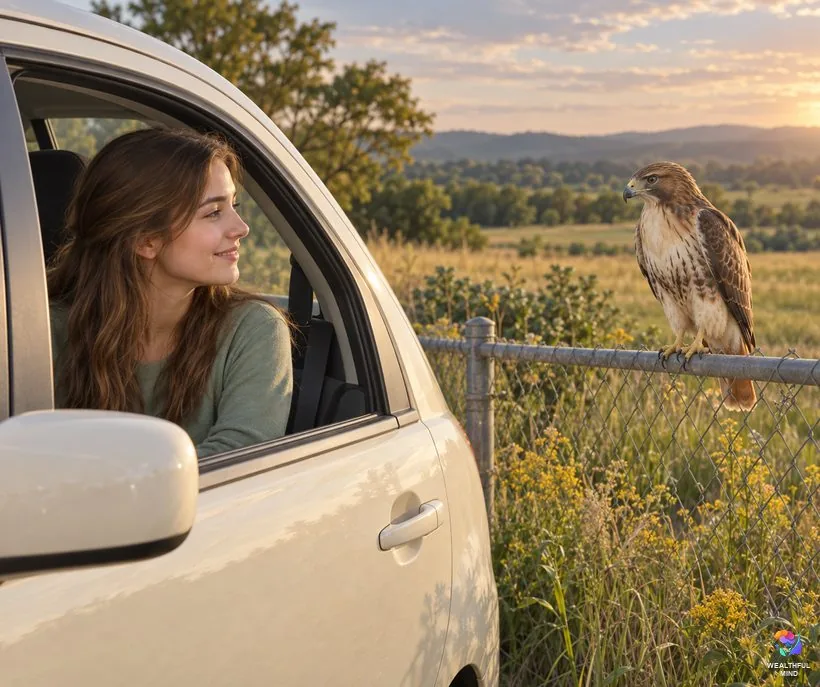
Maybe you saw one on a lamp post, then another over the freeway, then one sitting on a chain-link fence a few feet from your car. If this keeps happening to you, the message many people hear is simple. Keep going, you are not alone in this.
Here is the honest bird answer. Male red-tails often defend a territory of about two square miles from other hawks. So the hawk on the fence and the hawk over the freeway are most likely different birds.
You are driving through hawk country. In fact, the easiest way to find a red-tail is to go for a drive and watch the fenceposts and the sky.
What follows you is your attention. Once a hawk has caught your eye, you notice every one you pass, and that noticing is often the whole point.
○ A Hawk in Your Yard or Sitting Near You
A hawk on your fence, your roof or a branch outside your window feels personal. Many people read a visit like this as a sign to protect your space and your energy, or to look at something at home that you have been avoiding.
The bird reason depends on the hawk. Cornell’s All About Birds guide explains that red-tailed hawks eat mostly mammals, so they are less likely to visit a busy feeder than a Cooper’s hawk or a sharp-shinned hawk is.
So if a hawk keeps coming back to your garden, it is probably one of those two, and it has most likely come for the small birds at your feeder. Birders tend to find that exciting. Your garden is full of life.
If you have a small dog or cat, you can relax a little. The same Cornell guide says it is very rare for a red-tailed hawk to go after dogs or cats.
○ Seeing Hawks Every Day
This is the situation people write about most. Someone sees hawks everywhere for weeks, usually during a big decision, a move, a breakup or a stretch when life feels unsettled.
The readings people share back are steady ones. Take a bird’s-eye view. Keep doing what you are doing. Notice what you were thinking at the moment each hawk appeared.
How rare is seeing a hawk, then? Not rare at all. The Cornell Lab of Ornithology’s bird guide cites an estimate of about 3.1 million breeding red-tails worldwide, and says North American numbers grew by about 1.3% a year from 1966 to 2019.
Cornell also notes that across most of the continent there are more of them in winter, when red-tails from the far north arrive to join the ones that live there all year. That is why you might suddenly see hawks everywhere in December.
None of this makes your feeling wrong. Jot down the day and what you were thinking about each time. After a few weeks, that little record will say more about your hawks than any list of meanings can.
○ Two Hawks Together
Two hawks flying together are often read as a sign about partnership. It might point to a strong relationship, a good team or a reminder to lean on the people beside you.
This one has a lovely real basis. Mated red-tailed hawk pairs typically stay together until one of the pair dies.
If you see two hawks circling very high, you might be watching courtship. Courting red-tails soar in wide circles at a great height, and sometimes the pair clasp talons and plummet in spirals toward the ground before pulling apart.
Many people take this as a wonderful sign for love. We would too.
○ A Hawk After Someone Dies
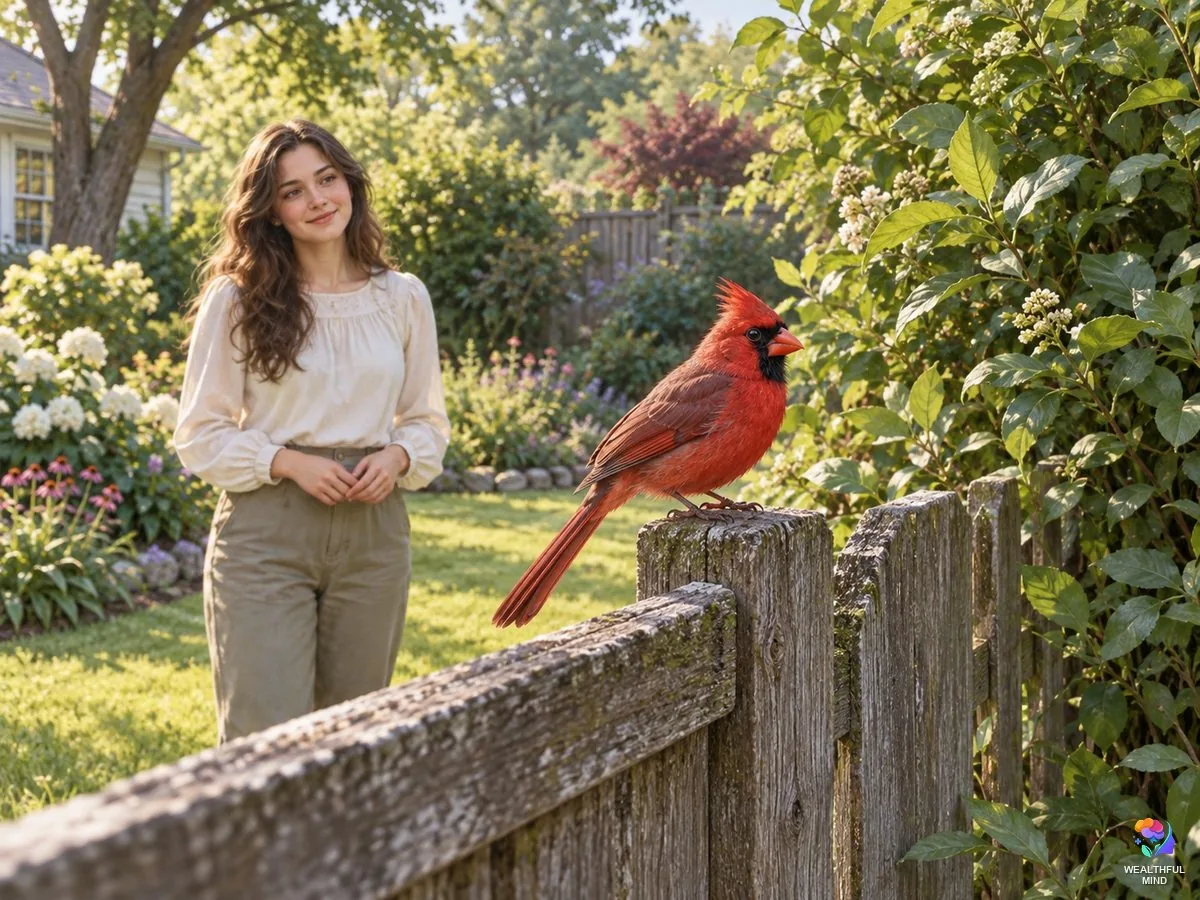
Some people see a hawk at a funeral, beside a grave or on the drive home, and feel their loved one is near, keeping them company for a moment. If that happened to you, the comfort you felt is real and it is yours to keep.
We do want to be honest with you about one thing. We could not trace this belief to any older tradition, and pages that call it an old Native American belief name no people and no source. It is a modern, personal way of reading a hawk, and it is no less meaningful for that.
The cardinal is the bird most often tied to this belief, and our cardinal spiritual meaning page covers it.
And if you are waiting for a hawk that never shows up, please do not read anything into the empty sky. A missing sign says nothing about your bond with the person you lost.
○ Finding a Hawk Feather
Finding a hawk feather is usually taken as a sign of insight, protection or a message on its way. Many people feel it as a small gift.
But if you are in the United States, please leave it where it is. According to the US Fish and Wildlife Service, the Migratory Bird Treaty Act forbids keeping a native North American bird’s feathers, or any other part of it, unless you hold a permit. That holds even for a feather the bird dropped naturally, or one taken from a bird killed on a road or by a window.
Red-tailed, Cooper’s and sharp-shinned hawks all appear by name on the protected migratory bird list in the Code of Federal Regulations. Breaking the Act can mean a fine of up to $15,000, up to six months in jail, or both.
So snap a picture, enjoy the moment and walk on. The picture carries the meaning just as well. (Our white feather spiritual meaning page has more on feathers and the law.)
There is one legal route. Federally enrolled tribal members can get hawk feathers for religious and cultural use through two federally approved feather repositories. Elsewhere in the world, wildlife laws differ, so look up the rules where you live before you keep any wild bird’s feather.
○ An Injured or Dead Hawk
If you find a hawk hurt on the road, watch it from a safe distance rather than reaching for it. Those talons can be up to 1.33 inches long.
Once you are sure it is injured, the US Fish and Wildlife Service suggests calling a local wildlife rehabilitator, a veterinary office that can handle wildlife or your state wildlife agency. They can help you work out the next steps.
A dead hawk is usually read as the close of one chapter and the start of another, not as a curse. Leave the bird where it is, because picking up a protected bird, or even its feathers, needs a federal salvage permit. You can report its location to your state fish and game office or a feather repository instead.
Our page on the dead bird spiritual meaning goes into those meanings more gently.
Red-Tailed Hawk Spiritual Meaning
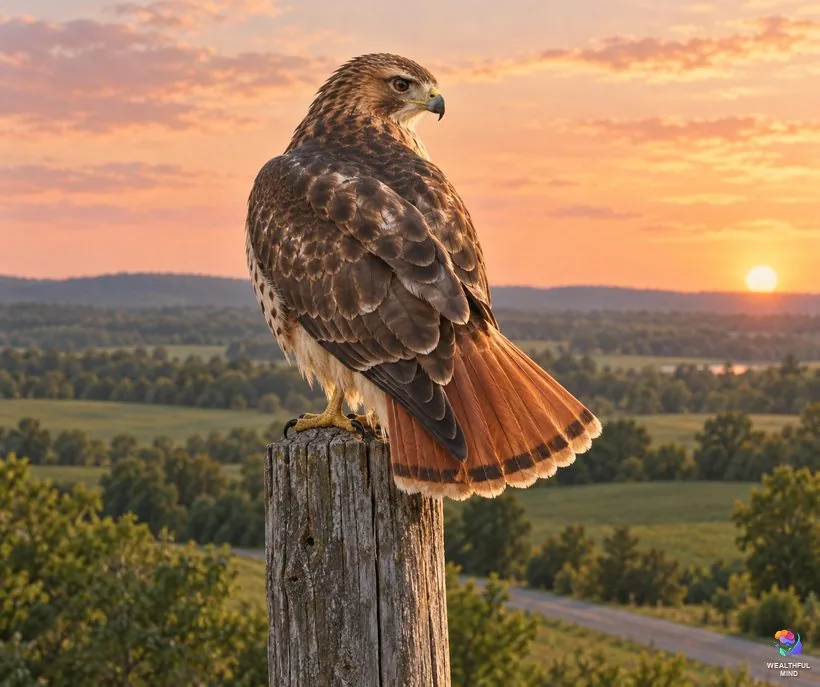
The red-tailed hawk is the one you are most likely to actually see, so most hawk signs are red-tail signs. Its meanings are the core ones above, with a little extra.
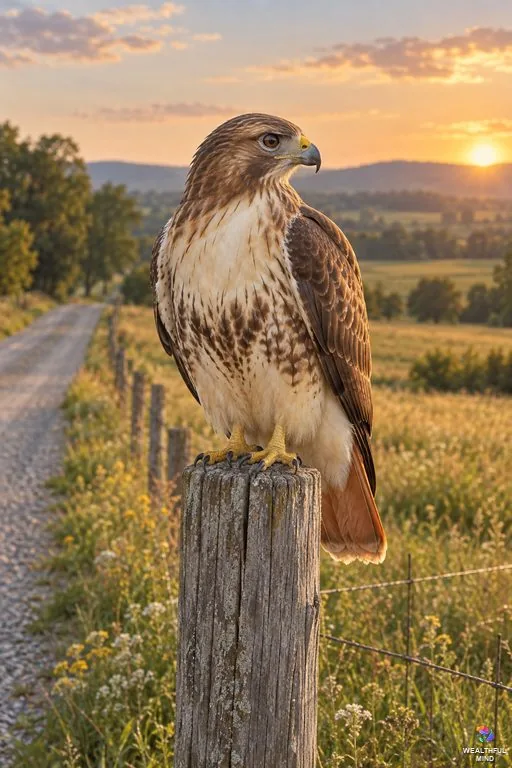
People connect the red tail with strength, courage and staying grounded. They often read a red-tail on a roadside pole as a guardian keeping watch over the road you are traveling.
You can recognize an adult by its brick-red tail, but do not be thrown if the tail is brown. Young red-tails do not get their red feathers until the start of their second year, and with 14 subspecies and many color forms, adults vary a lot too.
People love two more things about this bird.
- That scream. Cornell’s bird guide says that when a hawk or eagle appears in a film, whatever the species, the shrill cry on the soundtrack is almost always a red-tailed hawk. An Audubon writer explains why: bald eagles have “sort of a dopey chuckle” for a call, so filmmakers show the eagle and play the hawk.
- Its long life. The oldest known wild red-tail was at least 30 years and 8 months old when it was found in Michigan.
So if a red-tail turned up for you, many would read it as a steady, lasting kind of sign. Less a flash of luck, more a guardian.
Black Hawk and White Hawk Meaning
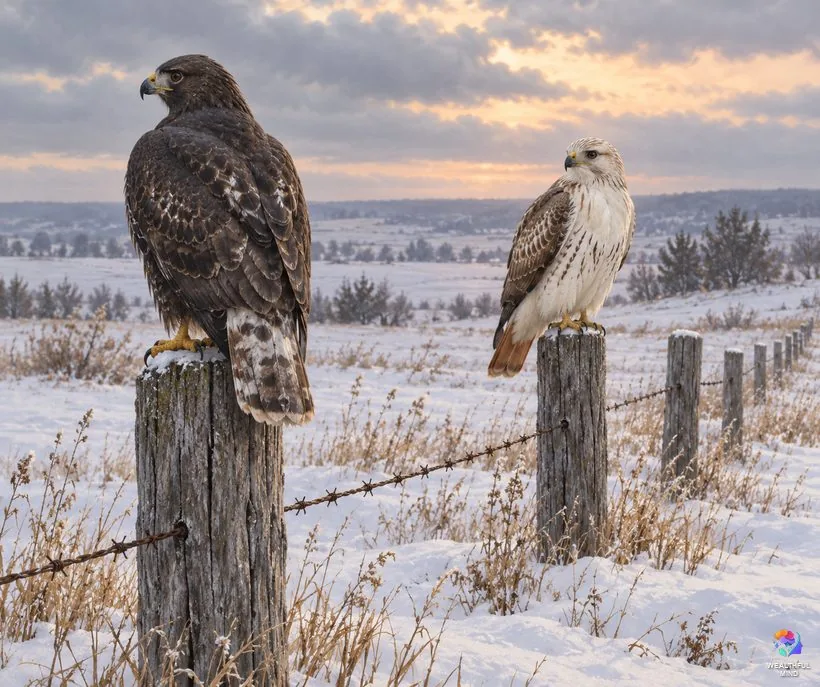
A very dark hawk is often read as mystery, protection or a quiet time of going inward before a change. A pale or white hawk is read as purity, a fresh start or a message from spirit.
Both feel unusual, which is part of why you might feel singled out when you see one.
There are real birds behind both. Cornell’s All About Birds guide describes the “Harlan’s Hawk” as a very dark form of the red-tailed hawk that breeds in Alaska and northwestern Canada and winters on the southern Great Plains. Instead of a red tail, it has a marbled white, brown and gray one.
The Common Black Hawk is a separate species altogether, and the Code of Federal Regulations names it on that same list of protected birds.
For white, the most famous example is Pale Male, a red-tailed hawk who became a celebrity in New York City. He was a light color form with an almost white head.
So the white hawk you saw is most likely a pale red-tail. That makes it a special sighting in its own right.
The Hawk as a Spirit Animal
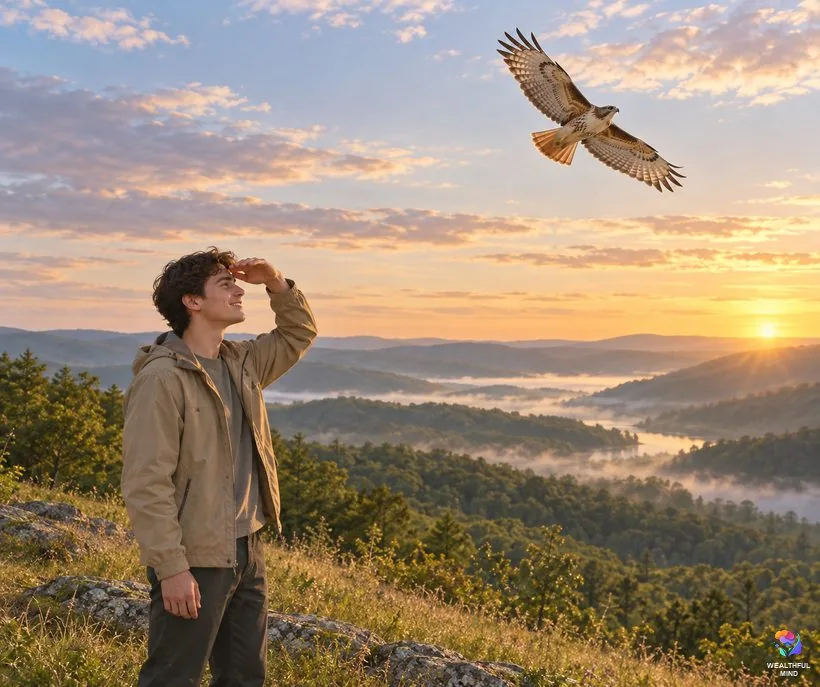
If the hawk feels like your spirit animal, people usually mean you share its traits. You notice what others miss, you see the long view, and you move fast once you have decided. Hawk people are said to be quiet watchers who like their own space.
One respectful note. The words “spirit animal” and “totem” come from the beliefs of particular peoples, and some people from those communities feel the terms get borrowed too lightly.
You can still use them, since that is how most people search. But “the hawk is my personal symbol” says the same thing in plain words, and it is respectful to everyone.
If you want to work with the hawk as your symbol, try this.
- Pick one decision you have been circling for weeks.
- Write it down, then write how it looks from high up, meaning a year from now.
- Do the one small thing that view makes obvious, today.
Hawks in Scripture, Myth and Tradition
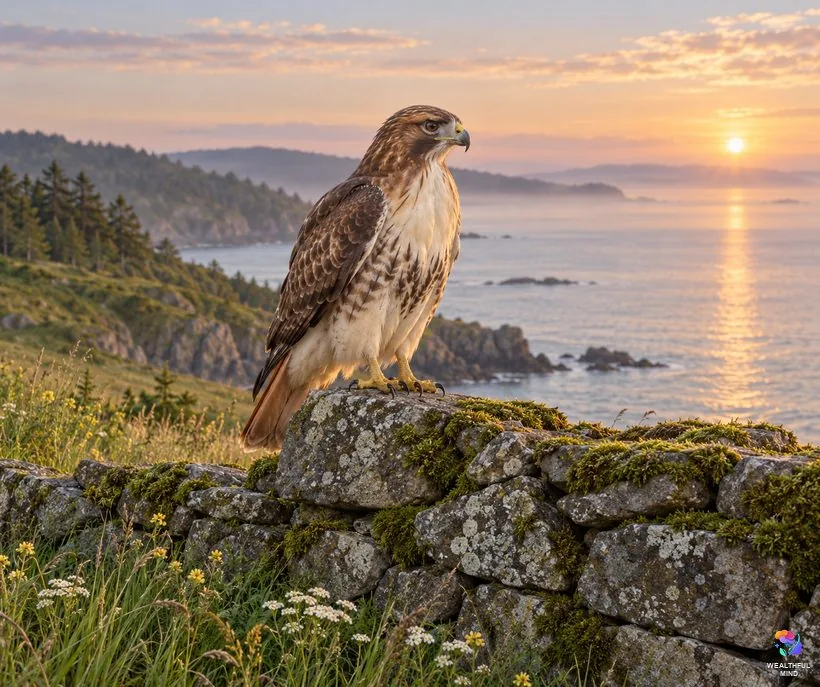
Many pages say “Native Americans” or “many cultures” see the hawk as a messenger and stop there. Here is what we could follow back to a named people or a real text.
○ Is the Hawk in the Bible?
Yes, a few times. The best-known hawk verse in the Bible is Job chapter 39, verse 26, where God asks Job, “Doth the hawk fly by thy wisdom, and stretch her wings toward the south?” (King James Version).
It sits inside a long speech that points Job to the wild world, which runs on a wisdom far bigger than his own.
The hawk also turns up in the Bible in Leviticus chapter 11, verse 16, in the list of birds the Israelites were not to eat.
People often ask what a hawk from God would mean. No verse in the Bible describes a hawk sent as a personal sign. Many Christians still feel a hawk as a nudge from God, and the Job verse fits that feeling well.
It reminds you that God sees further than you do, and that you can trust Him with what you cannot see yet. That is a faith reading, and a beautiful one.
○ A Hawk Omen in Homer’s Odyssey
The clearest old example of a hawk read as a sign comes from ancient Greece. In book 15 of Homer’s Odyssey, just as young Telemachus is about to set off, “a bird flew forth upon the right, a hawk, the swift messenger of Apollo”, holding a dove in its talons. A seer named Theoclymenus tells him a god sent the bird, and reads it as a sign that no house in Ithaca is more kingly than his.
A hawk on the right was good news for Telemachus. If one ever flies past on your right as you set out on something new, that is a lovely old story to carry with you.
○ Horus Is a Falcon, Not a Hawk
Page after page calls the Egyptian god Horus a hawk. He is a falcon. The Metropolitan Museum of Art describes a 4th century BCE inlay in its collection as the falcon god Horus, a god closely tied to kingship.
The mix-up is old. The ancient Greeks called the Egyptian town of Nekhen “Hierakonpolis”, the City of the Hawk. Even a 1976 Penn Museum article calls the same royal bird “a golden hawk” in one paragraph and “the falcon” in another.
The two birds are also further apart than they look. In 2008, Audubon reported on genetic research showing that falcons are not closely related to hawks and eagles, and are close kin of parrots instead.
None of this spoils the meaning for you. The same Penn Museum article describes the king on the ancient Narmer Palette under the watchful, protective gaze of Horus. That picture of a guardian watching from above fits a hawk sighting just as well.
○ Norse and Irish Hawks
In Norse myth, a wise eagle sits on a branch of Yggdrasil, the world tree, and “between his eyes sits a hawk that is called Vedfolner.” That line comes from the Prose Edda.
A hawk perched right where the wise eagle looks out is a neat picture of the hawk as a bird of sight and knowing.
Ireland has an Old Irish text called The Colloquy between Fintan and the Hawk of Achill, a conversation between Fintan and an ancient hawk. University College Cork keeps it in its CELT library, and its record there lists a 1932 study titled “The Hawk of Achill or the Legend of the Oldest Animals”.
We think this text is the likeliest root of the modern idea that the hawk stands for memory and the long view of time.
○ Native American Views
There are a great many Native nations, and they do not share one meaning for the hawk. So treat any page that says “Native Americans believe” and names no one with care.
Here is what we could trace.
- The Seneca have a Hawk Clan. Seneca language lessons teach the line “Ageswe’ gai:yo'”, which means “I am of the Hawk Clan.”
- James Mooney, who recorded Cherokee stories for the Bureau of American Ethnology, wrote that there is “very little concerning hawks” in them, apart from the great mythic hawk called the Tla’nuwa. In the story he recorded, a pair of these huge, savage birds carried off dogs and even young children, until a medicine man threw their young from the nest.
- Hawk feathers are still used in ceremony today. Federally enrolled tribal members can get them for religious and cultural purposes through feather repositories, one of them run by members of the Comanche Nation.
That Cherokee story is a long way from the gentle “Cherokee messenger” you will find on many pages. We will not invent a meaning for any nation beyond what is above. If a Native tradition matters to you, the best teacher is someone from that nation.
Which Hawk Did You See?
Knowing the bird can sharpen the meaning for you, and it only takes a few seconds.
Red-tails are big, with wings a little over four feet across, and females are usually much larger than males. Even so, the biggest females weigh only about 3 pounds.
- A big, broad-winged hawk on a pole or circling over a field is almost always a red-tail.
- A smaller hawk darting through your garden after birds is probably a Cooper’s or sharp-shinned hawk.
- A very dark hawk on the plains in winter might be a Harlan’s red-tail, and an almost white one is usually a pale red-tail.
How to Read Your Own Hawk Sign

The four steps on our signs page work for any sign. This is what they look like with a hawk.
Say you are visiting a new city to look at apartments, still unsure whether to move. On the drive in, a red-tail lifts off a fencepost and circles over the road ahead of you.
- Name the situation. A big move you have not decided on yet.
- Notice your first feeling. Was it a lift in your chest, or a knot in your stomach?
- Watch for repetition. Note whether hawks keep turning up on this trip, and keep in mind that winter brings more of them.
- Check the tradition. Bigger picture, focus, being watched over.
If your first feeling was a lift, your reading might be to look at the whole move, not only the scary rent, and then decide.
Your small step today could be a list of everything you would need in order to say yes.
Next time a hawk crosses your sky, let it slow you down for one breath. Look up, look around at your life, and then go and do the thing you saw clearly.
Questions People Ask About Hawks
Is seeing a hawk good luck?
Most people read it as a good sign. A hawk is usually taken as a call to see the bigger picture, to focus and to trust that you are watched over. The oldest example we found is in Homer’s Odyssey, where a hawk flying on the right is read as a good omen for young Telemachus. So if a hawk made you stop and look up, take it kindly.
When God sends a hawk, what does it mean?
No verse in the Bible describes God sending a hawk as a personal sign. The best known hawk verse is Job chapter 39, verse 26, where God asks Job whether the hawk flies by his wisdom, a reminder that God sees far beyond us. Many Christians still feel a hawk as a nudge from God to trust Him with what they cannot see yet. That is a faith reading, and it is yours to hold.
What does it mean when a hawk keeps crossing your path?
Many people take it as a cue to ease off and check where your life is heading. There is a plain reason too. Audubon notes that red-tailed hawks often hunt along highways, so you will cross paths with them on most long drives. Keep a note of what you were thinking about at each crossing, and see what pattern shows up.
How rare is seeing a hawk?
Not rare at all. Cornell’s All About Birds guide calls the red-tailed hawk probably the most common hawk in North America, and it cites an estimate of about 3.1 million breeding red-tails worldwide. Across most of the continent there are even more of them in winter, when hawks from the far north fly south.
What does a hawk visiting you mean spiritually?
A hawk on your fence, roof or window ledge is often taken as a nudge to protect your space and your energy, or to look closely at something at home. If it keeps visiting your garden, it is most likely a Cooper’s hawk or a sharp-shinned hawk, which Cornell’s bird guide says are more likely to visit feeders than red-tails are.
Is a hawk a sign from a loved one who died?
Many people feel that it is, and that feeling is yours to keep. We could not trace this belief to any older tradition, so it is best seen as a modern, personal way of reading a hawk. The bird most often linked to a lost loved one is the cardinal. And if you never see one, that says nothing about your bond with them.
Can I keep a hawk feather I found?
Not in the United States without a permit. According to the US Fish and Wildlife Service, the Migratory Bird Treaty Act covers every feather of a native bird, even molted ones found on the ground, and the law allows a fine of up to $15,000. Federally enrolled tribal members have a legal route through feather repositories. Everyone else can enjoy it, take a picture and leave the feather where it lies.
Is Horus a hawk or a falcon?
A falcon. The Metropolitan Museum of Art labels him the falcon god Horus. The hawk idea comes from the Greek name for his town, Hierakonpolis, the City of the Hawk, and from older writers using the two words loosely. In 2008 Audubon reported genetic research showing that falcons are not close relatives of hawks and are close kin of parrots.