The blue jay spiritual meaning most people give today is a push to speak up, stay alert and protect what is yours, and if you are grieving, a blue jay at your window is often taken as a hello from the person you lost.
Older traditions are stranger (one tells of a trickster jay who walked into the land of the dead), and the real bird’s habits explain why it feels like a messenger at all. Our view is simple: the best reading starts with what the jay was actually doing when you saw it.
Quick pick
What Did the Blue Jay Do?
Find your moment below. Each one jumps to the meaning and the real reason.
- Did it come after someone died? Many take it as a hello from them
- Is it at your window every day? A familiar visitor, and it may know your face
- Is it screaming at you? Speak up, or heed a warning, and check for a nest
- Did it sound like a hawk? Blue jays copy hawk calls, so it may have been the jay
- Did you find a blue feather? Speak honestly, then photograph it and leave it
- Did you see it with a cardinal? Balance and a double message
Keep reading below What a blue jay means What the Bible says Real blue jay traditions Questions

To compare the blue jay with other birds, start with our guide to bird symbolism. To read any sign you notice, from a bird to a number on a receipt, see signs from the universe.
What Does a Blue Jay Mean Spiritually?
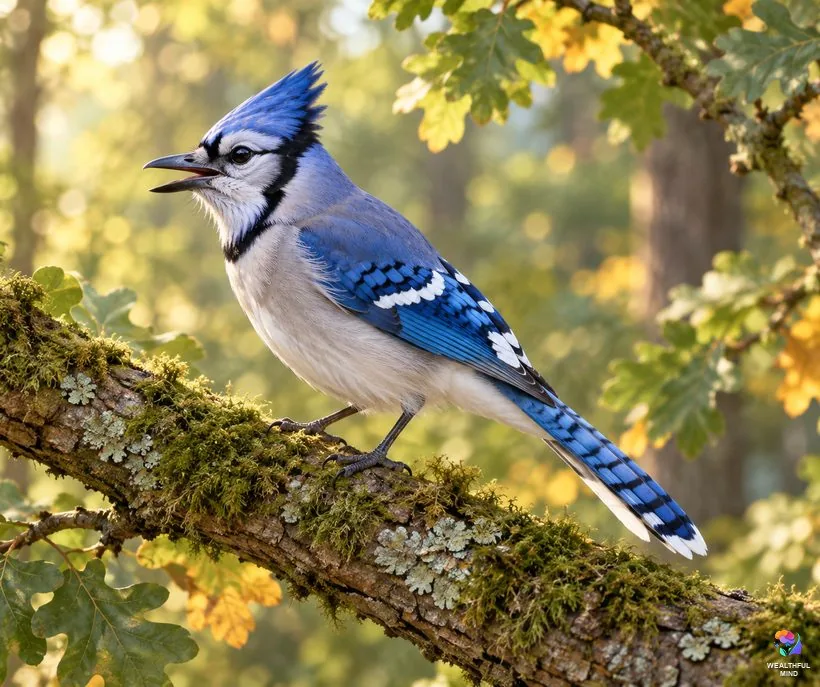
Most blue jay meanings come straight from how the bird behaves. People watched it, then gave it a message.
- Speak your truth. The blue jay is one of the loudest birds in eastern backyards. So many people take it as a nudge to say what you have been holding back.
- Stay alert. Jays raise the alarm when a predator is near. If one calls at you, it is read as a reminder to pay attention.
- Be bold. At the feeder, a jay chases smaller birds away to get the food. You can read that as permission to take up a little more space.
- Plan ahead. Jays hide nuts in the ground for winter. The message for you is to prepare now for later.
- Look after your people. Jays defend their nests loudly against predators. So the bird also stands for loyalty and protection.
In New Age circles, the blue jay is also linked to the throat chakra, the energy center tied to speaking and being heard. That link is modern (we could not trace it to any old tradition).
If you work with chakras, our guide to the seven chakras and how to unblock them explains the throat chakra properly.
Is Seeing a Blue Jay Good Luck?
Today, mostly yes. Most people read a jay in the yard as a good sign, a bright visitor or a loved one checking in.
It has not always been that way. In African American folk belief in the plantation South, the jaybird was called the bird of Satan, and it was said to carry reports about people down to the devil. You can read that story in full further down.
Our honest answer is that the luck lives in what you were thinking about when the jay showed up. If you were wondering whether to speak up, take the jay as a yes. If you were simply enjoying your coffee, enjoy the jay too.
Do Blue Jays Represent Loved Ones Who Have Died?
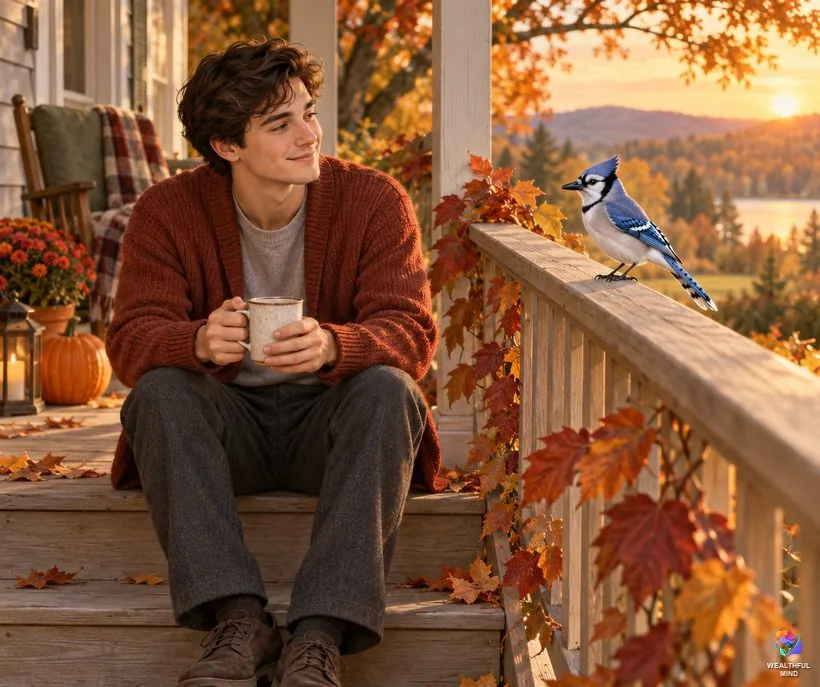
Many people believe they do. In grief forums, people describe a jay landing on the car mirror on the day they almost skipped their grief group.
One person wrote that cardinals sat outside while their father was dying. After he died, blue jays came instead, as if he had picked a different bird so they would know it was him.
This is a modern belief, shared by many families, not an old tradition, and nobody can prove that a bird carries a message from the dead. But the comfort you feel is real, and you are allowed to take it.
○ Why a Blue Jay Feels Like a Visit
Some birds flit past and are gone. A blue jay lands close, looks right at you and makes a noise about it.
Audubon notes that a blue jay can recognize and remember your face. So the jay at your window may well be the same bird, choosing to come back to you.
It is easy to feel seen by a bird that has learned who you are.
○ When They Loved Blue Jays (or the Toronto Blue Jays)
A sign means the most when it fits the person. If your grandmother kept a peanut feeder for her jays, a jay at your window will feel like her way of saying hello. The same goes if your dad cheered for baseball’s Toronto Blue Jays every season, and several grieving families of Toronto fans say exactly that.
Some people watch the yard for months and no jay comes. That does not mean your person has moved on without you, or that you missed your chance.
Love does not run on bird sightings. Your sign may turn up as something else, like a white butterfly, and if nothing turns up at all, the bond is just as real.
○ The Old Story Where Blue Jay Visits the Land of the Dead
One old tradition really does tie a jay to the dead. It comes from the Chinook peoples of the lower Columbia River, in what is now Oregon and Washington, and the anthropologist Franz Boas published it in English in 1894.
In the story, ghosts come one night and buy Blue-Jay’s sister, Iô’i, as a wife. By morning she is gone.
Blue-Jay waits a year, then asks the trees and the birds where people go when they die. Nobody will tell him, until an old wedge offers to carry him there for a price. He finds his sister in a town of ghosts, who turn into bones every time he shouts.
On the way home he crosses burning prairies, catches fire and dies, and only then comes back to his sister as a ghost himself.
Blue-Jay is a show-off who never listens. But he missed his sister so much that he went looking for her past the edge of life, and if you are missing someone, that part may speak to you.
If the jay you found had died, pull on gloves before you move it. The CDC notes that jays are among the birds that often die of West Nile virus, and it advises against touching any dead animal with bare skin. Our page on what a dead bird means spiritually covers the rest.
When God Sends You a Blue Jay: What the Bible Says
You will not find a blue jay in the King James Bible, or any jay at all. It is a North American bird, so the Bible’s writers never saw one.
The closest teaching is about sparrows. In the King James Bible, Matthew chapter 10, verse 29 reads, “Are not two sparrows sold for a farthing? and one of them shall not fall on the ground without your Father.” Luke chapter 12, verse 6 says the same of five sparrows, that “not one of them is forgotten before God.”
So the Christian blue jay meanings you see online (a messenger from heaven, a symbol of faithfulness) are modern and personal, not biblical. That does not make them wrong for you.
If you prayed and a jay landed on the fence a minute later, the sparrow verses describe a God who notices every small bird, and notices you too.
A Blue Jay at Your Window or in Your Yard Every Day
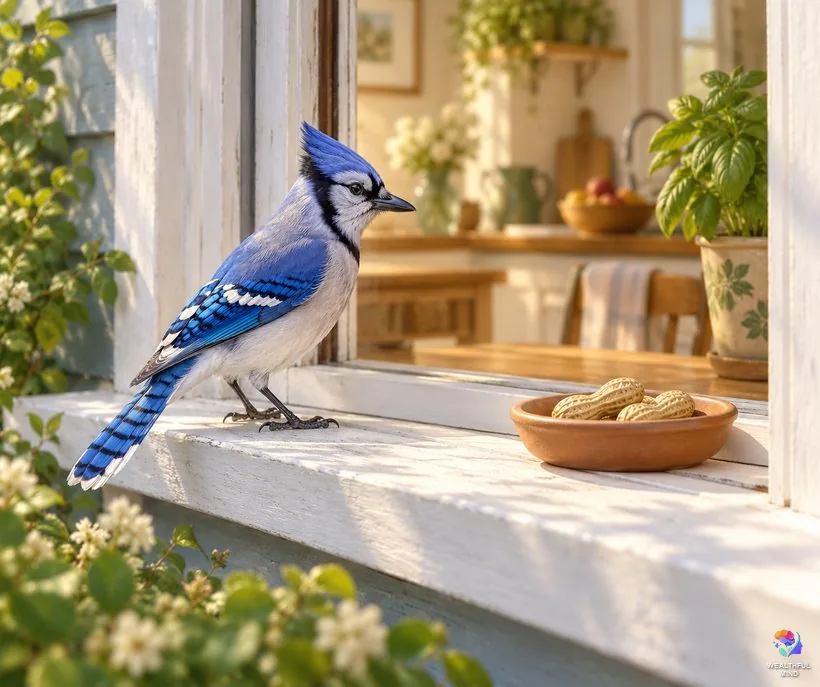
A jay that visits you every day is often read as a familiar visitor, a small guardian. Some people say it means there is something you already know you need to say or do, and the bird will keep coming back until you act on it.
There are usually plain reasons, too.
- Food. Peanuts are a blue jay’s favorite food at the feeder. If you or a neighbor puts any out, the jays learn the schedule fast.
- Memory. Since jays remember faces, they may know you as the peanut person. People who feed them say their jays fly round to the bedroom window and screech if breakfast is late.
- Fall flocks. Some blue jays, mainly along the Great Lakes and the Atlantic coast, move south in fall and north in spring. A yard that suddenly fills with jays in fall may simply be on their route (more on that below).
If the visits feel meaningful to you, write each one down with the date and what was on your mind. A manifestation journal works well for this. After a month, you will see whether the jay keeps coming at the same kind of moment.
Why Is a Blue Jay Screaming at You?
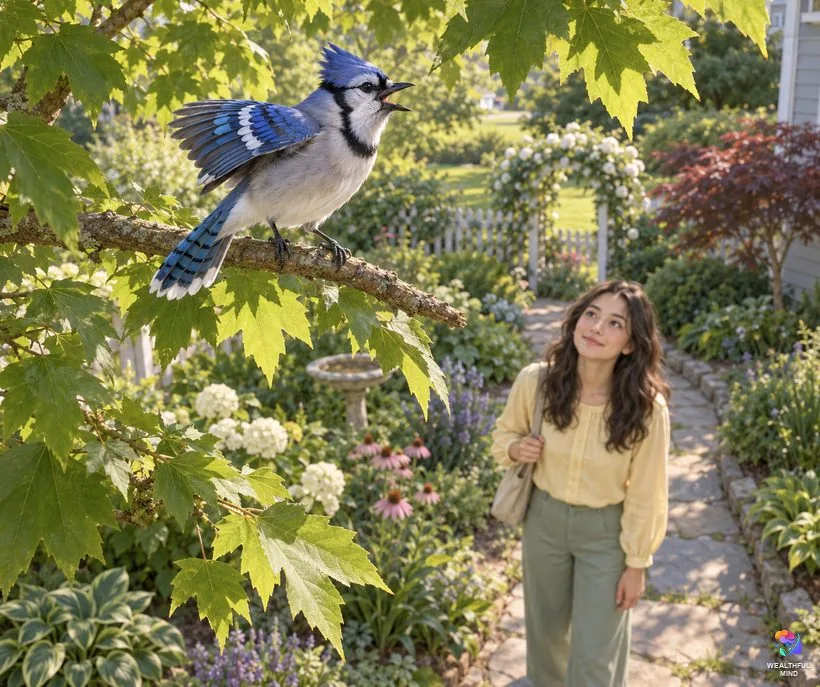
Spiritually, a screaming jay is read as a loud nudge for you to say the thing, or to listen to a warning you have been brushing off.
The bird almost always has a plainer reason.
- Something dangerous is near. Jays sound the alarm when a predator is around. Look for a cat under the hedge or an owl in the tree.
- You are near its nest. Blue jays go quiet around their own nest, but they attack with loud calls if a predator threatens it. In late spring and summer, that predator can be you, walking out of your front door.
- It wants the food. Some jays copy a hawk’s scream to scare other birds off a feeder. More on that just below.
If a pair keeps swooping at you, people who live with jays say it stops once the young leave the nest, which happens 17 to 21 days after they hatch. Until then, try another door for a while, wear a hat, or toss a few peanuts well away from your path.
Jays are loud at dawn, too. If it is birdsong in the dark that keeps you up, read what birds chirping at night is said to mean.
○ When a Blue Jay Sounds Like a Hawk
If you heard a hawk and then saw only a blue jay, the jay may have been your hawk. According to Audubon, blue jays do near-perfect impressions of Red-tailed, Red-shouldered and Cooper’s Hawks.
Scientists think they use them to scare other birds away from food, and as a real alarm when a predator is close. Captive jays have even learned to copy a cat’s meow and human speech.
A bird that speaks in another bird’s voice is often taken as a message about the masks you wear, or about finding the right voice for the moment.
If it really was a hawk, you want our page on the hawk spiritual meaning.
Blue Jay Feather Meaning

A blue jay feather is usually read as a sign for you to speak honestly, or as a small gift from someone you miss. Some people ask for a blue feather as a sign, and then one turns up on a walk.
Try this where you stand: hold the feather up with the sun behind it, and watch the blue disappear.
Audubon explains why: blue jay feathers have no blue pigment at all. The color comes from tiny structures that scatter blue light, and lit from behind, the feather is light brown.
That is a meaning in itself, if you want one (the same thing can look completely different once you change where you stand).
So can you take it home? In the US, not without a permit.
The federal rules for migratory birds say no one may possess one, or any part of one, without a permit, and the blue jay is named on that list. The US Fish and Wildlife Service enforces the law behind those rules, the Migratory Bird Treaty Act of 1918.
Our suggestion: enjoy the light trick, get a photo on your phone, and set the feather back down for the next walker to find. Outside the US, your own country’s wildlife rules decide. Our page on white feather meaning covers feathers you find after a loss, and the feather law in more detail.
Seeing a Blue Jay and a Cardinal Together
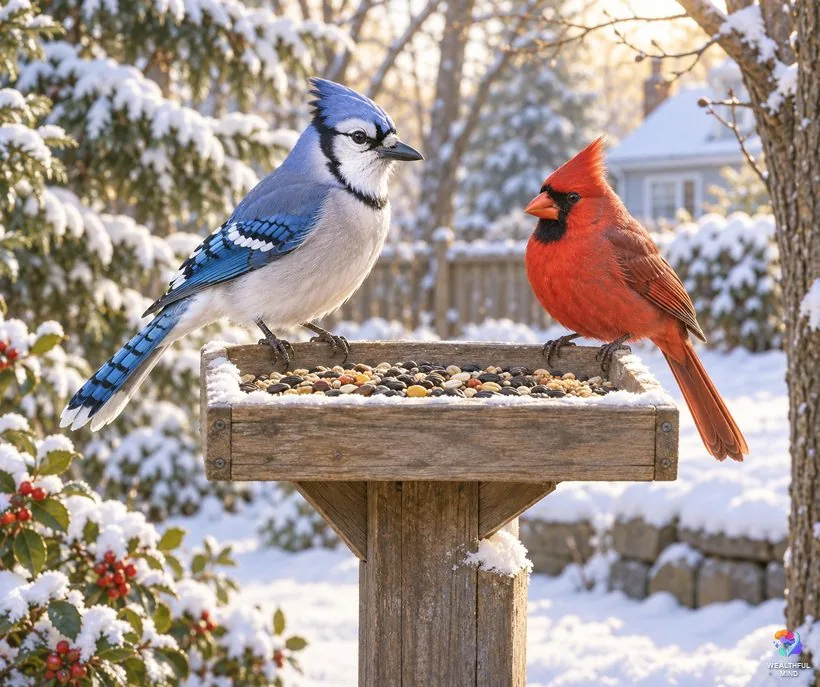
The usual reading is balance. The red cardinal stands for love and a loved one in heaven, and the blue jay for your voice and courage. Seen together, they are read as a double message for you, or as two loved ones visiting at once.
Some sites call it rare. It is not. In Project FeederWatch’s 2012 to 2013 count for the Mid-Atlantic region, Northern Cardinals turned up at about 98 percent of the sites reported by the region’s 1,191 FeederWatchers, and blue jays at about 88 percent.
So in the eastern US, seeing both at once is an ordinary winter morning. That does not take your meaning away, since plenty of signs are ordinary things that came at the right moment.
To read the red bird on its own, see the cardinal spiritual meaning.
Two Blue Jays, a Blue Jay Crossing Your Path, and Other Sightings
○ Two Blue Jays
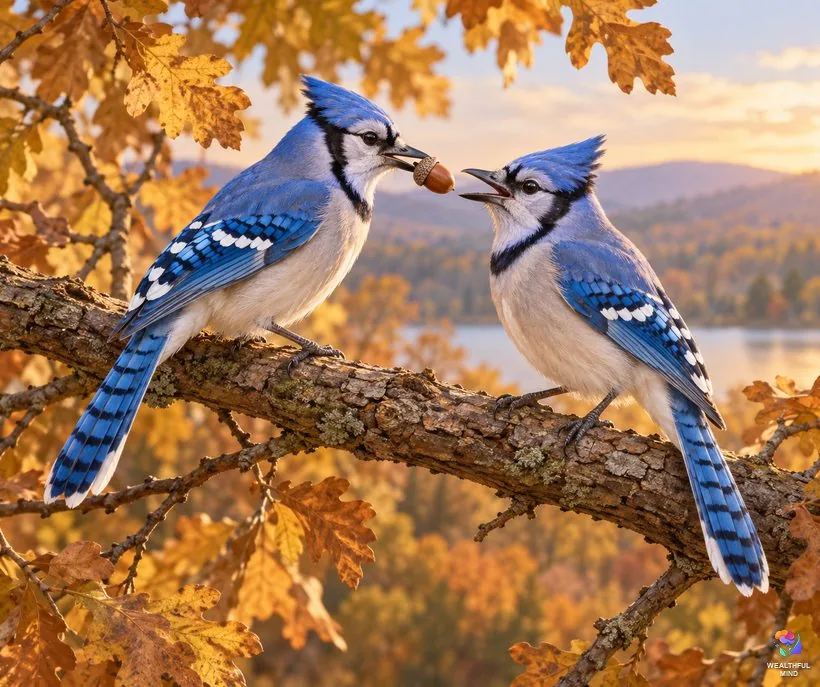
If you see two jays together, it is usually read as partnership, in love, in friendship or in a team that works. It fits the birds. Both parents build the nest, and both bring food to the young.
You may read online that blue jays mate for life. We could not find a bird science source that says so, so we will only say that pairs raise their young together.
○ A Blue Jay Crossing Your Path
A jay flying across your path is often taken as a nudge for you to stop and notice something, usually a choice you are about to make. Many people say the thought in your head at that moment is the message. Write it down before it slips away.
○ A Big Noisy Flock in Fall
A sudden crowd of jays around you is read as community, or as a season of change. It is also migration.
Blue jays travel by day in large flocks, a jay that migrates one year may stay put the next, and young birds go more often than adults. Scientists still do not know why.
Southern folk belief had its own reading. If you heard a flock of jays chirping, cold weather was on the way.
○ You Asked for a Sign and a Blue Jay Came
A blue jay or a blue feather is a popular sign to ask for in the manifestation community. If yours showed up, enjoy it.
Jays are common across the eastern US, though, so a jay makes a stronger sign if you rarely see one. If you want words to ask with, our list of universe prayers has a few you can use.
○ A Blue Jay in a Dream
Dream readers usually take a blue jay as your inner voice, something you want to say or a truth you have been avoiding. A screaming jay is read as a warning to pay attention, and a calm one as a sign that you are ready to speak.
Think about who else was in your dream. That is often where the meaning sits.
Blue Jay Stories From Real Traditions
Many pages say “Native American tradition says” and then name no one. The real stories come from named peoples, and they are far more interesting.
Plenty of tribes did not think much of jays, and cast them in their legends as nosy gossips, bullies or selfish thieves. Some Northwest peoples told of Bluejay as a trickster instead, greedy and silly but also clever and helpful to humans.
The Chinook Blue-Jay is the best known. He lies, then insists that his long-suffering older sister Iô’i is the liar.
In one tale he carries a young woman’s body to the land of the dead, hoping the Supernatural People there will bring her back to life. The ghost town story above is the darkest of them.
○ The Bluejay Dancers of the Salish
Among the Salish-speaking peoples of interior British Columbia and western Montana, a Bluejay was also a kind of person. A few men were believed to be possessed by a powerful and unpredictable Bluejay spirit at the midwinter Guardian Spirit Dances.
The spirit was said to give them the power to read thoughts, foretell the future and find lost things.
Bluejay dancers are said to have once climbed trees near the dance lodge and sat there screaming like jays and waving their arms, until the other dancers coaxed them down. A museum curator who wrote about them in 1967 said only a handful were left, all of them elderly men.
○ How the Steller’s Jay Got Its Ruffled Crest
The Makah people of Cape Flattery, Washington, told a settler in the 1860s why the Steller’s Jay has such a messy crest.
A mother asked her son, the mink, to fetch water, and he refused to stop making his arrow. While she was talking, she turned into a jay and flew into a bush.
He tried to shoot her, and the arrow glanced over the top of her head, ruffling her feathers “as they have always remained.” Look at a Steller’s Jay’s crest and you will see what they meant.
○ The Jaybird That Visits the Devil on Friday
African American families in Georgia, Alabama, Kentucky, Maryland and Louisiana told collectors that you never see a jaybird on a Friday, because that is the day it goes to hell. It carries kindling, a grain of sand or a drop of water down to the devil.
The reasons change from teller to teller.
Some said the sand was a ransom for the souls in hell, who could not be freed until all the sand on earth had been carried below. Others said the jaybirds had sold themselves to the devil for an ear of corn. In Maryland, the jay was a kind of sin reporter, telling the devil about people’s sins.
In Louisiana, the weekly trip was a punishment for something the jay did at the Crucifixion, though what it did had been forgotten. And the jays were said to be extra loud on Saturday, glad to be back on earth.
Ruth Anna Fisher’s 1920 story “A Legend of the Blue Jay,” printed in a school reader for Black children, tells the version a class of children from the Virginia mountains share with their teacher.
In it, the devil tempts the blue jay with a golden ear of corn, then a red one, then a blue ear that matches its feathers exactly, and the jay gives in. Ever since, it carries one grain of sand to the devil every Friday, and its wings get scorched on the trip, which is where its black markings come from.
The children in Ruth Anna Fisher’s story end with a challenge you can almost hear: “You never saw a blue-jay on Friday, did you?”
One more old Southern saying, recorded in 1923, makes the blue jay the maker of the land itself: when all the world was water, it brought up the first grain of dirt.
The collectors who wrote these beliefs down used the racial language of their time, which we have left out.
○ Which Jay Did You See?
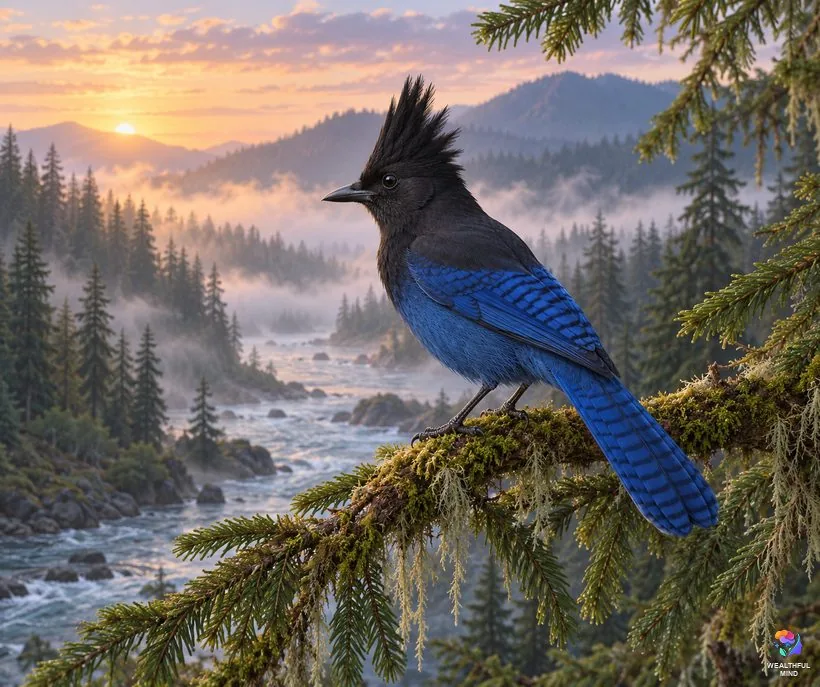
The true blue jay lives east of the Rocky Mountains. If you live in the West and saw a “blue jay,” it was most likely a Steller’s Jay or a scrub-jay, and the old Northwest stories are about the Steller’s Jay too.
The 1967 museum curator noted that the true blue jay is unknown in Salish country, and that English speakers there call the Steller’s Jay a blue jay.
To tell them apart, look at the wings. The blue jay has a black necklace, a crest and white bars on its wings, and other blue-colored jays lack that white pattern on the wings and tail.
The Steller’s Jay is darker all over, with a black head and a tall black crest. The meanings people give are much the same for all of them.
What the Real Blue Jay Is Like
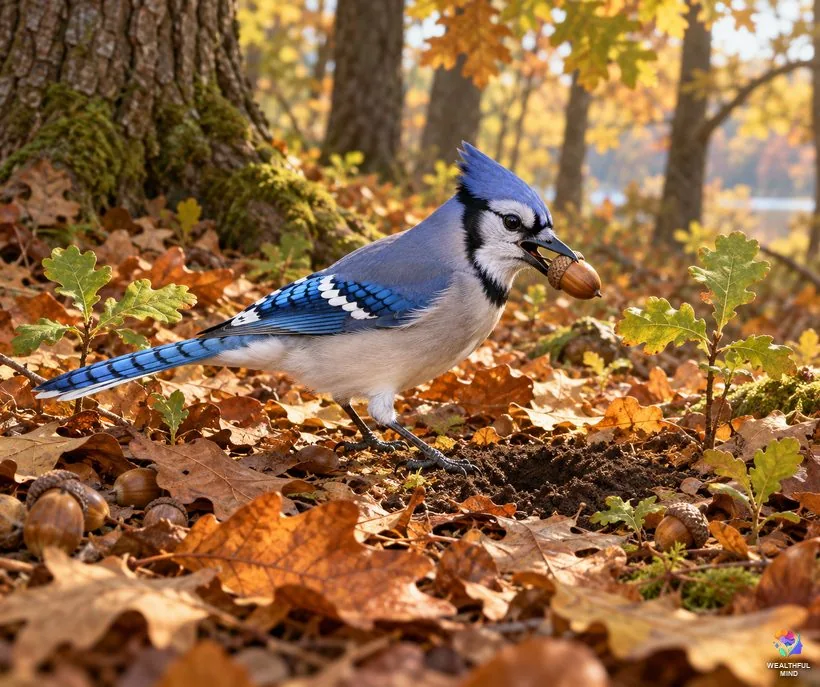
- It is in the crow family. Blue jays are corvids, like crows, ravens and magpies.
- It uses tools. In 2025, a blue jay was recorded for the first time using a piece of bark to pull a spider off a pine branch.
- It plants forests. One jay can hide up to 5,000 acorns in a year and remembers only about 1 in 4 of them, so it plants thousands of oaks without meaning to. Jays are thought to be one reason oak, beech and chestnut trees spread across North America after the last ice age.
- Its bad name has a small real basis. Most of what it eats is plant food, up to 75% over a year, but it also eats insects and sometimes other birds’ eggs and babies.
We like the acorn fact best as a meaning. A jay buries far more than it will ever eat, forgets most of it and leaves a forest behind.
If a blue jay keeps finding you, you could take it as a nudge to plant something now (a habit, a kindness, a skill) that someone will be glad of long after you have forgotten it. That is our own reading, not an old tradition.
The Blue Jay as a Spirit Animal
The spirit animal idea is modern, and so is almost everything it says about blue jays. If the blue jay is your spirit animal or totem, you are said to be outspoken, curious, protective of the people you love and a little bossy.
Your shadow side, they say, is gossip, showing off and not listening, which is a fair description of the Chinook Blue-Jay.
Be careful with spirit animal pages that tell you European jay legends. Those belong to the Eurasian jay, a different bird, not to the American blue jay.
If the blue jay feels like your bird, let it make you braver, not just louder. Say the true thing, kindly, and then go and plant your acorns.
Blue Jay Spiritual Meaning: Common Questions
When God sends you a blue jay, what does it mean?
Many Christians take a blue jay as a reminder that God sees them, or as a nudge to speak up with courage. The Bible itself never mentions a blue jay or any jay, so this reading is modern and personal. The closest teaching is the sparrows verse in Matthew chapter 10, verse 29 of the King James Bible: not one sparrow shall fall on the ground without your Father. If a jay came right after you prayed, you can hold it in that spirit.
Is it good luck to see a blue jay?
Most people today see it as a good sign, a bright visitor that reminds you to use your voice. Older African American folk belief in the US South was less kind: it called the jaybird the bird of Satan and said it carried reports about people to the devil every Friday. So luck depends on the tradition. We think the meaning lies in what you were thinking about when it appeared.
Do blue jays represent passed loved ones?
Many grieving people believe so, especially when the person loved jays or cheered for the Toronto Blue Jays. It is a modern belief rather than an old tradition, and nobody can prove a bird carries a message. The comfort is still real. And if a jay never comes, that takes nothing away from the bond you shared.
What does it mean if a blue jay visits you every day?
It is often read as a familiar visitor or a small guardian, and sometimes as a sign that there is something you need to say or do. There is usually a plain reason as well. Audubon notes that peanuts are their favorite feeder food and that blue jays remember human faces, so a daily jay may simply know you.
Why does a blue jay scream at me?
Spiritually, it is read as a push to speak up or to heed a warning. In real life, a jay screams when a predator such as a cat, hawk or owl is near, when you walk close to its nest in late spring or summer, or when it copies a hawk’s call to scare other birds off a feeder. People who live with jays say the swooping ends once the young leave the nest, which Audubon puts at 17 to 21 days after they hatch.
Can I keep a blue jay feather I found?
Not in the US unless you have a permit. The blue jay is on the federal list of protected migratory birds, and the rules say no one may possess any part of one, feathers included, without a permit. Hold it up to the sun to watch the blue turn brown, take a picture, then set it back down. Outside the US, check your own country’s wildlife rules.
What does it mean to see a blue jay and a cardinal together?
People usually read it as balance, or as a double message: the cardinal for love and loved ones, the blue jay for voice and courage. It is not rare in the eastern US. Project FeederWatch counts put both among the most common feeder birds in the Mid-Atlantic region, so the moment matters more than the pairing.
What does it mean when you find a dead blue jay?
Many people read it as the end of a chapter or a call to grieve something, and some take it as a message from a loved one. Wear gloves before you move it. The CDC lists jays among the birds that often die of West Nile virus, though it has found no evidence that people catch the virus from handling birds. Your state health or wildlife agency can tell you whether they want dead birds reported.