
The ADHD shifting method is a reality shifting method where you lie down with headphones and follow 8D audio that seems to circle your head. You breathe and count with it and repeat one affirmation, so a busy, wandering mind always has something to latch onto.
Quick pick
Which Version of the ADHD Method Should You Try?
Tap the line that sounds most like you to jump to your match.
- Do you like doing it your own way, with any song? Follow the 8D audio steps
- Would you rather be talked through it? Try the guided meditation version
- Do you fall asleep or lose count halfway? Read the fixes for a busy mind
- Is it hard to picture things in your head? See other methods that suit an ADHD brain
- Worried about volume or strange feelings? Read this before you try
Keep reading below What it is The steps Guided version Fixes Stay safe Questions

The ADHD method is one of many reality shifting methods for beginners. If you have never shifted at all, a plain explanation of reality shifting is the place to begin, and how to keep shifting safe is worth reading before your first session.
What Is the ADHD Shifting Method?

Most shifting methods ask you to lie still with your own thoughts. That is hard when your thoughts will not sit still.
The ADHD method gives your mind a job instead. The sound moves from ear to ear, and you breathe, count and say your affirmation along with it.
So there is always one small thing to do next.
One quick note, because the name confuses search engines. This page is about a reality shifting method, not “set shifting”, the skill of moving your attention between tasks that ADHD researchers study.
○ Why Is It Called the ADHD Method?
The name is a nickname from the shifting community. The method started on TikTok, and by early January 2021 a YouTube tutorial was already teaching it and giving the credit to a TikTok creator.
It was made for shifters with ADHD and for anyone whose mind drifts off in the middle of a method. Some shifters simply call it the 8D method.
You do not need ADHD to use it. Many people who love it have no ADHD at all, just a mind that wanders.
It is also not an ADHD treatment, and the safety section below explains where real help for focus comes from.
There is a little science close to the idea, though.
In a 2024 review of 13 studies, Joel Nigg and colleagues found that white or pink noise helped young people with ADHD, or with high levels of ADHD symptoms, a little on lab attention tasks. People without ADHD did a little worse with the noise on. The team says more data is needed before doctors can give advice based on it.
We like how well that fits the name. But the review tested plain noise in a lab, not 8D music and not shifting.
○ What Is 8D Audio?

8D audio is normal music or sound, mixed so it seems to move around your head. It slides from one ear, passes behind you and swings over to the other ear, again and again.
The trick only works when each ear hears its own sound, so you need headphones or earbuds.
Binaural beats are something else. They play two tones of slightly different pitch, one in each ear, and your brain hears a third, wobbling tone that seems to sit inside your head.
Ruth Ingendoh and colleagues looked at 14 studies in 2023 on whether binaural beats tune your brainwaves. Five found that they do, eight found no such effect and one was mixed, so the team called the findings inconsistent.
White noise is different again, a steady hiss like a fan that does not move at all.
No study we could find has tested 8D audio for ADHD. So pick it because you like how it feels, not because science says it works.
Any 8D song, rain track or ocean sound will do. We would start with a slow song with no words, because lyrics give your mind something else to follow.
What You Need Before You Start
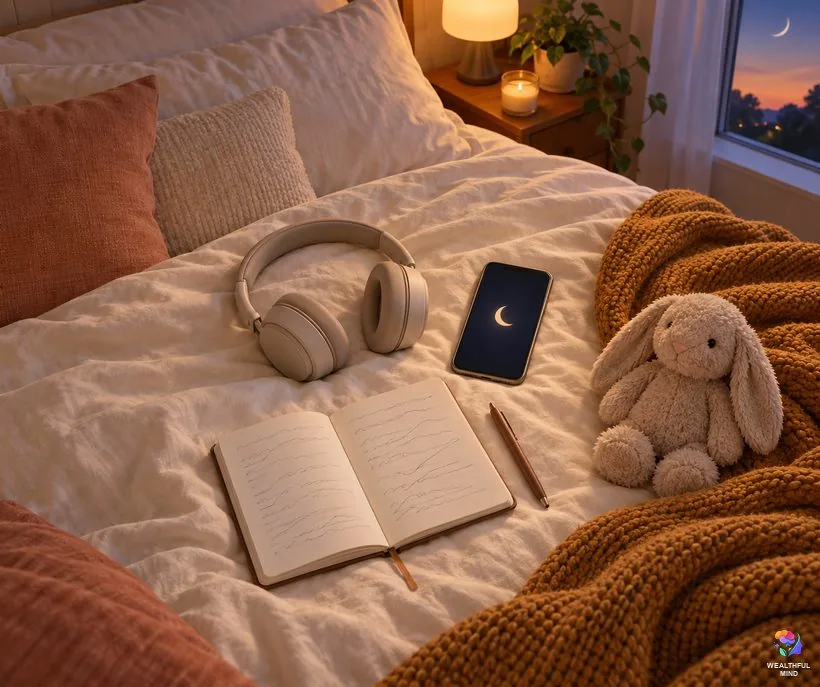
You do not need much. Get everything ready before you lie down, so you are not reaching for your phone halfway through.
- Headphones or earbuds that stay comfortable when you lie down.
- One long 8D track or a playlist, downloaded or set to loop.
- One short affirmation, such as “My DR is all around me.” Our list of shifting affirmations has plenty to choose from.
- A quiet time when nobody will walk in.
- Your phone on Do Not Disturb, with autoplay turned off.
Set the volume low before you press play. The World Health Organization (WHO) says to keep your device at no more than 60% of its maximum volume.
The circling sound still works when it is quiet, so there is no need to turn it up.
If you like, read your shifting script once and breathe slowly for a minute first. Neither is a must.
How to Do the ADHD Shifting Method, Step by Step

- Get comfortable. Lie on your back or your side, and let small twitches happen instead of fighting them.
- Start the sound and close your eyes. Give yourself a moment to settle in.
- Follow the sound with your attention. Keep track of where it is, the way your eyes would follow a bird across the sky.
- Breathe with it. Breathe in as the sound moves one way and out as it comes back, or breathe to the beat.
- Count up. Add one with each breath, or one each time the sound goes all the way around, whichever is easier for you.
- Say your affirmation on every fifth count. At 5, 10, 15 and so on, say it once in your head, then keep counting.
- Notice any feelings in your body without chasing them. Many shifters describe tingling, heaviness or a flash of light, but you do not need to feel anything. If something feels physically wrong or scary, stop, sit up and talk to a doctor or an adult you trust. Our guide to shifting symptoms and what they mean explains which signs matter.
- Picture your DR if you can. Add one detail at a time, like the light from your DR bedroom window. If pictures do not come, skip this step and keep listening.
- Choose your ending. You can fall asleep or open your eyes, as explained below.
Here is how it might look. Say your DR is the U.A. dorm from My Hero Academia and you picked an 8D rain track.
The rain slides from your left ear to your right as you breathe in. At five you think “I am in my DR”, and somewhere past twenty the rain starts to sound like it is hitting your dorm window.
○ Ending 1: Fall Asleep
This is the original ending. The early versions of the method finish in sleep, with the belief that you will wake up in your DR.
It suits bedtime, when you are tired anyway. Keep counting and affirming until you drift off.
Set a sleep timer in your music app, so the music switches off once you are asleep.
If you like letting sleep carry you into a method, our sleep shifting methods guide has more that end the same way.
○ Ending 2: Open Your Eyes in Your DR

This is the awake version, and many written guides give it today. Keep going until your DR feels close, say your affirmation one last time and open your eyes slowly.
Try it on a calm afternoon, when you are rested enough to stay awake through the counting. Our list of awake shifting methods collects others that finish with open eyes.
Neither ending is better. Shifters argue about it online, but we think the right one is simply the one that fits the time of day you practice.
The Guided Meditation Version

If counting on your own feels like too much to keep track of, let someone talk you through it. These days, plenty of shifters do the ADHD method with a guided audio on YouTube instead of a plain 8D song.
A favorite among shifters is Shifting Guided Meditation | The ADHD Method [8D] by Alunir Meditations, posted in February 2023 and just under half an hour long. The channel says it made this version itself and that you can use it awake or asleep. Listeners say it asks you questions about your DR and uses finger snaps along the way.
Alunir’s follow-up, SHIFT TONIGHT WITH ADHD | NON VIZUALISATION METHOD | 8D Theta Waves, came out in December 2023 and runs close to an hour and a half. It needs no picturing at all, with a bell for the cues and fast questions about your DR mixed in with affirmations, and it also works awake or asleep. Both audios were still up on YouTube when we checked on 7 October 2026.
If pictures come easily to you, start with the first one. If they do not, or if you keep falling asleep, go for the second, because the first opens with slow breathing that sends many listeners to sleep before the questions start.
One warning before you press play. Several listeners say an ad blasted at the end just as they felt close, and autoplay can start a new video on you the same way.
Turn off autoplay and check where the ads fall before your session. Or use a downloaded or ad-free copy you are allowed to use, such as one the creator offers.
When Your Mind Still Won’t Settle

A wandering mind is the reason this method exists, so expect it to wander anyway.
○ You Fall Asleep Too Early
The first versions of this method end in sleep, so dozing off is not a failure.
If you want the awake ending, practice before you are tired and pick music with a clear beat. The second guided audio may also help, because it keeps asking you questions.
○ You Lose Count or Forget the Affirmation
Losing count is fine. Pick any number and carry on, because nobody is marking you.
If it keeps happening, count each loop of the sound instead of each breath, since loops come slower. Or drop the numbers and say your affirmation each time the sound comes back to your left ear.
Keep the affirmation short, such as “I am there.” Some shifters with ADHD make the counting a little harder on purpose, like counting in threes, because an easy count lets the mind slip away.
Learn the steps before you lie down, too. If you have to check your phone for what comes next, your mind is on the steps and not on your DR.
○ You Need to Swallow, Scratch or Move
Swallow, scratch the itch, move your leg. The method was made to allow twitching, and a quick movement costs you less focus than ten minutes of trying to ignore an itch.
Lying still makes you notice your body more, which is why the urges show up. Get comfortable before you start (loose clothes, a pillow under your knees, a sip of water) and they might calm down.
○ The Audio Stops or an Ad Plays
A sudden ad or a track that ends early can ruin a calm session in a second.
Use a track that is longer than you need, or a playlist on loop, and download it if you can so a weak signal does not cut it off. Charge your phone and check that Do Not Disturb is on.
If you share your bedroom, ask for a quiet half hour, or pick a time when the house is calm.
○ You Get Bored After a Few Tries
Boredom hits an ADHD brain hard, and the same song every night gets old fast. Swap the track, switch between the do-it-yourself and guided versions, or change your counting game.
Another trick from shifting forums is to spend the session planning your next day inside your DR, from breakfast to bedtime.
A method you enjoy will always beat one you force.
If it still feels flat, give this method a rest and try one of the methods below. Our tips for beginner shifters have more small fixes for when shifting starts to feel like homework.
Other Shifting Methods That Suit an ADHD Brain

If the ADHD method is not working for you, these keep a busy mind busy in other ways.
- The Heartbeat method is another sound method. You listen to a steady heartbeat and imagine it belongs to someone in your DR.
- The 5 Senses method keeps your mind busy with sight, sound, touch, smell and taste, and you practice on your own room first.
- Shifting methods without visualization help if nothing shows up when you try to picture your DR, since they lean on what you say and feel instead.
- The Julia method gives your mind one short “I am” line after another, and it pairs well with focus music.
- The Estelle method is for music lovers, since you picture a slow dance with a partner from your DR.
- Subliminals for shifting hide affirmations under music, so you can play them while you do other things.
Is the ADHD Method Safe?

Listening to music with your eyes closed is about as calm as shifting gets. There are still a few things to watch.
Look after your ears first. The WHO says to give your ears regular breaks from loud sound so they can recover.
Nigg’s team also warns that long listening at even moderate volume can harm hearing, so keep the volume low when a track plays for a long time.
Do not let shifting cut into your sleep. The American Academy of Sleep Medicine’s target for ages 13 to 18 is 8 to 10 hours a day, kept up regularly.
Falling short night after night goes with attention and learning problems, which is the last thing a wandering mind needs. So use the sleep ending at your normal bedtime, and skip a session that would keep you up late.
Some listeners describe numbness, a spinning room or flashing lights during a session, and some find it scary enough to stop. That is the right call: take off your headphones, sit up and turn on a light. If the feeling lasts after you sit up, or shows up again next time, tell a parent or another adult you trust and get it checked by a doctor.
A few feelings are your body asking for help, and they have nothing to do with shifting. Call emergency services straight away for trouble breathing, fainting, sudden dizziness or chest pain that lasts two minutes or more. A racing heart you have never felt before needs a doctor, and it becomes an emergency if chest pain or shortness of breath comes with it.
Many 8D shifting tracks also mix in binaural beats or “theta waves”. Healthline notes that research on binaural beats for ADHD symptoms is limited. It also advises talking with a healthcare professional before you listen to them if you have seizures or a pacemaker.
The ADHD method is not an ADHD treatment either. If trouble focusing gets in the way of school, work or daily life, talk to a doctor.
The NHS lists real ways to support young people with ADHD, including regular sleep, exercise, changes at school and at home, and talking therapies like CBT. It adds that ADHD medicines must be started and monitored by an ADHD specialist.
You may also see 8D tracks with “EMDR” in the title. EMDR is a real therapy that the NHS lists for PTSD, where eye movements help process traumatic memories as part of a plan made with a GP and a mental health specialist. A YouTube track with that word in its title is not therapy.
And if shifting ever feels like the only way out of a life that hurts, please talk to someone today, like a parent, a friend, a teacher or a helpline.
Our safety guide for shifters lists helplines in the US, UK and India. If you are not safe right now, dial the emergency number for your country.
Frequently Asked Questions About the ADHD Shifting Method
What is the ADHD method for shifting?
It is a reality shifting method built around 8D audio, music mixed so it seems to circle your head. With headphones on, you follow that sound, breathe and count along, and say a short affirmation every fifth count. We think it suits a wandering mind better than most methods.
Do I need headphones, or can I play the music out loud?
Use headphones or earbuds if you can. 8D audio sends a slightly different sound to each ear, so through a speaker the circling is lost and you hear a normal song. Without headphones, play any steady sound, like a fan or rain, and put your focus on your breathing and counting instead.
Is the ADHD method an awake or a sleep method?
Both. The first version of the method ends in sleep, and many guides now finish with open eyes in your DR. Pick the sleep ending at your normal bedtime and the awake ending when you are rested, like on a quiet afternoon.
Can I move or hold something, like a stuffed animal?
Yes. Small twitches and moving to get comfortable are fine, and the method was written to allow them. If holding a stuffed animal or a soft blanket calms you, hold it, because feeling safe helps you focus far more than lying perfectly still.
One song or a playlist, and how long?
Either works. Loop one 8D song you love or make a playlist, and make it longer than you think you need, so it does not stop just as you feel close. Tracks without singing are easier, since words pull your attention away from the moving sound.
Do I need ADHD to use it?
No. The name comes from the shifting community, not from a doctor, and many people who use it simply have minds that wander. If you think you might have ADHD, that is a question for a doctor, not for a shifting method.
Do I have to do all the steps?
No. Some versions are nothing more than lying down and listening to the 8D track, with no counting or breathing at all. Treat the full steps as a menu: keep what helps you focus and drop what does not.
It isn’t working. What am I doing wrong?
Probably nothing. Learn the steps by heart first, so your mind stays on your DR instead of on what comes next, then try a different track or switch to a guided version. A few relaxed tries beat one long, forced one, and if it still does not suit you, try another method.
How do I shift back?
Many shifters write a safe word into their script, a word or phrase they believe will return them to their current reality (CR) the moment they say it. Add one to your shifting script before you start. In the middle of a session, you can always stop by opening your eyes and taking off your headphones.







Hi,
As I have ADHD, when it comes to the end of the method, my brain starts focus on if I should put off my earplugs or not, and so start unfocus on my DR. And then intrusive thoughts come. So I wanted to know if I need to keep my earplugs on or not ? (I can’t sleep with any sound, and to me it’s better if I fall asleep)
Hi. 🙂
Perhaps you could choose a video for the sounds that will run only as long as you need it. If you have autoplay turned off and have not set the video to loop, the sounds should stop when you are ready to fall asleep.
If it is the earphones themselves bugging you, my suggestion is just to take them off altogether when you feel you are ready to sleep.
If you want, you could even script this before you get started, i.e. “As I get close to my DR, I will automatically remove my headphones and go to sleep.” That way, you will not get distracted by making decisions. Good luck.
Thanks you so much, I will try and hope I won’t overthink about it once again!
Hi,
I do not own headphones but if I use regular music, will it work? If not, do you have any other techniques?
do i need to use headphones? can i just play the music outloud?
while using this method can i be holding onto something? like one of my stuffed animals, i tend to latch onto them or hug them and im not sure if that disturbs the process. Also is it okay if i move at all during this? When i try and sit still for a long time i might end up twitching or jerking.
is this an awake method? if i do it, do i or do i not have to fall asleep, and if not can i? and can i do it during the day and let my “clone” take over?
How do i shift back