
If you just woke up unsure, here is how to know if you shifted: one feeling cannot prove it, and nobody else can tell you either. Check where you are, write down what you remember, and sort it calmly. We think that order matters more than any list of signs, and the deciding can wait until tomorrow.
Most of the signs passed around online also turn up on ordinary nights, at the edge of sleep, and sleep doctors have names for them. The feelings people describe on the way into an attempt have their own guide to reality shifting symptoms. This page is about afterwards.
Before your next try, read our honest look at how dangerous reality shifting really is. And if you want a gentler place to start, our reality shifting methods for beginners cover the main ones.
How Do You Know If You Shifted?
Shifters describe a full shift as waking up in your desired reality (DR) and living there, with every sense working and nothing fading.
If you open your eyes in your current reality (CR), your own bed in your own room, then by shifters’ own description you are back. Or you never left.
Science cannot settle it for you either. A psychologist interviewed by Forbes said there is no scientific consensus on whether anyone can move their consciousness to another reality outside of dreams or mental constructs.
We could not find a single study of how shifters tell a shift from a dream. So the checks below come from sleep research and from shifters themselves.
So we will never tell you that you did or did not shift. That is yours to decide.
What we can do is help you look at it clearly, and make sure you feel fine while you do.
What to Do the Moment You Open Your Eyes
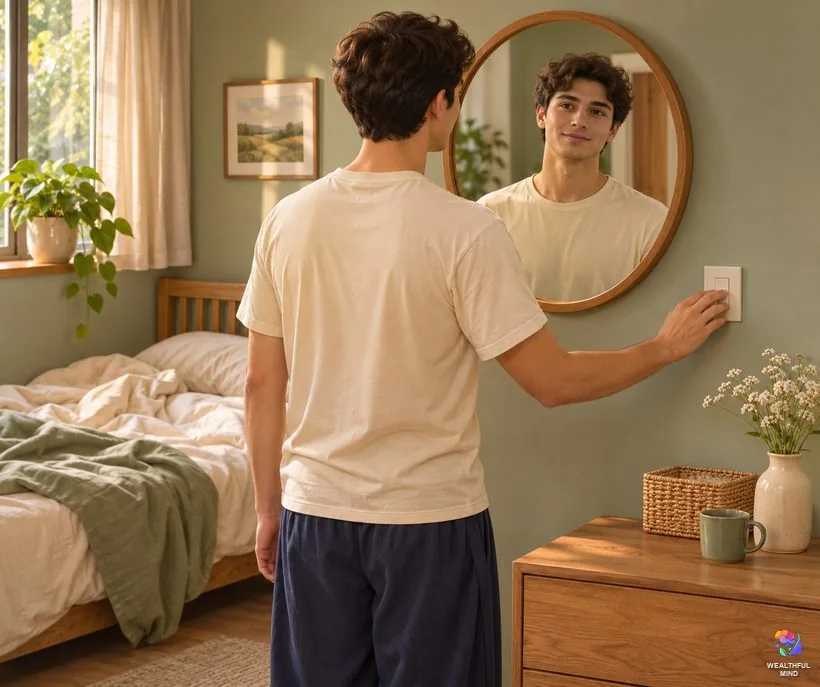
The first few minutes matter most, because memories of sleep slip away quickly. Do these in order, and keep your phone out of reach until you finish.
Step 1: Check Where You Are
Lucid dreamers have a habit made for this moment, called a reality check.
Researchers call it reality testing. The International Lucid Dream Induction Study (2020) traces it to Tholey in 1983 and to LaBerge and Rheingold in 1991. You look around, then do a small test that tells waking from dreaming.
Pick two or three of these and do them slowly:
- Read a line of text, look away, and read it again.
- Look at yourself in a mirror.
- Flip the light switch and watch the bulb.
- Press your feet into the floor and name five things you can see.
The Sleep Foundation says people who check whether events are real, by reading text or using a mirror, more often realize they are dreaming after a false awakening. The false awakening part below explains why the light switch is on the list too.
If every check behaves normally, you are awake, and the rest is sorting.
Be honest with yourself about what a check can do. The Sleep Foundation says there is little evidence that reality tests bring on lucid dreams. And the international study found that doing more checks each day did not change how often people had a lucid dream.
A check can tell you where you are now. It cannot tell you where you were.
Step 2: Write It Down Before You Decide

Write it down first, and decide what it was later. The Sleep Foundation notes that if you do not wake during or right after a dream, you are unlikely to remember the dream at all.
Write what happened, not what you hope it means. A note can be as short as this:
Tuesday, just before my alarm. Raven method, lying on my back, rain sounds on. Saw a long hallway with green tiles and heard someone call my name. Woke up in my room, but the lamp would not turn on. Woke again a bit later and it worked. Felt calm and a little floaty for a while.
Notice what that note leaves out (the words “I shifted” and “I failed”). Read it again the next evening, when the excitement or the disappointment has settled, and decide then if you still want to.
Paper or a notes app both work. Over a few weeks, your notes may show a pattern, like vivid scenes that only come after short nights or with one particular playlist.
Step 3: Sort What Happened
Now put your note next to the list below. Most of what people notice after an attempt fits one of a few sleep states, and each sleep state has a clue that gives it away.
Sorting it is not the same as dismissing it. A vivid dream of your DR is still a lovely thing to have had.
Step 4: Notice How You Feel
Feeling a little slow or floaty for a few minutes after you wake is normal on any morning. Drink some water, open the curtains and move around.
If you feel unreal, numb or cut off from your body for longer than a short while, stop for today.
Our guide on how to come back from shifting has calm steps for that feeling. The part on when to talk to someone below says when to tell someone you trust.
Dream, False Awakening or Shift? Sort It by What Happened

If your question is “did I shift or was it a dream”, start here. Find the line that sounds most like your note. Each one says what shifters say first, then what sleep research says.
○ “I Woke Up in My Own Room, but Something Was Off”
Some shifters read this as landing in a reality right next to their own, almost the same but slightly wrong.
Sleep researchers call it a false awakening.
The Sleep Foundation describes it as believing you are awake while you are still asleep, usually during REM sleep, the stage most tied to dreaming. The room can look exactly like yours, or have small differences such as odd shadows or doors that lead somewhere new.
The Sleep Foundation adds that false awakenings can repeat several times in a row, and leave false memories of things you never really did.
So if you “woke up” twice, or you remember brushing your teeth but the toothbrush is dry, this is the likeliest fit.
Here is how one might go. You try your method, drift off and wake to the smell of bread from your DR’s bakery. You reach for the lamp and it stays dark, and a minute later you wake again in your ordinary room, with your ordinary alarm going off.
○ “It Felt More Real Than Any Dream I Have Had”
This is the most common reason people think they shifted. Shifters often say a shift feels like normal life, while dreams feel hazy.
But dreams can feel very real too.
The Sleep Foundation explains that after a stretch of lost sleep, the body makes up for it with more intense REM sleep, which makes vivid dreams more likely. So a late night, a broken night or an alarm set to catch a shift can all make the next dream sharper.
A lucid dream adds another layer, because you realize you are dreaming while you are still asleep. Even shifters warn about this.
A well-liked guide on r/shiftingrealities says you could trick yourself into thinking a lucid dream was a shift because it “felt like real life”. Our lucid dream method guide goes through the difference in detail.
○ “I Felt Buzzing, Floating or Falling as I Drifted Off”

Many shifters treat these feelings as the start of a shift. Sleep medicine calls that drifting stretch between awake and asleep hypnagogia, and what you see or feel in it is called a hypnagogic hallucination.
The Sleep Foundation says people commonly see moving shapes, faces or whole scenes at this point, a lot like the flash of a DR that shifters describe. Some feel themselves falling or floating, too.
The clue is how it felt at the time. People usually know these are images rather than something real, according to the Sleep Foundation. So if part of you was watching it like a film as you fell asleep, this fits.
○ “I Could Not Move and Felt Someone in the Room”
Shifters call this state mind awake, body asleep. Some try to reach it on purpose as part of a method, and others stumble into it while trying to shift.
The NHS calls it sleep paralysis, when you cannot move or speak as you wake up or fall asleep, and says it can be scary but is harmless.
The NHS explains that it happens because your body is still in sleep mode while your brain is active. The feelings can last up to several minutes.
The Sleep Foundation says these episodes can bring feelings of flying or of leaving your body. That is why so many shifters read them as a doorway.
If it frightened you, or it keeps happening, look after yourself first.
The NHS suggests not sleeping on your back. It also suggests seeing a GP (a family doctor) if you often get sleep paralysis and feel very anxious about sleep or tired all the time.
○ “I Was Somewhere Else for a Few Seconds”
Shifters call a short visit like this a mini shift, and they count it as progress. Our page on mini shifts goes through the jolts, flashes and sounds that often come with one, and what else they could be.
○ “There Was a Gap, or I Cannot Remember Coming Back”
On Reddit, shifters split over this one. Some say a time jump means you shifted, and others say it sounds like dissociation, a feeling of being cut off from yourself or your surroundings. Neither side has any evidence behind it.
So do not decide. Write it down and notice whether it happens again. If gaps turn up while you are awake, or they scare you, that belongs in the section below, not in a shifting forum.
○ What Shifters Count as a Full Shift
The r/shiftingrealities guide above gives one shifter’s own test, and we like it because it doubts itself.
The writer says that in a full shift, time runs normally and your actions have consequences. Details stay clear and steady, they say, with no holes in what you see or remember. It should feel like real life while it happens, and still feel like real life when you look back.
That is one person’s view, not a rule, and it comes from the same writer who warns that a lucid dream can pass for a shift. If your night had gaps, skips or blurry edges, that does not make it worthless. It just fits the dream side of this list better.
What the Lists Online Do Not Tell You

Search this question and you will find long lists of signs you shifted: flickering lights, a buzzing body, a racing heart, headaches, blurred vision, your script “playing out”. The popular lists give no source, and none of the lists we read sorts what happened or says when to get help.
A lot of what the lists name is the sleep edge again, the floating, falling and buzzing from the list above. “Your script is playing out” is a belief, and nobody can check it.
The body symptoms are different, and we would skip any list that calls them signs.
MedlinePlus, from the US National Library of Medicine, lists chest pain lasting two minutes or more and fainting among the warning signs of a medical emergency. Sudden dizziness, weakness or a change in vision are on its list too. Call your local emergency number for any of those. See a doctor about any milder symptom that stays or comes back.
○ What People Mean by Shifting Timelines
A lot of what turns up for this search is about something else, “shifting timelines”. Spiritual and manifestation writers use it to mean your life moving onto a new track after you raise your frequency or vibration, visualize, or simply change.
Their signs are things like feeling homesick for no reason, or a sense that your old life no longer fits.
Some go further and say houses change color overnight or people remember a different past. We found no evidence for any of it.
It is a separate idea from reality shifting, where you aim to wake up in a scripted DR. If that idea is what drew you here, our guide to quantum jumping and how it compares with reality shifting is the closer match.
What If Nothing Happened?

Then you had a night of sleep, which is not a failure. Many shifters describe quiet nights, sometimes weeks of them, before anything happened.
You may read that you can shift and not remember it. Nobody can check that claim, and it makes a good night and a “failed” one look exactly the same, so we would let it go. A shift you cannot remember is not worth worrying about either way.
What you can protect is your sleep. Skip alarms set to catch a shift in the small hours, because broken nights cost you rest.
They also make dreams more vivid and harder to read, for the reason given above. Try your method at your normal bedtime for a few nights, then take a break, or pick a different one from our beginner list.
When to Pause and Talk to Someone

Shifting should sit beside your life, not take it over. Stop trying for a while and talk to a parent, a school counselor, a doctor or another adult you trust if any of these happen:
- You feel unreal, numb or cut off from yourself for more than a short while, or you start losing track of what is real.
- You see or hear things that are not there while you are fully awake.
- Sleep paralysis comes often and leaves you scared of going to sleep, or tired all the time.
- You are skipping sleep, meals, school or time with friends to keep trying.
- You have any of the body symptoms above.
The Sleep Foundation says hallucinations that come only as you fall asleep, and never in waking hours, are likely not a symptom of mental illness. That is exactly why waking ones need a doctor.
A psychologist interviewed by Forbes said the detached feeling some shifters seek is usually a short, chosen state. But it can be dangerous, the psychologist added, if it comes at the expense of engaging with your actual reality.
If you ever feel unsafe, call your local emergency number straight away.
Your Notes Know More Than Any List
Whatever you decide about last night, the person who knows the most about it is you, with a pen in your hand and a calm head. Keep the notebook by your bed, sleep well, and let each experience be what it was.
Happy shifting!
Frequently Asked Questions About Knowing If You Shifted
How do I know if I’ve reality shifted?
Nobody can tell you from the outside, and one feeling is not proof either way. Right after an attempt, do two or three reality checks (read a line twice, flip the light switch), write down what you remember before you decide anything, and then compare it with ordinary sleep states such as a vivid dream, a false awakening or sleep paralysis. What you make of it after that is your call.
How do you tell a shift from a dream?
Shifters say a full shift feels like steady, ordinary life, with time running normally and no gaps. Dreams can feel very real too, especially after a short night. The Sleep Foundation describes false awakenings, where you dream that you woke up in your own room and small details are slightly off, so if your room felt a little strange when you came to, that is a likely fit.
What does it feel like when you’re shifting?
Shifters describe tingling, a heavy or floating body, buzzing, or flashes of their DR as they drift off, and plenty feel nothing at all. Many of these also happen on ordinary nights as people fall asleep. Our guide to reality shifting symptoms goes through them one by one, including the few that mean you should stop.
Is sleep paralysis part of shifting?
Some shifters call it mind awake, body asleep and try to reach it on purpose. The NHS describes sleep paralysis as being unable to move or speak as you wake up or fall asleep, and says it can be scary but is harmless. If it happens often and you feel anxious about sleeping or tired all the time, the NHS suggests seeing a GP.
Can you shift and not remember it?
Some shifters say so, but nobody can check it, and it makes a quiet night look the same as a successful one. We would not worry about it. If you remember nothing, you most likely slept, and a good night of sleep is worth having anyway.
Is there any proof that shifting is real?
No. A psychologist interviewed by Forbes said there is no scientific consensus that anyone can move their consciousness to another reality outside of dreams or mental constructs. Shifters treat it as a personal experience, and it is fine to value yours while staying honest about what is known.